Easy to cancel is a selling point: how shoppers choose subscription brands and boxes through AI
Before signing up for a recurring charge, shoppers ask AI whether a subscription is worth it, how it compares and how hard it is to cancel. Here's what AI tells them, and how subscription brands and boxes get recommended.
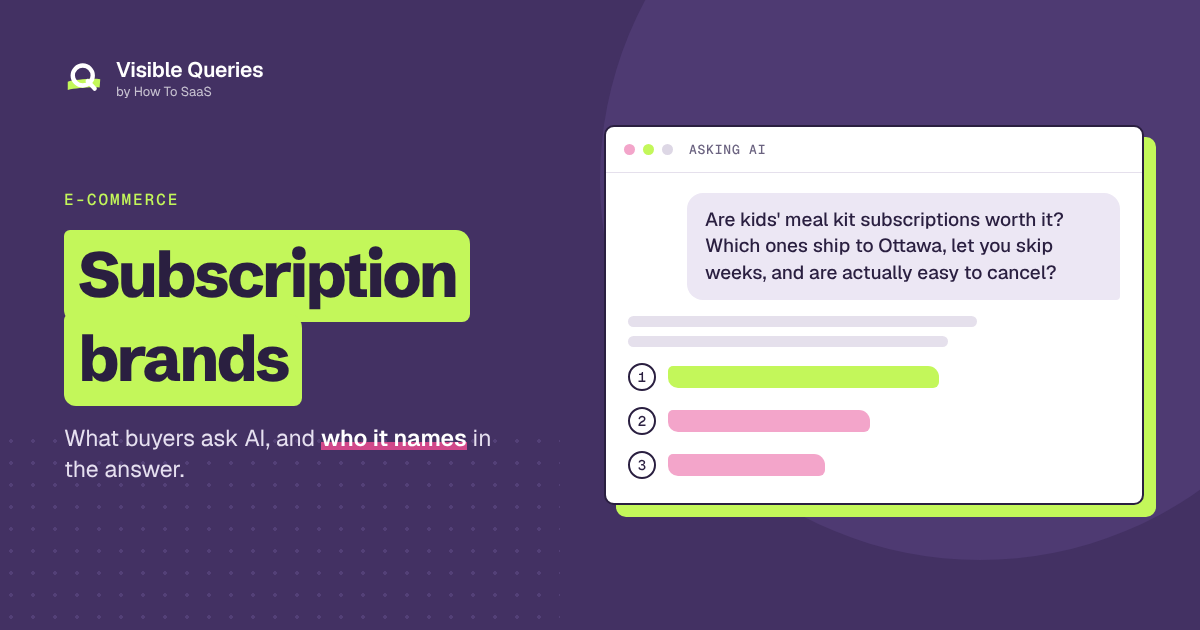
A parent in Ottawa has two kids who'd happily live on crackers. A friend mentioned a kids' meal kit subscription. Another mentioned a snack box. Both sound good, and both sound like the kind of thing that charges your card for six months after you stop using it. So they ask Claude:
"Are kids' meal kit subscriptions worth it? Which ones ship to Ottawa, let you skip weeks, and are actually easy to cancel?"
AI explains when a meal kit saves money and when it doesn't, what "skip a week" usually means in practice, and the common complaints about subscriptions: surprise renewals, cancellation only by phone, boxes that arrive after you thought you'd paused. Then it names three options, with a line on each. One gets the line "easy to pause or cancel online, no phone call needed." That's the one they try.
Subscriptions are the best business model in e-commerce when they work, and the most scrutinized one in AI answers. Our e-commerce guide covers how online shoppers research in general. This one goes through the questions that decide subscription sign-ups, what AI usually says, and what subscription brands and box companies can publish to get recommended.
Here are the questions at a glance:
| The question | What gets you named |
|---|---|
| "Is a [product] subscription worth it?" | An honest cost comparison with buying one-off |
| "Best [product] subscription for [someone like me]?" | Pages for each type of subscriber |
| "Can I skip, pause or change my box?" | Plain subscription terms |
| "Is it hard to cancel [brand]?" | Online cancellation, stated clearly |
| "[Brand] vs [competitor]?" | Clear price per item, shipping and flexibility |
| "Is [brand] a good gift?" | Gift subscription pages with dates and options |
"Is a [product] subscription worth it?"
This question decides whether the shopper subscribes to anyone at all.
What AI usually says: It weighs convenience against cost, compares the price per item with buying one-off, and lists who subscriptions suit and who they don't.
Why it matters: If AI's answer is "probably not, unless you use a lot," the shopper leaves the category. Brands that help AI give a fair, specific answer get named as the example of when it is worth it.
What to publish: An honest guide to when your subscription saves money and when it doesn't, with real numbers: price per bag, per meal or per item against your one-off price and typical store prices. "If you drink two bags a month, you save about $6" is the kind of line AI repeats.
"What's the best [product] subscription for [someone like me]?"
What AI usually says: It names three to five subscriptions, grouped by need: best for beginners, best value, best for families, best for gifting.
What to publish: Pages for each kind of subscriber you serve well, written the way they'd describe themselves: "for home espresso fans," "for families with picky eaters," "for people who want to try new roasters every month." This is where focused subscription brands beat the big names.
"Can I skip, pause or change my box?"
What AI usually says: Whatever it can find in your FAQ, terms or reviews. If the answer isn't clear, it says so, which reads as a warning.
What to publish: A subscription terms page in plain language: how often you ship, how to skip, how long you can pause, how to change items or frequency, when the card is charged, and how far ahead the cutoff is. Put it in text, not in a help widget.
"Is it hard to cancel [brand]?"
This is the question subscription brands least want to be asked, and AI is asked it constantly.
What AI usually says: It summarizes your cancellation process and, very often, complaints about it. Reddit threads and review sites about "couldn't cancel" or "charged after I cancelled" carry a lot of weight.
Why it matters: "Hard to cancel" is one of the most damaging things AI can say about a subscription, and it sticks for years. "Easy to cancel online" is one of the most reassuring. Many brands fear that easy cancellation costs subscribers. In AI answers, it wins sign-ups.
What to publish: A plain statement of how to cancel, in a few clicks, without a phone call, and what happens after. If you've fixed an old cancellation problem, say so and date it. Then answer old complaints in public where you can.
Subscription facts that go out of date fastest
Subscription brands change a lot: prices, box sizes, shipping regions, intro offers, minimum commitments. AI picks up old versions and keeps repeating them. The facts most likely to be wrong in AI answers are:
- Price per box or per item, especially after a price change
- Where you ship, especially if you've added a country or region
- Minimum commitment, if you've dropped one
- Intro offers that ended months ago
- Box contents or sizes after a product change
In the sample report from our e-commerce guide, AI tells shoppers the sample coffee brand "only ships in the US." It ships to Canada, and its Canada topic is one of the five the report tracks. One outdated sentence can close a whole market.
Keep a single, dated page with your current terms, and update every listing, FAQ and partner page when something changes.
What the sample report shows
Here's what a Visible Queries report looks like for Ember & Oak Coffee, the sample online coffee brand from our e-commerce guide. It sells a coffee subscription, so its biggest topic is "Best coffee subscriptions," searched about 6,900 times a month.
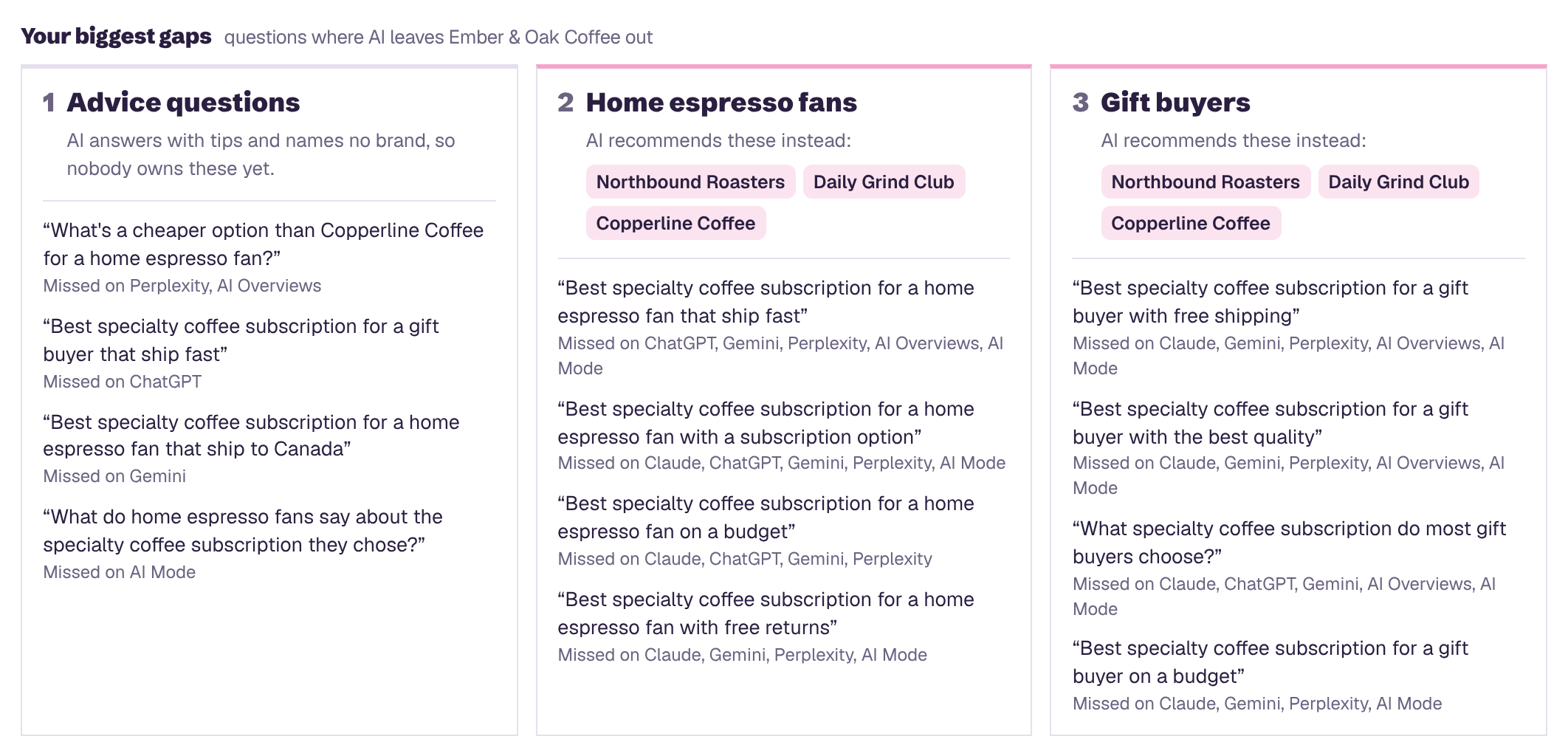
On that biggest topic, the gap is wide:
Want to see how often AI recommends your subscription? Get your free AI visibility score from just your website address.
If you only fix three things
- Publish your subscription terms in plain language. Price per item, skipping, pausing, cancelling.
- Make cancelling easy, and say so. It's a selling point in AI answers.
- Build pages for each type of subscriber. And keep every fact current and dated.
Shoppers are asking AI which subscription to trust with their card. The brands that win will be the ones AI can describe as good value and easy to leave.
See what your report covers on our e-commerce page.
Part of our guide: How people shop online now, and why AI visibility decides which store gets the sale
See what AI tells shoppers about your subscription
Enter your website and get a free AI visibility report. It takes a few minutes, and you'll see:
- Your AI visibility score, overall and for ChatGPT, Gemini, Claude, Perplexity and Google's AI Overviews and AI Mode
- Which subscriptions AI recommends instead of yours, and how often
- Which topics you win and lose, and how often each one is searched
- What AI gets wrong about you, like pricing, shipping and cancelling
- A downloadable PDF you can share with your team