How people shop online now, and why AI visibility decides which store gets the sale
Online shoppers now ask ChatGPT, Gemini and Google's AI what to buy and where to buy it, then click straight through. Here's how their journey works, what they ask at each step, and how to build an online brand AI recommends and links to.
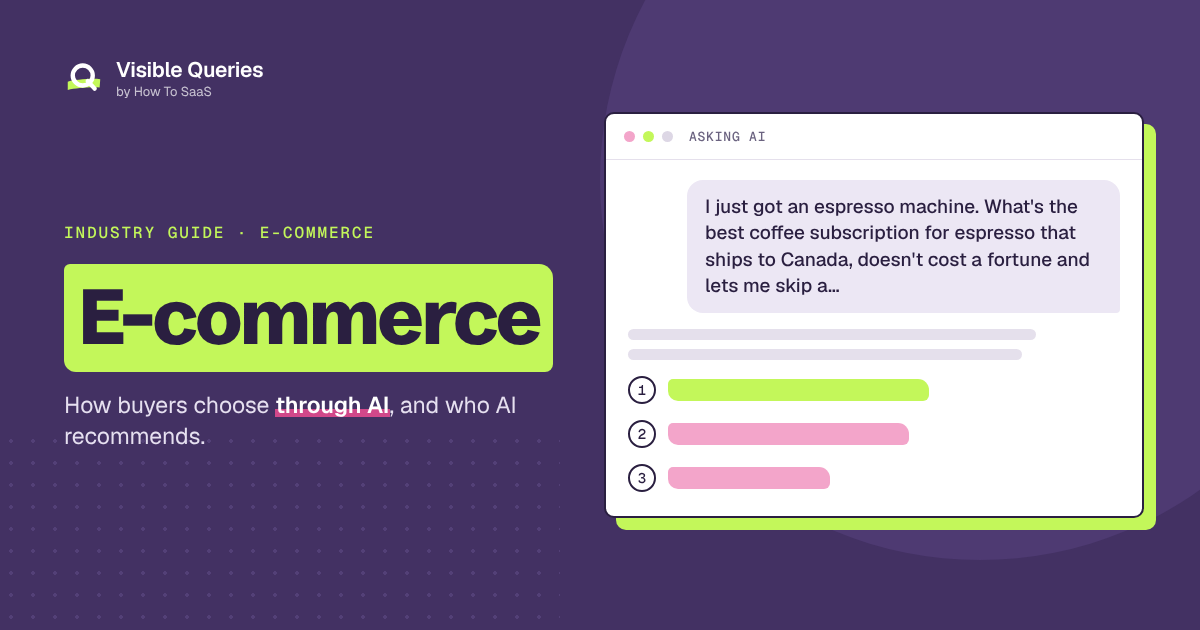
It's Sunday morning in Toronto. Someone has just unboxed a new espresso machine, pulled their first shot with supermarket beans, and watched it run out of the portafilter thin and sour. They're not driving across town to a café every week for better beans. So they pick up their phone and ask ChatGPT:
"I just got an espresso machine. What's the best coffee subscription for espresso that ships to Canada, doesn't cost a fortune and lets me skip a month?"
The answer reads like advice from a friend who knows coffee. It explains why freshly roasted beans matter for espresso, what "roast date" means, and why medium-dark blends are more forgiving for beginners. Then it names four subscriptions, with a line on each: who roasts the freshest, who's cheapest per bag, who ships free over a certain amount, and who makes it easy to pause. Three of the names link straight to the brand's store. One links to an Amazon listing.
Ten minutes later, they've signed up for one of them.
They never typed a query into a search bar. They never scrolled past four shopping ads, never opened a "best coffee subscriptions" roundup, and never saw the product pages of the brands that weren't named. AI did the comparing for them, and the brands it named got the customer, the first order and, if the coffee's good, a year of repeat revenue.
For online brands, that answer is now the most valuable shelf on the internet. You can't buy placement on it. You can't outbid a competitor for it. And if you're not on it, you won't see a lost sale in your analytics, because the shopper never arrived.
This guide walks through how people shop online now, step by step, from the moment a need appears to the moment they reorder or recommend you. It covers what shoppers ask AI at each step, what makes AI recommend one online store over another, why AI so often sends the click to a marketplace instead of to you, and what the brands that keep getting recommended do differently. It's written for online-first businesses of every shape: direct-to-consumer brands, Shopify stores, Amazon and marketplace sellers, subscription brands, multi-brand online retailers, and makers selling custom and handmade products.
If you sell mainly through physical stores, or you want the deep dive on a product category like beauty, apparel or furniture, our retail guide covers that side. This one is about the online store itself: how shoppers find it, judge it and decide whether to buy from it.
Along the way you'll see screenshots from a Visible Queries report for Ember & Oak Coffee, a sample online coffee brand that sells beans and subscriptions from its own store. The brand and its competitors are made up, but the report is real. It's what any online brand sees when it runs its own. You can see the same report for your store on our e-commerce page.
Why the old playbook isn't enough anymore
For fifteen years, online brands grew on a familiar machine. You bought traffic on Facebook, Instagram and Google Shopping. You optimized product pages for search. You chased placement in "best of" roundups, ran influencer campaigns, collected reviews, and built an email list to bring customers back. If the numbers worked, every dollar in ads came back as more than a dollar in orders.
Most of that still matters. But it was built on an assumption that's breaking down: that the shopper would do the comparing themselves, one tab at a time, and that your job was to be one of the tabs they opened.
AI changes who does the comparing. The shopper asks a question, and the assistant reads your product pages, your shipping and returns policy, your reviews, Reddit threads, YouTube reviews, publisher roundups and marketplace listings, then writes a recommendation. The shopper reads the recommendation, not your homepage.
Three things follow from that:
- AI sits above the ads, and you can't buy your way in. Paid social and paid search keep getting more expensive, and now the first thing many shoppers see is an AI answer that no ad budget controls. Brands that relied on outbidding competitors for attention are finding that the most trusted spot on the page isn't for sale.
- Being named isn't the same as getting the sale. AI answers often link to Amazon, a reseller or a review roundup instead of your own store. When that happens, you pay marketplace fees, lose the customer's email, compete on price next to look-alike products, and never get the chance to sell them a subscription. Where AI sends the click matters as much as whether it names you.
- Facts decide the "is this a good store" question. Shoppers ask AI whether a brand is legit, how long shipping takes, whether returns are free and whether a subscription is hard to cancel. AI answers from whatever it can find. If your policies are vague or buried, it answers from an old Reddit thread, a two-year-old complaint or a competitor's comparison page.
None of this means your product pages, reviews or ads stop mattering. They matter more, because they're the raw material AI works from. What changes is that your store now has to work for two readers at once: the shopper and the assistant shopping on their behalf.
The online shopper's journey, step by step
Online purchases range from a $12 phone case bought in two minutes to a $2,000 mattress researched for a month. The steps are the same. What changes is how long each one takes and how much is at stake if the shopper gets it wrong.
- A need appears. Something runs out, breaks, gets gifted, or a new hobby starts.
- They learn what matters. What to look for, what to avoid, and what a fair price is.
- They build a shortlist. Which brands and stores are worth a closer look.
- They check whether the store can be trusted. Is it legit, how good is the quality, what's the catch?
- They decide where to buy. Direct from the brand, on Amazon, or from another retailer, and whether to subscribe.
- They reorder, cancel or recommend. Repeat orders, subscriptions and the reviews that feed the next shopper's journey.
AI now shows up at every one of these steps, and for online brands it shows up at one more than it used to: step 5, where it increasingly tells shoppers where to click. Here's what each step looks like.
Step 1: A need appears
Online purchases almost never start with "I should buy from a new brand." They start with a moment:
- A new espresso machine and nothing good to put in it (coffee)
- A third night of bad sleep on an old mattress (sleep and home)
- A birthday in five days and no idea what to get a picky sibling (gifts)
- A dog with an itchy skin problem the vet thinks is food-related (pet)
- A first half-marathon on the calendar and shoes that hurt after six miles (fitness)
- A move to a new apartment with nothing on the walls (home décor)
What shoppers ask AI at this step usually doesn't name a brand or even a product:
- "Why does my espresso taste sour?"
- "How do I know if my mattress is the reason I'm sleeping badly?"
- "What's a thoughtful gift for someone who's really into coffee?"
- "Can a food allergy make a dog itch?"
These answers frame everything that comes next. If AI says sour espresso usually comes from stale or light-roasted beans, the shopper is now looking for fresh, darker-roasted beans, and the brands that explained that idea are already in their head. If AI says it's a grinder problem, they go shopping for a grinder instead. The brands whose explanations shape these early answers are effectively writing the shopper's list of requirements.
Step 2: They learn what matters
This is the education step. Shoppers want to sound like they know what they're doing, avoid wasting money, and not get fooled by marketing.
- "Are coffee subscriptions worth it, or is it cheaper to buy bags as you go?"
- "Memory foam vs hybrid mattress: which is better for back pain?"
- "What should I look for in a fragrance-free moisturizer?"
- "How much should a good pair of running shoes cost?"
- "Is a $40 bag of coffee actually better than a $15 one?"
AI answers these with explanations, trade-offs, rough price ranges and, very often, a few example brands. Those examples matter. A shopper who sees the same three names while learning what matters starts treating those three as the safe choices before they've compared anything.
This is where many online brands lose quietly. Their store explains their products, not the category. There's no plain-English guide to what makes good espresso beans, no honest "is a subscription worth it for you" page, no explanation of why their price is what it is. So AI learns the category from publishers, Reddit and the competitors who did publish that thinking.
Here's what this looks like in a real report. Each row is a topic shoppers ask about, with how often it's searched each month and the share of AI answers on that topic that name the sample brand and each of its top competitors.
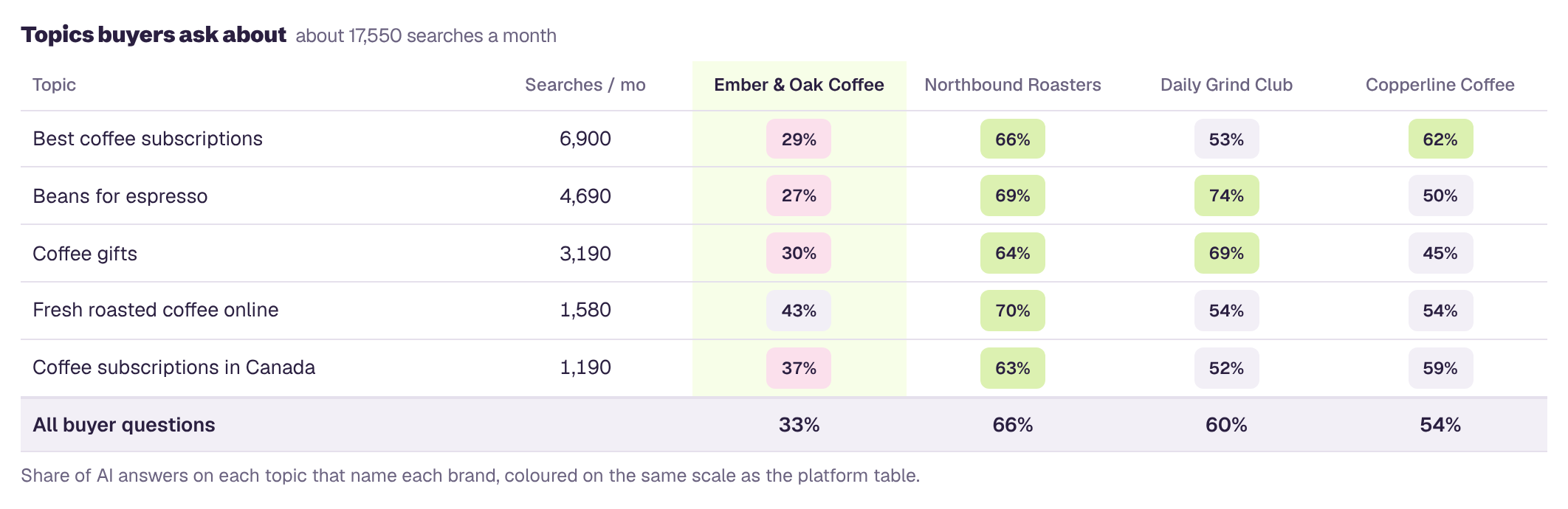
Look at "Beans for espresso." That's the topic behind the shopper in our opening scene, searched about 4,690 times a month. Daily Grind Club is named in 74% of those answers and Northbound Roasters in 69%. Ember & Oak, which sells espresso blends, is named in 27%. Across all five topics, which add up to about 17,550 searches a month, Ember & Oak trails the leading competitor on every one.
What good online brands do at this step: they teach the category, not just the product. They publish clear guides to what matters, what to avoid, what a fair price looks like and who their product isn't right for. Writing "you probably don't need a subscription if you drink one cup a week" feels risky, but it's exactly the kind of honest guidance AI trusts and repeats.
Step 3: They build a shortlist
Now the shopper wants names, usually filtered by their situation:
- "Best coffee subscription for espresso lovers that ships to Canada"
- "Which online mattress brands have the best trial and free returns?"
- "Best grain-free dog food brands for sensitive skin"
- "Sustainable activewear brands that make plus sizes"
- "What are good alternatives to [big brand] that cost less?"
- "Best coffee gift box under $50 that arrives by Friday"
These questions are where the shortlist gets made, and they're far more specific than the keywords online brands used to target. Shoppers describe their budget, their location, their deadline, their values and their quirks, because AI lets them. The answer changes with every detail.
That's both a threat and an opportunity. A big brand can dominate "best coffee subscription" and still lose "best coffee subscription for espresso that ships to Canada," where a smaller brand that's clear about its espresso focus and Canadian shipping wins. A focused online brand can win dozens of these specific questions even if it never wins the head term.
The flip side is that vague positioning gets punished. If your store says you sell "premium coffee for everyone," AI has no reason to put you on any specific shortlist. The report shows this as gaps: groups of shoppers whose questions leave you out, and the competitors AI names instead.
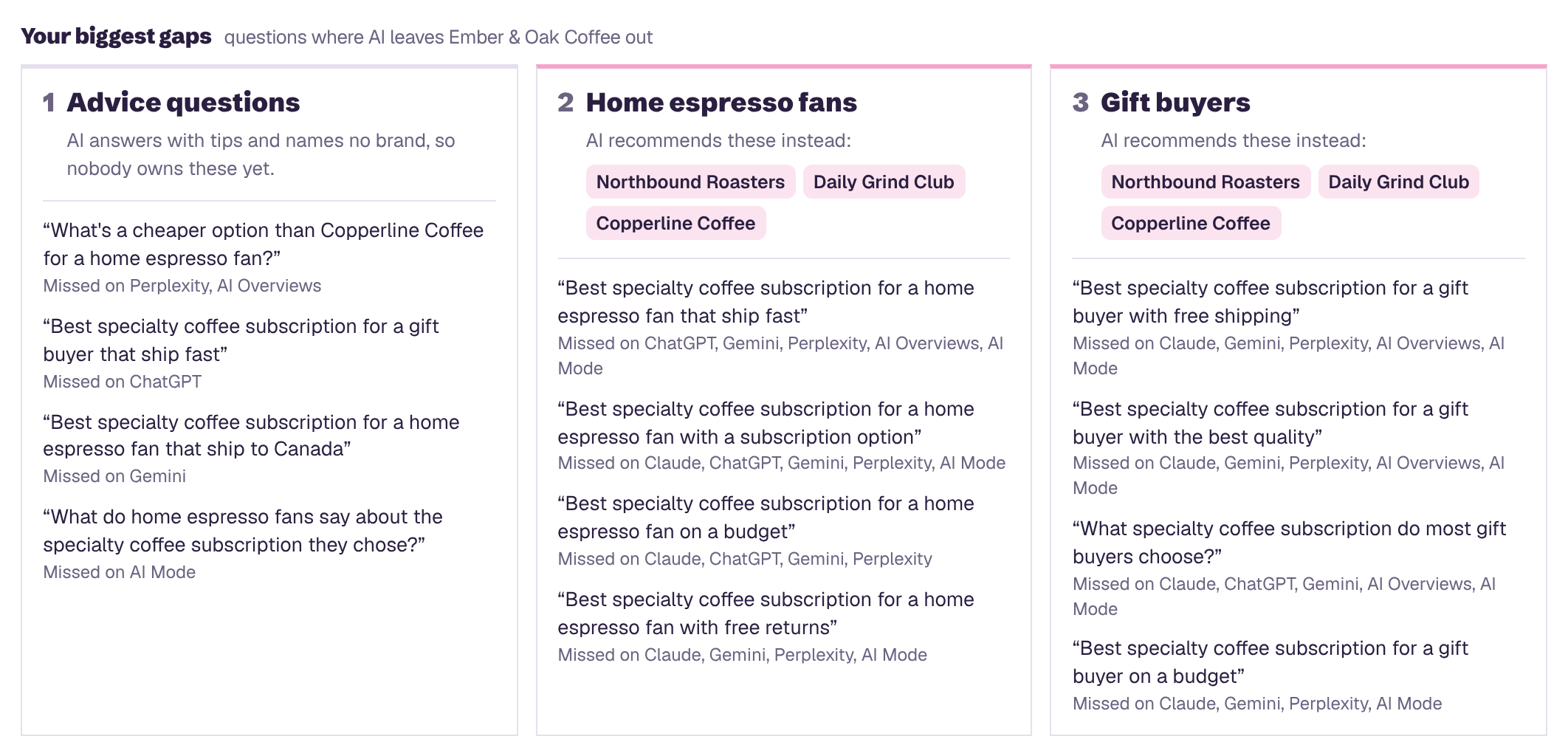
In the sample, home espresso fans and gift buyers are the two biggest gaps, and the same three competitors fill both. Notice the first column too: advice questions where AI answers with tips and names no brand at all. Nobody owns those yet, which makes them some of the easiest wins available.
What good online brands do at this step: they're specific about who they're for. Collection and landing pages for each core use, buyer and budget ("espresso blends," "coffee gifts under $50," "decaf that doesn't taste like decaf"), with real details: who it suits, how it's different, and what it costs. They also publish honest comparison pages for the competitors shoppers mention most.
Step 4: They check whether the store can be trusted
Once there's a shortlist, the questions get sharper. Online shoppers are trying to avoid a purchase that goes wrong: a product that doesn't match the photos, an order that takes three weeks, a return they have to fight for, or a subscription they can't cancel.
- "Is [brand] legit, or is it a dropshipper?"
- "How long does [brand] take to ship to Canada?"
- "Does [brand] have free returns?"
- "Is it hard to cancel a [brand] subscription?"
- "What do people complain about with [brand]?"
- "Is [brand] good quality or just good marketing?"
AI answers by pulling together your store's policy pages, FAQ, product reviews, Trustpilot, Reddit, YouTube reviews, marketplace listings and news. Two things make or break you here.
The first is facts. If your shipping regions, delivery times, return window, subscription terms and prices aren't clearly published, AI fills the gap with guesses or old information. The most common and most expensive version is AI confidently telling a shopper you don't do something you do.
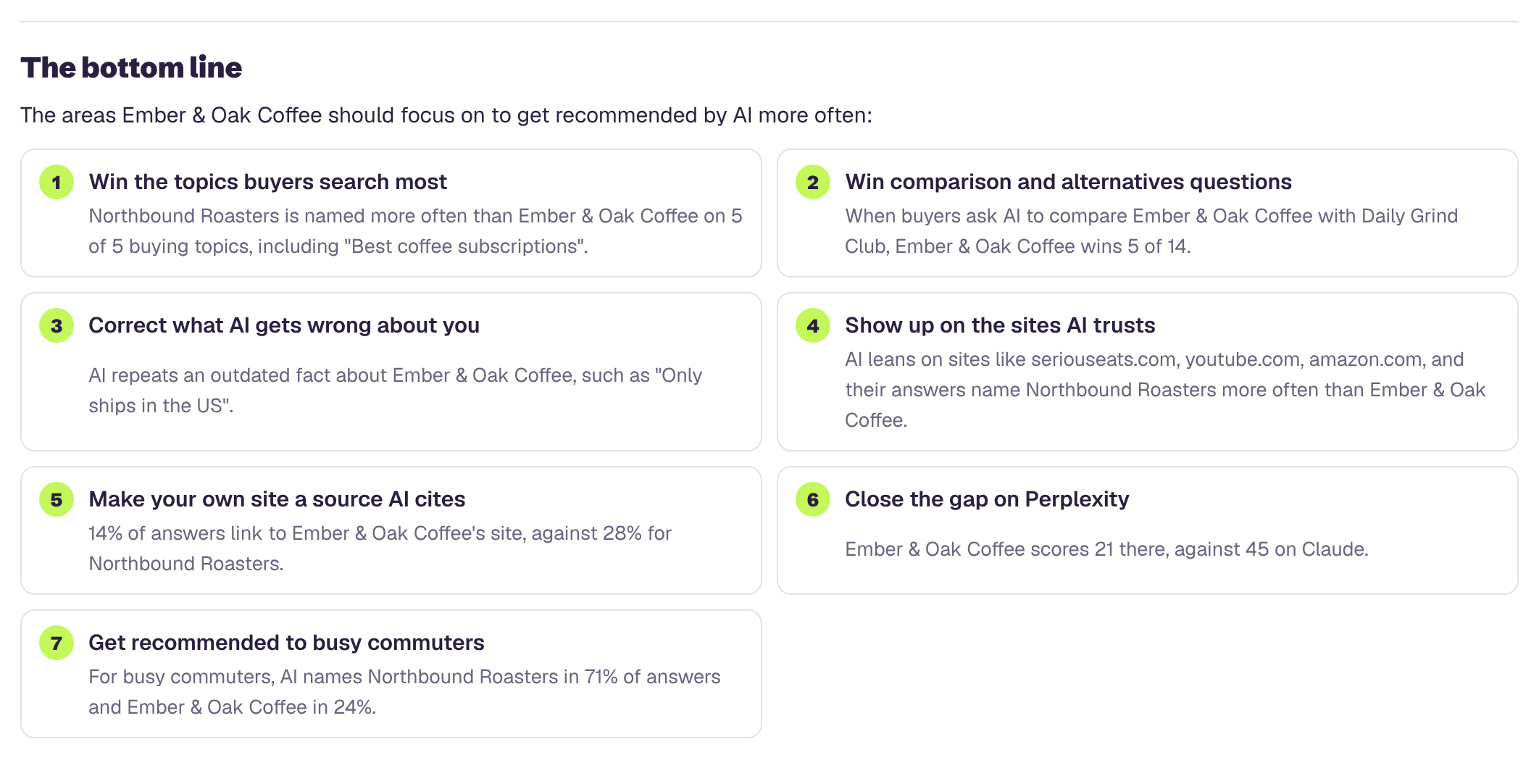
In the sample, AI tells shoppers Ember & Oak "only ships in the US." It ships to Canada. Every Canadian shopper who asks hears that Ember & Oak isn't an option, and that's exactly the market behind the "Coffee subscriptions in Canada" topic, where Ember & Oak is named in 37% of answers and Northbound Roasters in 63%. The report's accuracy score measures how often AI gets a brand's core facts right, and in this sample it's 78%. That sounds high until you work out which fact is in the other 22%.
The second is reputation themes. AI summarizes reviews into themes, like "great coffee but shipping is slow" or "nice product, nightmare to cancel." Those summaries travel into every trust question. A handful of complaints about a holiday shipping delay two years ago can become the headline, long after you fixed it.
What good online brands do at this step: they make the trust facts impossible to miss. A clear shipping page with regions, costs and real delivery times. A returns page in plain language. Subscription terms that spell out how to skip, pause and cancel. An About page that shows who they are and where products come from, which answers the "is this a dropshipper" question before anyone asks. And they answer reviews and fix the problems behind them, because those themes are what AI repeats.
Step 5: They decide where to buy
This step barely existed in AI's role a couple of years ago. Now it's one of the most important for online brands. Shoppers ask:
- "Is it cheaper to buy [product] on Amazon or direct from [brand]?"
- "Where's the best place to buy [brand] coffee?"
- "Does [brand] have a discount code or a first-order offer?"
- "Should I subscribe to [brand] or just buy bags when I need them?"
- "Who has [product] in stock with fast shipping?"
AI answers with links. And where those links point decides where the money goes. If AI sends the shopper to your own store, you get full margin, the customer's email, the chance to offer a subscription, and the relationship. If it sends them to a marketplace, you pay fees, the shopper sees three look-alike products next to yours, and you may never hear from them again. If it sends them to a reseller or a roundup, the reseller might be selling a competitor by the time they arrive.
The report measures this as citation rate: how often AI links to your own site when it answers shoppers' questions.

In the sample, Ember & Oak is named in 33% of answers but linked in only 14%. Northbound Roasters is linked in 28%. That gap means even the shoppers who do hear about Ember & Oak from AI are often sent somewhere else to buy, including to amazon.com, one of the sites AI leans on most in this sample.
Want to know where AI sends your shoppers? Get your free AI visibility score from just your store's address.
What good online brands do at this step: they make their own store the best place to buy, and they say so plainly. A visible reason to buy direct (fresher stock, free shipping over a threshold, a subscription discount, a better guarantee) published as fact, not hype. Prices that match across channels, or a clear reason they don't. Product pages AI can read and quote: real names, prices, sizes, availability and policies in text, not just in images. And if they sell on marketplaces too, they make sure listings point back to the brand rather than competing with it.
Step 6: They reorder, cancel or recommend
After the first order, the journey keeps going, and it feeds every earlier step for the next shopper.
- "How do I get the best espresso out of [brand]'s beans?"
- "Is it worth staying subscribed to [brand]?"
- "Alternatives to [brand] that are cheaper?"
- "How do I cancel [brand]?"
That third question is the one to watch. Customers ask AI about alternatives when they're bored, annoyed or price-shopping, and what they hear depends on the same things that won or lost the first sale.
This is also where the reputation loop runs. Customers who get their order fast, love the product and find the subscription easy to manage write specific, positive reviews, post on Reddit, make YouTube videos and tell friends. That material becomes what AI says about you to the next shopper at step 4. Customers who struggle to cancel write the reviews that become your AI reputation's weak spot.
What good online brands do at this step: they treat retention content and customer experience as part of their visibility. Brewing guides, care guides, sizing help and how-to content keep their name attached to post-purchase questions. Easy cancellation sounds like it costs subscribers, but "easy to cancel" is one of the most reassuring things AI can say about a subscription brand. And programs that turn happy customers into reviewers, user-generated photos and community answers give AI specific, credible material to work from.
How the journey plays out across online business models
The six steps hold for every kind of online store, but the step that decides the sale is different depending on how you sell. Here's where the weight falls for each model, and what the businesses that win tend to do.
Direct-to-consumer and Shopify brands
Brands that sell their own products from their own store live or die on steps 3 and 5. They need to get onto shortlists against much bigger names, and then they need AI to send the click to their store rather than to a marketplace or a roundup.
The DTC brands that win here pick a lane and say it plainly ("espresso blends roasted to order," "running shoes for wide feet"). They publish the category education that big brands skip, make their product pages readable by AI, and give shoppers a concrete reason to buy direct. Founder and sourcing stories help too, because they answer "who's actually behind this" in a way a marketplace listing can't.
Full guide: AI visibility for DTC and Shopify brands
Amazon and marketplace sellers
Brands that sell mostly on Amazon, Walmart Marketplace, Etsy or other platforms face a different problem. AI often knows the product but not the brand. It describes "a highly rated bamboo cutting board on Amazon" instead of naming the seller, or it recommends the category leader with the most reviews.
Marketplace brands that win in AI answers build an identity that lives outside the marketplace: a brand site that explains who they are, consistent product names across every channel, coverage in roundups and on Reddit, and reviews that mention the brand by name. They also decide on purpose where they want AI to send shoppers, and make that destination the most complete source of facts.
Full guide: AI visibility for Amazon and marketplace sellers
Subscription brands and subscription boxes
Subscriptions change the stakes of every step. The shopper isn't making one purchase. They're agreeing to a recurring charge, so they ask AI harder questions: "Is [brand] worth it?", "Can I skip a month?", "Is it hard to cancel?", "Coffee subscription vs buying bags: which is cheaper?"
Subscription brands that win publish their terms in plain language, explain the value against buying one-off, make skipping and cancelling easy (and say so), and earn reviews about the ongoing experience, not just the first box. AI is quick to warn shoppers about subscriptions that are hard to leave.
Full guide: AI visibility for subscription brands and boxes
Multi-brand online retailers
Online stores that sell other companies' products, like specialty outdoor shops, beauty retailers, kitchen stores and electronics sites, face a two-part question. Shoppers first ask AI which product to buy, and then where to buy it. The retailer has to win the second question for products it doesn't control.
The online retailers that win become a source AI trusts for the first question too. Expert buying guides, honest product comparisons, real staff picks, fast and transparent shipping, and a clear reason to buy from them (expert advice, price matching, a better return window) give AI reasons to recommend the store, not just the product.
Full guide: AI visibility for multi-brand online retailers
Custom, personalized and handmade products
Makers and brands selling custom jewelry, personalized gifts, made-to-order furniture, custom apparel and handmade goods face shoppers with very specific questions: "Where can I get a custom pet portrait that arrives before Christmas?", "Best place for personalized wedding party gifts under $40?", "Who makes solid wood dining tables to order in Canada?"
Lead times, customization options, proof and approval steps, and quality signals decide these sales. Makers who publish exactly what can be customized, how long it takes, what it costs and what past orders looked like give AI the details it needs to match them to these precise questions.
Full guide: AI visibility for custom, personalized and handmade products
Big-ticket and considered online purchases
Mattresses, furniture, bikes, appliances and other expensive items bought online don't have their own spoke article, but they follow the same journey with extra weight on step 4. Shoppers ask about trial periods, white-glove delivery, assembly, warranties and what happens if it doesn't fit through the door. Brands that publish these details completely, and earn reviews that describe delivery and returns, win the trust questions that decide a $1,500 order.
Building an online brand AI recommends
Put the six steps and the business models together and a pattern comes out. The online brands AI recommends aren't always the ones with the biggest ad budgets. They're the ones whose products, store, policies and reputation all line up, so everything AI reads tells a clear, consistent story about who the product is for, why it's good and why to buy it from them.
Here's what that looks like in practice.
1. Teach the category, not just the product. Shoppers at steps 1 and 2 are learning. Publish clear guides to what matters, what to avoid, what a fair price is, and when your product isn't the right choice.
2. Pick a lane and say it plainly. "Espresso blends roasted to order and shipped within 48 hours" gets you onto specific shortlists. "Premium coffee for everyone" gets you onto none. Build pages for each use, buyer and budget you genuinely serve.
3. Publish the trust facts in plain text. Shipping regions, costs and delivery times. Return window and who pays for returns. Subscription terms, including how to skip and cancel. Warranty. Where products are made. If a shopper has to start checkout to find out whether you ship to their country, AI will answer for you, and it may get it wrong.
4. Keep facts identical everywhere. Your store, your marketplace listings, your social profiles, Google Merchant Center and any retailer listings should all say the same thing about prices, sizes, availability and policies. Old or inconsistent listings are where wrong AI answers come from.
5. Give shoppers a reason to buy direct, and say it. Fresher stock, a subscription discount, free shipping over a threshold, a longer guarantee, exclusive products. Publish it as a fact AI can repeat, not a slogan.
6. Make product pages readable by AI. Real product names, prices, sizes, ingredients or materials, and availability in text on the page, not only in images or apps. Structured product data helps, but plain, complete text helps more.
7. Be honest about competitors. Fair comparison pages for the brands shoppers compare you with give AI concrete material for "[you] vs [them]" and "alternatives to" questions. Overclaiming tends to backfire, because AI cross-checks.
8. Earn mentions where AI looks. Reddit threads, YouTube reviews, publisher roundups and niche communities are among the sources AI cites most for "best" product questions. Send product to reviewers who'll be honest, show up helpfully in communities, and pitch the roundups that already rank.
9. Turn customers into evidence. Reviews that mention specific use cases, photos, unboxing videos and community answers give AI credible, third-party material. Ask for reviews at the moment customers are happiest, and answer the critical ones in public.
10. Measure it. Most online brands have never looked at what AI says about them across the questions their shoppers actually ask, or where AI sends the click.
That last point is where the report comes in. Here's the top of the sample report for Ember & Oak Coffee:
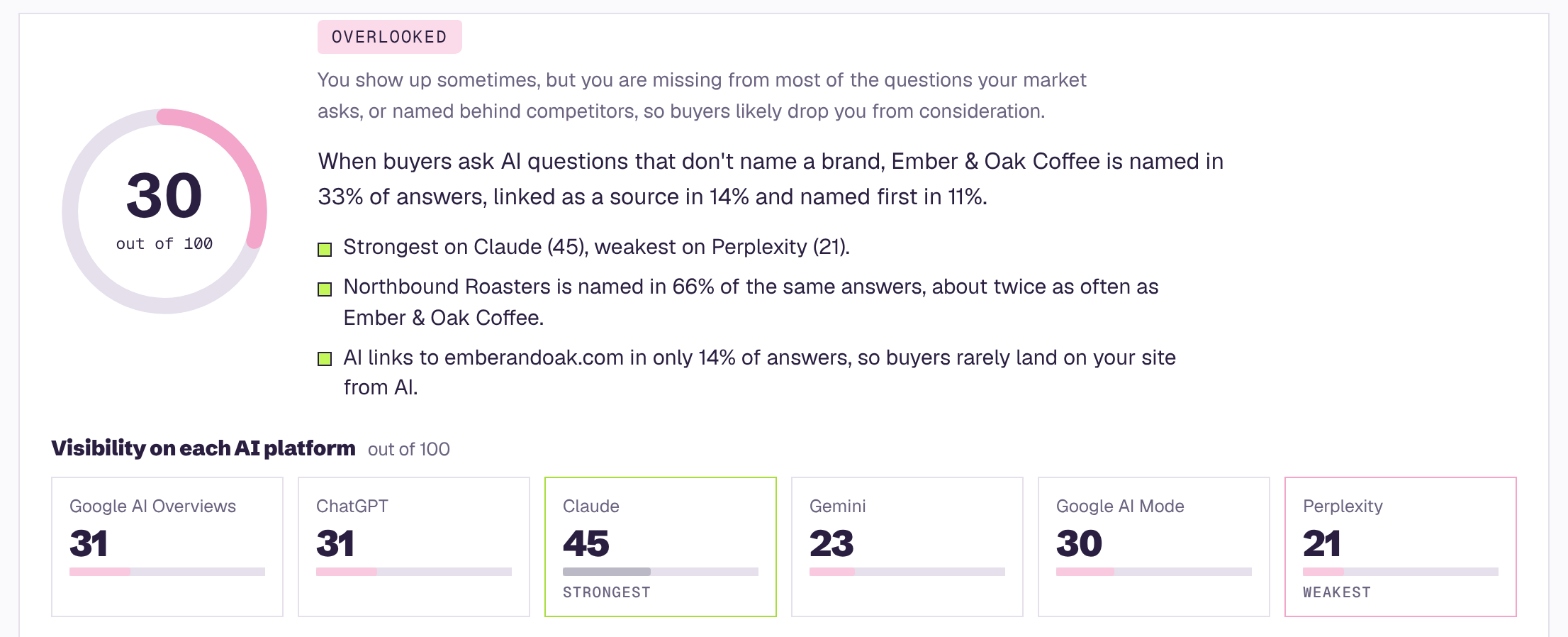
Ember & Oak scores 30, in the Overlooked band. That's a very common place for good online brands: AI knows them when asked by name, but rarely recommends them when shoppers ask what to buy. Ember & Oak is named in 33% of answers to questions that don't name a brand, while Northbound Roasters is named in 66%, about twice as often. The platform scores show where the gap is widest. Ember & Oak is strongest on Claude at 45 and weakest on Perplexity at 21, so the same shopper can get a very different shortlist depending on which assistant they open.
For online brands, two numbers deserve special attention. Citation rate shows whether AI sends shoppers to your store or somewhere else. Accuracy shows whether AI is telling shoppers the truth about shipping, returns and prices, which are the facts that lose sales at step 4.
Run the report again after making changes, and you can watch these numbers move against the competitors that matter.
People haven't stopped shopping online
People still need coffee for their new espresso machine, a better mattress, a last-minute gift and food their dog won't scratch over. What's changed is who does the first round of comparing. More and more, it's an AI assistant, and it hands the shopper a short list of brands and a link to click before they ever see your ads or your homepage.
The good news for well-run online brands is that AI mostly rewards what good brands already care about: a product that's clearly better for someone, honest information, fair policies, fast shipping and customers who are happy to talk about it. The work is making all of that visible, specific and consistent in the places AI reads, and checking that it's working.
Keep learning
- AI visibility for e-commerce brands: what your report shows and the questions shoppers ask at each stage
- How shoppers choose products now, our guide for retail and consumer brands
- What is AI visibility?
- How to get your business recommended by AI, with guides for ChatGPT, Google AI Overviews, Perplexity, Gemini and Claude
- The AI visibility glossary
See if AI sends shoppers to your store
Enter your website and get a free AI visibility report. It takes a few minutes, and you'll see:
- Your AI visibility score, overall and for ChatGPT, Gemini, Claude, Perplexity and Google's AI Overviews and AI Mode
- Which brands AI recommends instead of you, and how often
- How often AI links to your own store, not a marketplace or reseller
- Which topics you win and lose, and how often each one is searched
- What AI gets wrong about you, like shipping, returns and prices
- A downloadable PDF you can share with your team