How shoppers choose products now, and why AI visibility decides which brands they buy
Shoppers now ask ChatGPT, Gemini and Google's AI which products to buy. Here's how their journey works, what they ask at each step, and how to build a retail or ecommerce brand AI recommends.
It's 11 p.m. and a 34-year-old in Denver is staring at red, itchy patches on her cheeks. It's the third time this year a new moisturizer has done this. She's done gambling on whatever the drugstore has on the endcap.
A few years ago, she would have searched "best moisturizer for sensitive skin," read a couple of listicles stuffed with affiliate links, scrolled through TikTok, and ended up buying whatever had the most reviews on Amazon.
Tonight she opens ChatGPT instead and types the whole story:
"My skin gets red and itchy from almost every moisturizer I try. I think it might be fragrance. What should I look for, and which brands are actually good for really sensitive skin? I don't want to spend more than $40."
The answer explains common irritants, why "unscented" isn't the same as "fragrance-free," and which ingredients tend to soothe rather than irritate. Then it recommends four specific products, with a line on why each one fits, the price range, and where to buy.
She clicks through to the first one and orders it.
That's the new path to purchase for a growing share of shoppers, whether they're buying skincare, running shoes, a sofa, dog food, a car seat or a bottle of wine. The answer is personal, specific and confident, and it has room for only a few brands. The brands on that list get the order. The others don't even know they were considered.
This article walks through how shoppers move from need to purchase today, step by step, with examples from across retail and ecommerce: apparel and footwear, jewelry, beauty and skincare, supplements, food and beverage, wine and spirits, home goods and furniture, pet products, outdoor gear, electronics, baby products, local boutiques and car dealerships. It covers what shoppers ask AI at each step, what makes AI recommend one brand over another, and what the brands that keep getting recommended tend to do differently. Most of it comes down to making great products that are easy to understand and easy to trust.
Along the way you'll see screenshots from a Visible Queries report for Wildroot Skin, a sample skincare brand. The brand and its competitors are made up, but the report is real. It's exactly what any retail or ecommerce brand sees when it runs its own.
Why the old playbook isn't enough anymore
For the last decade, ecommerce growth ran on a familiar formula: paid social, influencers, search ads, Amazon, affiliate listicles, email and a lot of retargeting. Brands bought attention and optimized conversion.
All of that still works to a degree. But AI changes what happens before a shopper ever sees an ad. When someone asks an assistant what to buy, it reads product pages, ingredient lists, reviews across retailers, Reddit threads, editorial roundups and brand websites, then gives a recommendation that feels like advice from a knowledgeable friend. No ad slot sits inside that answer.
Three things follow from that:
- The consideration set shrinks to a handful. A search results page or an Amazon category shows hundreds of options. An AI answer names three to five. The brands on that short list win a disproportionate share of sales.
- Specific needs get specific answers. Shoppers ask about their skin type, their dog's allergies, their budget, their apartment size or their running gait. AI recommends brands that clearly match that need, not the brand with the biggest ad budget.
- Product facts matter more than marketing claims. AI reads ingredient lists, materials, dimensions, certifications, return policies and review patterns. "Clean, luxurious, game-changing" tells it nothing. "Fragrance-free, 1% ceramides, dermatologist-tested, $28 for 50 ml" tells it a lot.
None of this makes great creative, influencers or retail distribution less valuable. They feed the reviews, mentions and content AI learns from. What changes is that the brand has to be clearly understood by the assistant, not just noticed by the shopper.
The shopper's journey, step by step
Whether it's a $12 lip balm or a $3,000 sofa, the path to purchase follows similar steps. What changes is how long the shopper spends at each one.
- A need appears. Something runs out, breaks, stops working, or a new life stage arrives.
- They learn what matters. What causes the problem, which features or ingredients matter, and what a fair price is.
- They build a shortlist. Which products or brands fit their specific need.
- They check who to trust. Reviews, safety, quality, legitimacy and return policies.
- They buy. Price, where to buy, shipping speed, discounts and bundles.
- They use it, rebuy and talk about it. Results, repurchase, subscriptions, reviews and recommendations to friends.
AI now shows up at every one of these steps. Here's what it looks like at each one.
Step 1: A need appears
Every purchase starts with a moment:
- A reaction to a product, a skin change or a new routine (beauty and skincare)
- Running shoes that suddenly cause knee pain, or a new job with a dress code (apparel and footwear)
- A new puppy, or a dog with a sensitive stomach (pet products)
- A move into a new apartment with an awkward living room (home goods and furniture)
- A baby on the way (baby products)
- A first camping trip, or a ski season that starts in three weeks (outdoor gear)
- A dinner party on Saturday and no idea what wine goes with lamb (wine and spirits)
- A lease that's ending and a car that won't pass inspection (car dealerships)
The first questions shoppers ask AI are usually about the problem, not a product:
- "Why does my skin keep reacting to new skincare products?"
- "Why do my knees hurt after running in my old shoes?"
- "What should I feed a dog with a sensitive stomach?"
- "How do I make a small living room feel bigger?"
The answers shape what the shopper goes looking for. If AI explains that the irritation is probably from fragrance and recommends looking for products with ceramides, the shopper is now shopping for "fragrance-free ceramide moisturizer," and the brands that clearly offer that have a head start.
Step 2: They learn what matters
This is the research step, and AI has made shoppers much better informed. They learn which features, ingredients or materials matter, what to avoid, and what a reasonable price is.
- "Are drugstore skincare brands good enough for sensitive skin?"
- "Is fragrance in skincare really that bad for sensitive skin?"
- "Merino wool vs synthetic base layers for skiing: which is better?"
- "What's the difference between a hybrid and an all-foam mattress?"
- "Is grain-free dog food actually bad for dogs?"
- "How much should a good stroller cost?"
- "Which protein powders are third-party tested?"
AI answers with explanations and, often, product examples. Brands whose content shapes these explanations, like ingredient guides, material comparisons, sizing advice and honest "who this is for" pages, become the brands shoppers trust before they've ever bought.
This is where a lot of brands lose without realizing it. Their product pages are built for conversion, with lifestyle photos, short punchy copy and a buy button, and they explain almost nothing. So AI learns the category from editorial sites, retailers and competitors who did explain it.
Here's what this looks like in a real report. Each row is a topic shoppers ask about, with how often it's searched each month and the share of AI answers on that topic that name the brand and each of its top competitors.
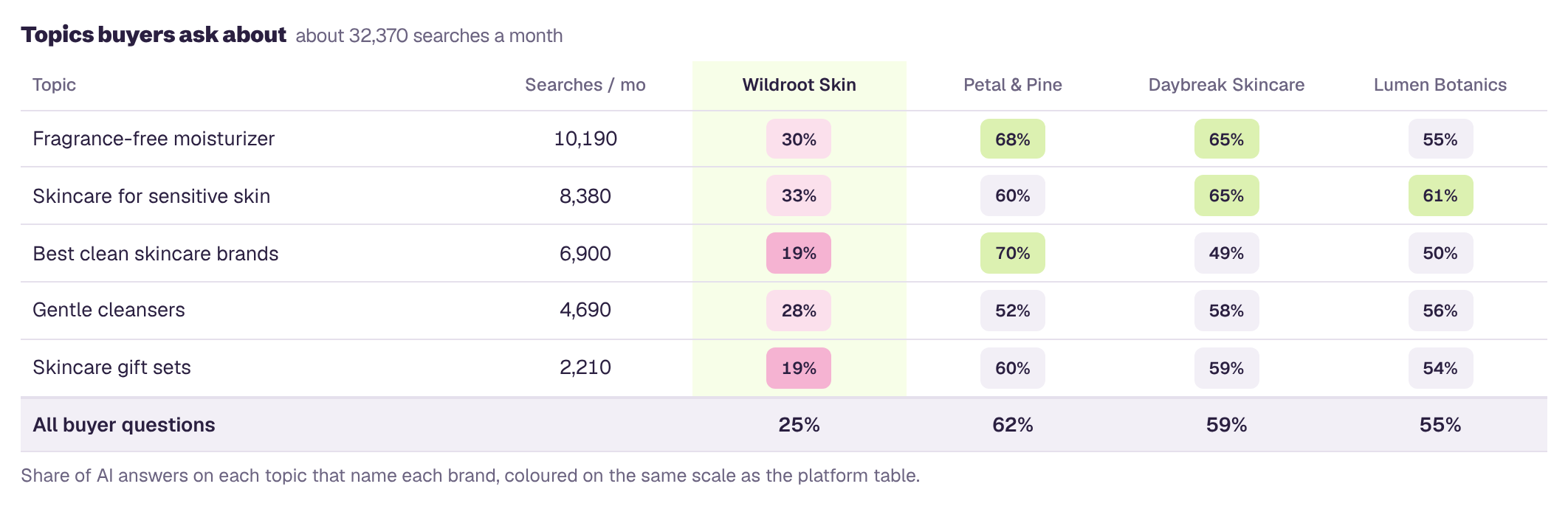
Look at "Best clean skincare brands." Petal & Pine is named in 70% of those answers and Wildroot Skin in 19%. That's a shopper at the very start of the journey, and in four answers out of five, the brand built for exactly their problem isn't there.
What good brands do at this step: they teach. Ingredient and material explainers, sizing and fit guides, comparison guides ("hybrid vs foam," "merino vs synthetic"), honest advice on what to avoid, and clear explanations of who each product is for and who it isn't for. That content earns trust with shoppers and gives AI something worth citing.
Step 3: They build a shortlist
Now the shopper wants names, and they describe their exact situation:
- "Best fragrance-free moisturizer for sensitive skin under $40"
- "Best running shoes for flat feet and knee pain"
- "Best sofa for a small apartment that's easy to clean with a cat"
- "Best hypoallergenic dog food for a golden retriever with allergies"
- "Lightweight stroller that folds with one hand and fits in a Honda Civic trunk"
- "Best Canadian-made winter boots for -30°C"
- "Best non-alcoholic spirits for a dinner party"
These questions are much more specific than the keywords brands used to target, and the answers change with every detail. That's an opportunity. A smaller brand that's crystal clear about who it's for can win dozens of specific questions even if it never wins "best moisturizer." It's also a risk: a brand that describes itself vaguely matches nothing.
Category-leader questions still matter too. In our sample report, Wildroot Skin is named in only 13% of "best clean skincare brands" answers, even though it's built for exactly that shopper.
What good brands do at this step: they're specific about fit. Product pages that state who it's for, key specs, materials or ingredients, sizing, dimensions, certifications and price. Collection and guide pages organized by need ("for sensitive skin," "for small spaces," "for flat feet"). And consistent product data across their site, Amazon, retailers and marketplaces, because AI reads all of them.
Step 4: They check who to trust
Once a shopper has a few options, they vet. Shoppers have been burned by fake reviews, knockoffs, misleading claims and impossible returns, so they ask:
- "Is Wildroot Skin legit? What do people with sensitive skin say about it?"
- "Does [brand] contain fragrance or essential oils?"
- "Is [supplement brand] third-party tested? Has it had any recalls?"
- "What are the most common complaints about [sofa brand]?"
- "Does [brand] run true to size?"
- "How hard is it to return something to [brand]?"
- "Is [car seat] safety-rated, and has it been recalled?"
AI answers by summarizing reviews from your site, Amazon, retailers and Reddit, plus editorial coverage, safety databases and your own product information. It picks up themes. "Works well for sensitive skin, but some people find the texture heavy" is helpful. "Customers report slow shipping and difficult returns" can quietly undo a lot of marketing.
This step also exposes a problem that's especially damaging in retail: AI getting product facts wrong.
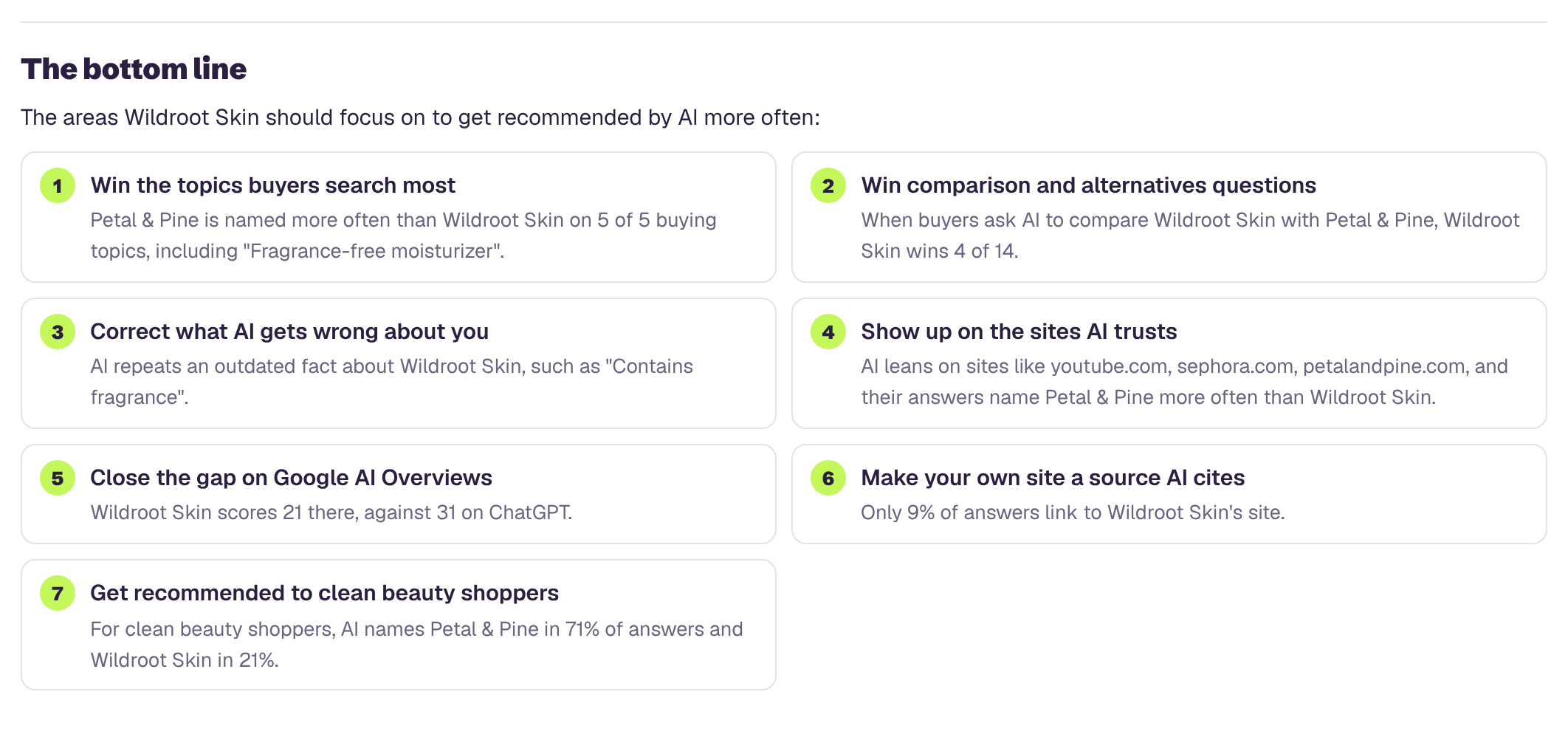
In our sample report, the top gap is a single wrong fact, and it's devastating. AI says Wildroot Skin "contains fragrance." Every Wildroot product is fragrance-free, and that's the whole point of the brand. A shopper like the one in Denver, who specifically wants to avoid fragrance, hears that this brand is wrong for her. The report's accuracy score is 83% in this sample. That sounds high, but the error it's missing is the one that matters most.
Wrong product facts come from many places: an old formula, a retailer listing with outdated ingredients, a review that mixes up two products, a discontinued item, or vague wording like "unscented" that AI interprets differently. They're especially common for brands sold across many channels.
What good brands do at this step: they make trust easy to verify. Full ingredient or material lists in text, not just images. Certifications, testing and safety information stated plainly. Clear, generous return and warranty policies. Honest sizing guidance. And product information kept identical across their own site, Amazon, retail partners and marketplaces. They also answer reviews, especially critical ones, because AI reads the replies.
Step 5: They buy
The final step is about price, convenience and confidence:
- "Where can I buy Wildroot Skin in Canada?"
- "Is [brand] cheaper on Amazon or their own site?"
- "Does [brand] have a discount code or a subscribe-and-save option?"
- "Petal & Pine vs Wildroot Skin: which is better value for sensitive skin?"
- "Which mattress brands offer a 100-night trial?"
- "Is it better to buy a used Honda CR-V from a dealer or privately?"
AI increasingly helps shoppers make the purchase too, pointing them to specific retailers, comparing prices and sometimes showing products with prices right inside the answer. If AI doesn't know where your product is sold, or thinks it's out of stock, the sale goes to whoever it can point to.
The competitor table shows who's winning these moments overall: how often AI names each brand when shoppers ask questions that don't name a brand. In the sample report, Petal & Pine is named in 62% of those answers and Wildroot Skin in 25%. A shopper who asks AI a few questions over a week will hear one brand far more often than the other, and familiarity is a powerful tiebreaker at checkout.
What good brands do at this step: they make buying easy to understand. Where to buy (own site, retailers, regions, US and Canada), shipping times and costs, trial periods, subscriptions, bundles and price guarantees, all stated clearly. They also write honest comparison content for the brands they're most often compared to.
Step 6: They use it, rebuy and talk about it
The journey continues after delivery, and it's the step that builds a lasting brand.
- "How long does it take to see results from a ceramide moisturizer?"
- "How do I wash a merino sweater without shrinking it?"
- "How do I transition my dog to a new food?"
- "Is it normal for a new memory foam mattress to smell?"
Brands that answer these questions keep their name attached to the experience, reduce returns and earn the reviews that feed every earlier step. Customers who get great results write specific reviews ("finally a moisturizer that doesn't make my rosacea flare"), post about it and recommend it to friends. That's exactly the material AI uses to recommend the brand to the next shopper.
What good brands do at this step: they treat post-purchase content and experience as part of the product. Care guides, how-to-use content, results timelines, easy reorders and subscriptions, and follow-up emails that ask for reviews mentioning specific results. A customer who succeeds with your product becomes your best source of AI visibility.
How the journey plays out across retail categories
The six steps hold across retail and ecommerce, but the step that decides the sale is different in each category. Here's where the weight falls, and what the brands that win tend to do.
Apparel, footwear and jewelry
Fit, sizing and occasion drive these questions: "Best work pants for women that don't need tailoring," "Do [brand] boots run small?", "Lab-grown vs natural diamond engagement rings: what's the real difference?" Returns are a huge concern, so step 4 weighs heavily.
Brands that publish detailed fit guides, materials and care information, sustainability facts they can back up, and clear return policies, and whose reviews talk about fit, tend to win. For jewelry, certification and sourcing transparency carry a lot of weight in AI answers.
Full guide: AI visibility for apparel, footwear and jewelry brands
Beauty, skincare and supplements
These are some of the most researched purchases there are, and the ones where ingredient facts matter most. Shoppers ask about skin types, conditions, sensitivities, interactions and evidence: "Does niacinamide help with redness?", "Is [supplement] third-party tested?", "Can I use retinol while pregnant?"
Brands that publish full ingredient lists, concentrations, testing and certifications, and honest guidance on who shouldn't use a product earn the most trust in AI answers. Unsupported claims tend to backfire, because AI is often cautious with health-adjacent recommendations.
Full guide: AI visibility for beauty, skincare and supplement brands
Food, beverage and alcohol brands
Questions here are about taste, diet, occasion and availability: "Best high-protein snacks without artificial sweeteners," "What wine pairs with lamb under $25?", "Where can I buy [brand] cold brew in Toronto?" Availability matters a lot, because a recommendation is useless if the shopper can't find it nearby.
Brands that publish nutrition and dietary information clearly, explain occasions and pairings, and keep retailer and region availability up to date tend to show up when it counts. For alcohol brands, tasting notes, awards and pairing guides give AI concrete material.
Full guide: AI visibility for food, beverage and alcohol brands
Home goods and furniture
These are big, considered purchases with long research cycles and real fear of getting it wrong: "Best sofa for a family with kids and a dog," "Will a king bed fit in a 12x12 room?", "Which mattress brands have the best trials?" Dimensions, materials, durability, delivery and returns all decide the sale.
Brands that publish complete dimensions, materials and fabric performance details, room-planning help, delivery and assembly information, and trial terms make it easy for AI to match them to a shopper's room and life.
Full guide: AI visibility for home goods and furniture brands
Local boutiques and specialty stores
Local retailers face a different challenge: shoppers ask "where can I find [product] near me?" or "best independent bookstores in Halifax" or "which bike shops in Portland do professional fittings?" These answers are local, and they depend on what AI knows about each store.
Stores that keep their Google Business Profile current, publish what brands and services they carry, show up in local guides and press, and earn reviews that describe the experience tend to win local questions against big-box competitors.
Full guide: AI visibility for local boutiques and specialty stores
Car dealerships
Car buyers ask AI for help with almost every step, from which model to buy to whether a price is fair and which dealer to trust: "Best dealership in Calgary for a used Toyota," "Is $2,000 over MSRP reasonable for a RAV4 Hybrid?", "Which dealers near me don't add mandatory add-ons?"
Trust is the deciding factor. Dealerships that publish transparent pricing policies, clear information about fees and add-ons, service department details and reviews that mention a no-pressure experience tend to be the ones AI recommends.
Full guide: AI visibility for car dealerships
Pet, outdoor, electronics and baby products
These categories don't have their own spoke articles, but the same journey applies, with step 4 weighing especially heavily.
- Pet products: owners ask about ingredients, allergies, vet recommendations and recalls. Clear sourcing and nutrition information wins.
- Outdoor gear: shoppers ask about conditions, temperature ratings, weight and durability. Specific, tested specs win.
- Consumer electronics and accessories: shoppers ask about compatibility, battery life and warranties. Complete spec sheets and compatibility lists win.
- Baby products: parents ask about safety ratings, recalls and certifications above all. Visible safety testing and certification win.
Building a brand AI recommends
Put the six steps and the categories together and a pattern comes out. The brands AI recommends aren't always the biggest advertisers. They're the ones whose products, information and reputation all line up, so everything AI reads tells a clear, consistent story about who the product is for and why it's good.
1. Explain the problem your product solves. Shoppers at steps 1 and 2 are learning. Help them understand causes, ingredients, materials and trade-offs.
2. Be specific about who each product is for. Skin type, foot shape, room size, dog breed, climate, budget. Specific fit wins specific questions.
3. Publish complete product facts in text. Ingredients, materials, dimensions, sizing, certifications, testing and care, readable on the page, not just in images.
4. Keep product data identical everywhere. Your site, Amazon, retailers, marketplaces and wholesale partners. Inconsistent listings are where wrong AI answers come from.
5. Make policies easy to find. Returns, trials, warranties, shipping times and where you sell, including US versus Canada.
6. Earn reviews that say something. Ask customers to mention their situation and results. "Great for my sensitive, rosacea-prone skin" is far more useful to AI than five stars and "love it."
7. Be talked about beyond your own channels. Editorial reviews, expert recommendations, community discussion, awards and press give AI independent evidence.
8. Write honest comparisons. Explain how you differ from the brands you're most often compared with. Fair comparisons give AI concrete material for head-to-head questions.
9. Make products that deliver. No content fixes a product that disappoints or a return process that frustrates. AI will find the pattern in reviews.
10. Measure it. Most brands have never seen what AI tells shoppers about them, or which competitors it recommends instead.
That last point is where the report comes in. Here's the top of the sample report for Wildroot Skin:
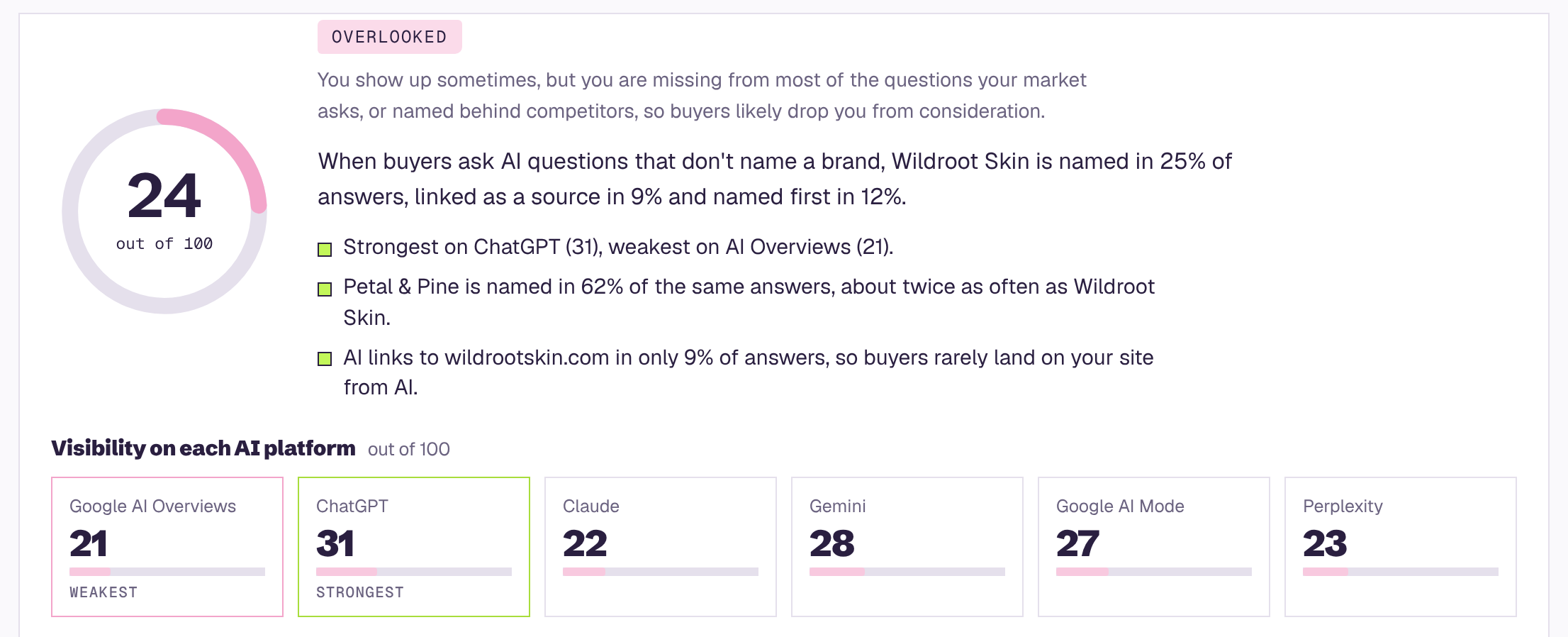
Wildroot Skin scores 24, in the Overlooked band. That's a very common situation: AI knows Wildroot Skin when it's asked by name, but rarely recommends it when shoppers ask what to buy. It's named in 25% of answers to questions that don't name a brand, while Petal & Pine is named in 62%. Just below, the report breaks it down further:

For retail brands, first mention and citation rate deserve special attention. Wildroot Skin is named first in just 12% of answers, and AI links to its own site in 9%. When AI does recommend the brand, it's usually further down the list and pointing shoppers somewhere else to buy.
Run the report again after making changes, and you can watch these numbers move against the brands you compete with.
Shoppers haven't stopped looking for great products
People still need moisturizer, running shoes, sofas and dog food. What's changed is who helps them choose. More and more, it's an AI assistant, and it hands them a short list of brands before they ever see an ad or a product page.
The good news for great brands is that AI mostly rewards what shoppers already value: products that work, honest information, fair policies and customers who are happy to say so. The work is making all of that visible, specific and consistent in the places AI reads, and checking that it's working.
Keep learning
- What is AI visibility?
- How to get your business recommended by AI, with guides for ChatGPT, Google AI Overviews, Perplexity, Gemini and Claude
- AI visibility benchmark 2026
- The AI visibility glossary
See what AI tells shoppers about your brand
Enter your website and get a free AI visibility report. It takes a few minutes, and you'll see:
- Your AI visibility score, overall and for ChatGPT, Gemini, Claude, Perplexity and Google's AI Overviews and AI Mode
- Which brands AI recommends instead of you, and how often
- Which topics you win and lose, and how often each one is searched
- What AI gets wrong about you, and what to fix first
- Your biggest gaps: the buyer questions where AI leaves you out, and who it recommends instead
- A downloadable PDF you can share with your team