Will it fit, will it last, and can the kids destroy it? How shoppers choose home goods and furniture brands through AI
Shoppers now ask AI which sofas hold up to kids and pets, which mattresses suit side sleepers and which furniture is worth the price. Here's what AI tells them, and how home goods and furniture brands get named.
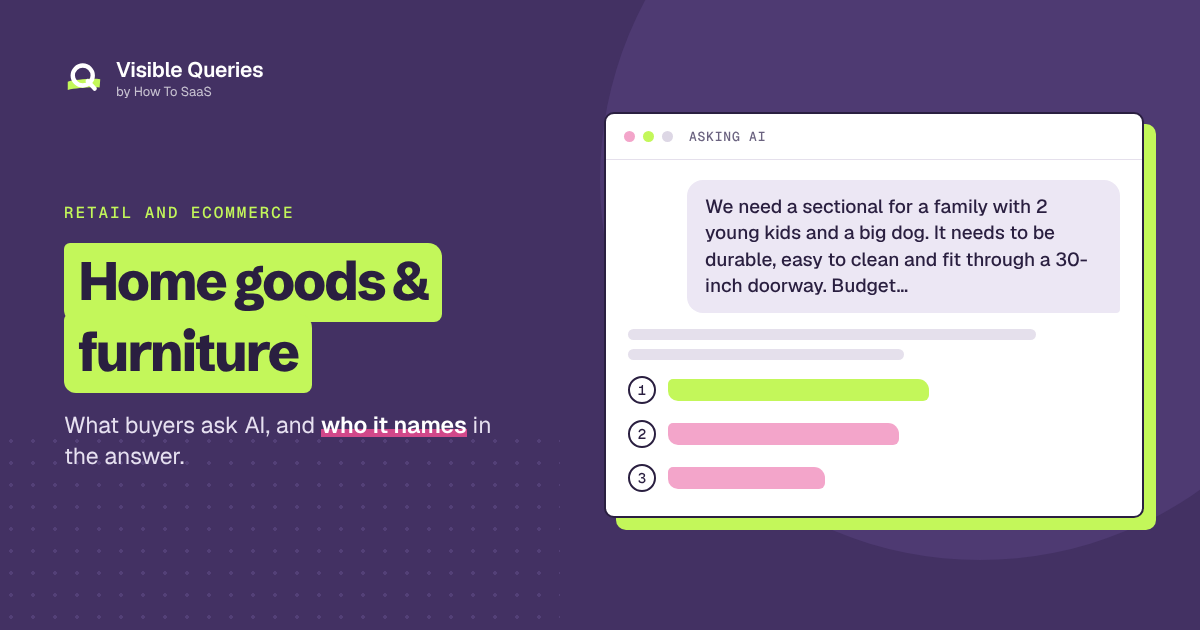
A family in Atlanta needs a new sectional. They have two kids under six, a large dog, and a living room with a narrow doorway. Their last sofa started sagging after two years. They ask ChatGPT:
"We need a sectional for a family with 2 young kids and a big dog. It needs to be durable, easy to clean and fit through a 30-inch doorway. Budget around $3,000. Which fabrics hold up best? Which brands are worth it, and which ones have good return policies?"
AI explains durable frame and cushion construction, performance fabrics and their trade-offs, why modular or boxed sofas help with narrow doorways, how to compare warranties and return policies, and names several brands and models. The family orders one that week.
Furniture and home goods are big, considered purchases. Shoppers can't sit on a sofa online or feel a towel through a screen, so they ask about construction, materials, dimensions, durability and returns. AI is now where a lot of that research happens.
Our retail and ecommerce guide covers how shoppers research in general. This one goes through the questions that decide home goods and furniture purchases, what AI usually says, and what brands can publish so AI names them.
Here are the questions at a glance:
| The question | What gets you named |
|---|---|
| "Which [product] holds up to kids and pets?" | Construction and material details |
| "Will it fit?" | Full dimensions, including packaged size |
| "Is it worth the price?" | What makes it last, specifically |
| "Returns? Trial? Delivery?" | Policies in plain text |
"Which [product] holds up to [kids, pets, heavy use]?"
This is the defining question for the category.
What AI usually says: It names products and materials known for durability and easy care.
What to publish: Construction details: frame materials, joinery, cushion fill, fabric rub counts, stain resistance and cleaning instructions. Specific details let AI recommend you for the right shoppers.
"Will it fit?"
What AI usually says: It suggests measuring doorways, hallways and rooms, and recommends modular or boxed furniture for tight spaces.
What to publish: Full dimensions, including packaged dimensions, assembly requirements and delivery options.
"Is it worth the price?"
What AI usually says: It weighs materials, construction, warranties and reviews against price.
What to publish: What makes your products worth it, specifically: materials, construction, where they're made, warranties and how long they typically last.
"Return policy? Trial period? Delivery?"
What to publish: Return policies, trial periods (especially for mattresses), delivery options, white-glove service and costs, all in plain text.
What the report's headline shows
For many home brands, the report's headline shows a familiar pattern:
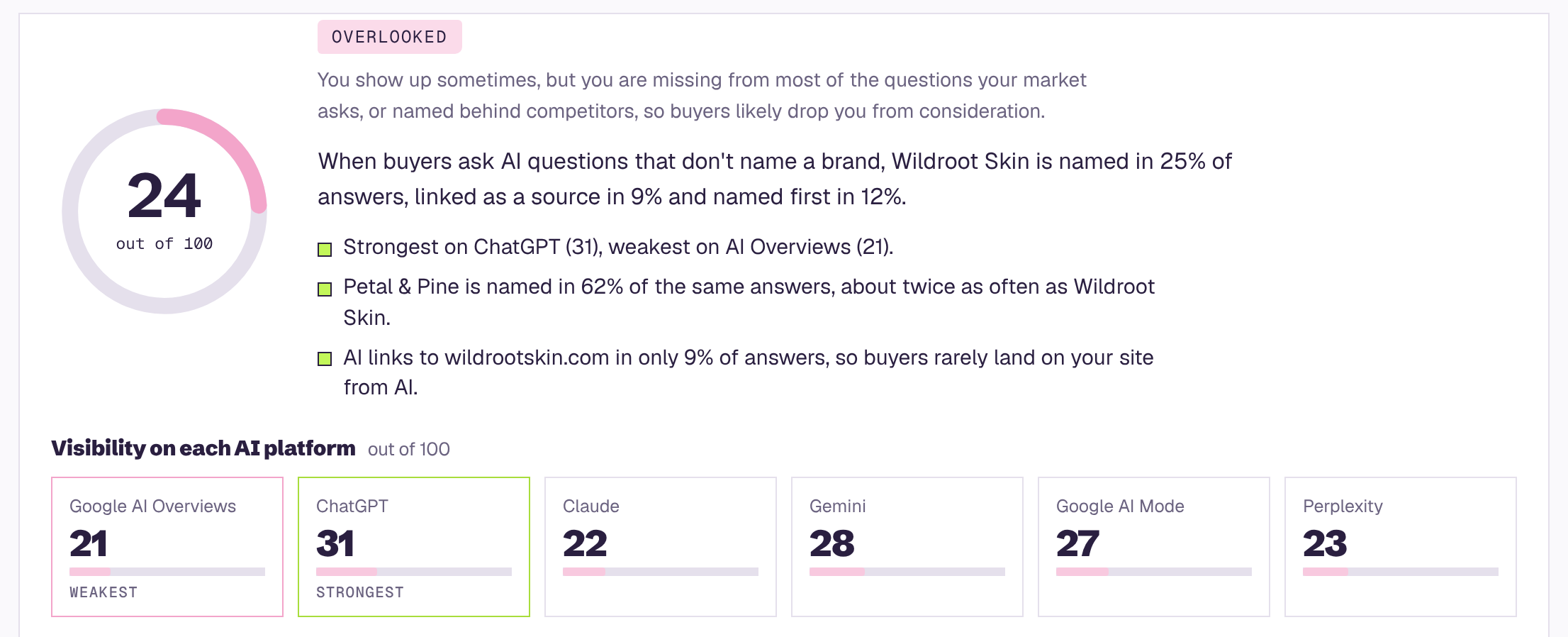
The usual pattern is that AI knows the brand when asked by name but rarely recommends it for open questions like "best sofa for dogs" or "best mattress for side sleepers." Use-case pages close that gap.
Here's more from the same kind of report, for Wildroot Skin, a fictional skincare brand.
Under the score, the report breaks visibility into the numbers that matter most:

The gap is clearest side by side:
Mattresses, bedding and bath
Mattress shoppers ask about sleep positions, firmness, cooling, back pain and trial periods. Bedding and bath shoppers ask about materials, thread count, weave and care. Publish detailed guides and product information for each.
Showrooms and local retailers
Many shoppers still want to see furniture in person. If you have showrooms or retail partners, list locations in text, with what's on display.
If you only fix three things
- Publish construction and material details.
- List full dimensions, delivery and returns clearly.
- Give each use case its own page. Kids, pets, small spaces and more.
Shoppers are asking AI which furniture will survive their real life. The brand AI names will be the one that explains its products most specifically.
Part of our guide: Why AI visibility matters for retail and ecommerce brands
See what AI tells shoppers about your brand
Enter your website and get a free AI visibility report. It takes a few minutes, and you'll see:
- Your AI visibility score, overall and for ChatGPT, Gemini, Claude, Perplexity and Google's AI Overviews and AI Mode
- Which brands AI recommends instead of you, and how often
- Which topics you win and lose, and how often each one is searched
- What AI gets wrong about you, and what to fix first
- Your biggest gaps: the buyer questions where AI leaves you out, and who it recommends instead
- A downloadable PDF you can share with your team