Made to order, found by AI: how shoppers choose custom, personalized and handmade products
Shoppers now ask AI where to get a custom gift, a personalized piece or something handmade, with a deadline attached. Here's what AI tells them, and how makers and custom brands get recommended.
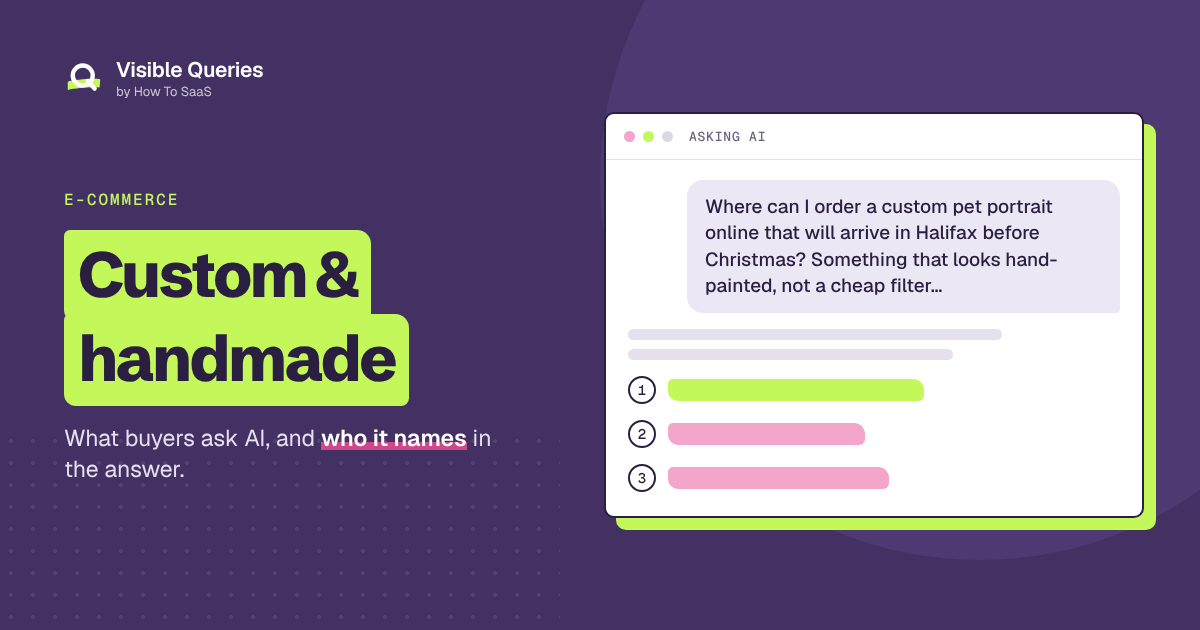
It's December 2nd. Someone in Halifax wants a custom portrait of their sister's dog as a Christmas present. They've seen a few on Instagram, but they don't know who's good, who's fast, or who will actually deliver before the 25th. They ask ChatGPT:
"Where can I order a custom pet portrait online that will arrive in Halifax before Christmas? Something that looks hand-painted, not a cheap filter, under $150."
AI explains the difference between hand-painted, digital and AI-generated portraits, what turnaround times are realistic in December, and why you should check whether a proof is included. Then it names four options. The two it describes in detail both publish their December order cutoff for Canada, show real examples, and explain their proof process. Those two get the order. The others might be just as talented, but AI couldn't tell whether they'd deliver in time.
Custom and handmade products are bought on trust and timing. Our e-commerce guide covers how online shoppers research in general. This one goes through the questions that decide custom and handmade purchases, what AI usually says, and what makers, personalization brands and made-to-order businesses can publish to get recommended.
Here are the questions at a glance:
| The question | What gets you named |
|---|---|
| "Where can I get a custom [product] by [date]?" | Published turnaround times and order cutoffs |
| "Best personalized gift for [person] under [budget]?" | Gift pages by recipient, occasion and price |
| "What can I customize?" | A clear list of options and limits |
| "Is [maker] good quality?" | Real photos of past orders and reviews that describe them |
| "Do I get to approve it first?" | A plain description of your proof process |
| "Do they ship to [place]?" | Shipping regions and times in text |
"Where can I get a custom [product] by [date]?"
Deadlines drive most custom purchases: holidays, weddings, birthdays, anniversaries, new babies.
What AI usually says: It names makers it believes can deliver in time, and warns the shopper to check turnaround. If it can't find your timeline, it leaves you out or adds a warning.
Why it matters: A shopper with a deadline won't take a chance on a maker whose timing is unclear.
What to publish: Your production time and shipping time, separately, in text. Holiday and seasonal order cutoffs by region, published early and dated. Rush options, if you offer them, with prices.
"What's the best personalized gift for [person] under [budget]?"
What AI usually says: It suggests gift ideas and names a few shops for each, matching recipient, occasion and price.
What to publish: Gift pages by recipient ("for dog owners," "for new parents," "for groomsmen"), occasion and price range, with real examples. These match the way shoppers phrase the question far better than a catalog sorted by product type.
"What exactly can I customize?"
What AI usually says: Whatever your product pages say. Vague pages get vague answers.
What to publish: A plain list of what can be customized (names, dates, colors, sizes, materials, photos), the limits (character counts, image quality needed), and what costs extra. For furniture and bigger pieces, list dimensions, woods or fabrics, and finishes.
"Is [maker] good quality? Do I get a proof?"
What AI usually says: It summarizes reviews, often from Etsy or other marketplaces, and looks for photos and examples. It also notes whether proofs or approvals are offered.
What to publish: A gallery of real past orders with short descriptions. A clear explanation of your proof process: whether the customer sees a proof, how many revisions are included, and what happens if they're unhappy. Ask happy customers to describe what they ordered in their review, so AI has specific material.
Marketplace shop, your own site, or both
Many makers start on Etsy or a similar marketplace, and AI often knows the shop by its marketplace name. If you also have your own site, the same problems DTC brands face apply: AI may send the shopper to the marketplace, or describe your shop without naming you. Use one consistent shop name everywhere, link your marketplace shop and your own site to each other, and make sure your own site has the timing, options and examples that the marketplace listing has.
What the sample report shows
Here's what a Visible Queries report looks like for Ember & Oak Coffee, the sample online coffee brand from our e-commerce guide. It isn't a custom-products business, but one of its biggest gaps is exactly the shopper custom makers rely on: the gift buyer.
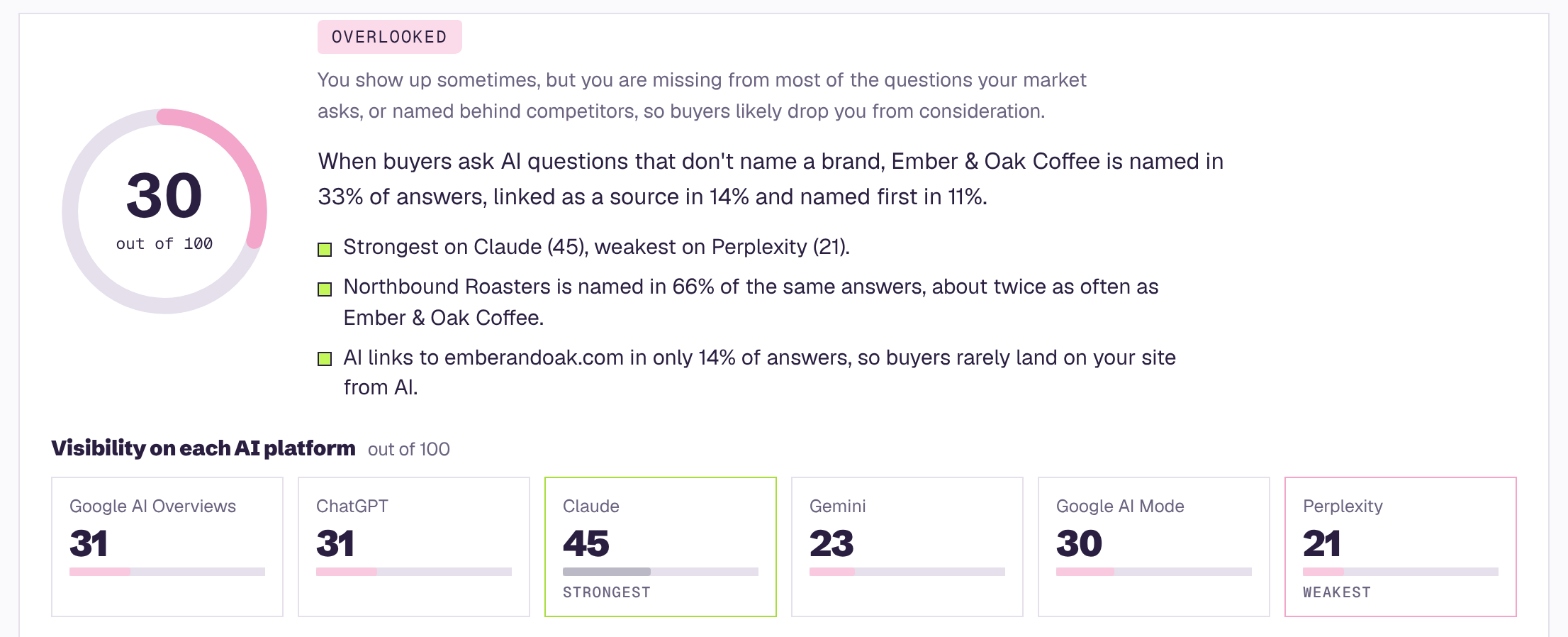
On "Coffee gifts," searched about 3,190 times a month, two competitors are named more than twice as often:
Want to see whether AI recommends you to gift buyers? Get your free AI visibility score from just your website address.
If you only fix three things
- Publish production times, shipping times and seasonal cutoffs. Dated, by region.
- Build gift pages by recipient, occasion and budget.
- Show real past orders and explain your proof process.
Shoppers are asking AI who can make something special in time. The makers that win will be the ones AI can trust to deliver.
See what your report covers on our e-commerce page.
Part of our guide: How people shop online now, and why AI visibility decides which store gets the sale
See if AI recommends your custom products
Enter your website and get a free AI visibility report. It takes a few minutes, and you'll see:
- Your AI visibility score, overall and for ChatGPT, Gemini, Claude, Perplexity and Google's AI Overviews and AI Mode
- Which makers and brands AI recommends instead of you, and how often
- Which topics you win and lose, and how often each one is searched
- What AI gets wrong about you, like turnaround times and where you ship
- A downloadable PDF you can share with your team