Curly hair, balayage and a good fade: how people choose a salon or barber through AI
People now ask AI which salon is best for their hair type, what color should cost and which barber does a good fade nearby. Here's what AI tells them, and how hair salons and barbershops get named.
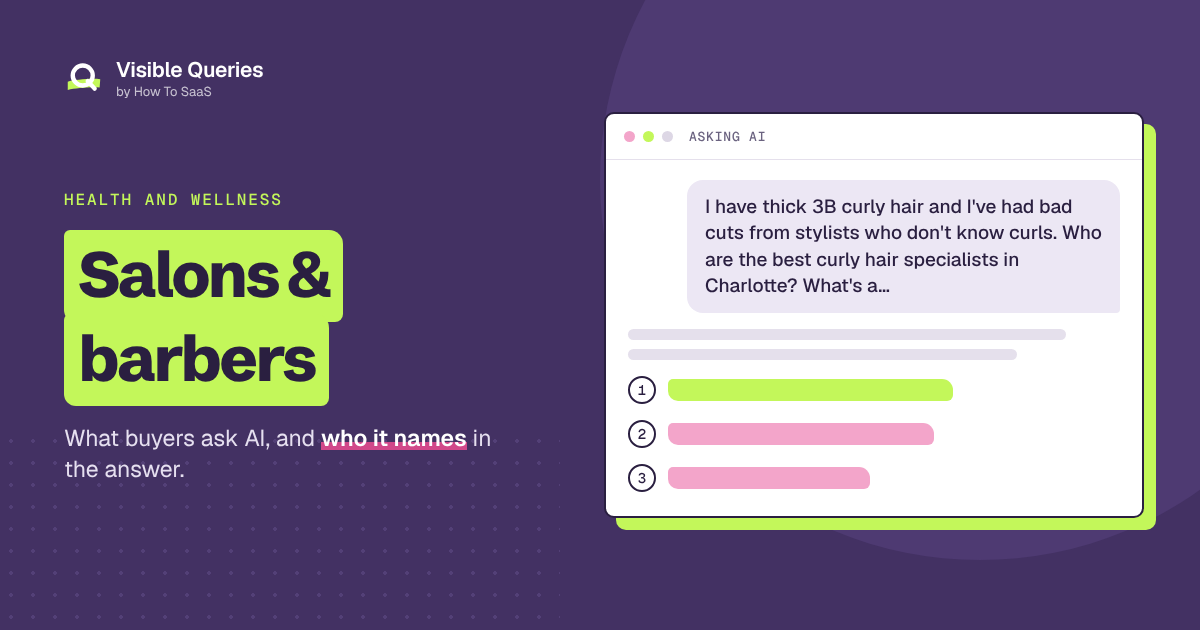
Someone in Charlotte has thick, curly hair and a long history of bad haircuts from stylists who cut it straight and wet. They've just moved, so they don't have a stylist anyway. They ask ChatGPT:
"I have thick 3B curly hair and I've had bad cuts from stylists who don't know curls. Who are the best curly hair specialists in Charlotte? What's a curly cut, what should it cost, and what should I ask before booking?"
AI explains what a curl-specific cut is, the common methods, why many curl specialists cut dry, what to ask (do they have curly-hair portfolios, how do they style afterward), and typical price ranges. Then it names three local stylists. One gets a client for life.
Hair is personal. People are trusting someone with how they look every day. They choose by hair type, style, stylist, price and vibe, and switching is hard once they find someone good. AI is increasingly where that search begins, especially for people who've just moved or had a bad experience.
Our health and wellness guide covers the journey across gyms, studios and salons. This one goes through the questions that decide salon and barbershop clients, what AI usually says, and what shops can publish so AI names them.
Here are the questions at a glance:
| The question | What gets you named |
|---|---|
| "Who's good with my hair type?" | Stylist bios with hair types and specialties |
| "How much does balayage or color cost?" | Starting prices by service and stylist level |
| "Is a consultation needed?" | How consultations work and what they cost |
| "Best barber for a fade near me?" | Services named the way clients search for them |
| "Is [salon] good?" | Reviews that mention specific services, with photos |
"Who's good with my hair type?"
This is the defining question for salons.
What AI usually says: It names stylists or salons known for curly hair, coily and textured hair, fine or thinning hair, blonding, vivid color, extensions or men's cuts, based on what it can find.
Why it matters: People with specific hair needs don't want a general salon. They want a specialist, and they ask for one by name.
What to publish: A page for each specialty, with the stylists who do it, their training, before-and-after photos with descriptions, and what the appointment involves. Textured hair, curls, blonding, color correction, extensions, keratin and men's grooming each deserve their own page.
"How much does balayage, highlights or color correction cost?"
What AI usually says: Wide ranges, with what drives price: hair length and thickness, the stylist's level, the starting color and how much time it takes. It often notes that color correction is priced by the hour.
What to publish: Starting prices by service and stylist level, what's included (toner, gloss, blowout), how consultations work and why prices vary. A clear pricing page prevents sticker shock and wins the "how much" question.
"Is a consultation needed? What should I ask?"
What AI usually says: It suggests consultations for big changes, color correction and extensions, and lists questions to ask about experience, maintenance and cost.
What to publish: How your consultations work, whether they're free, what you'll ask and what clients should bring, like inspiration photos.
"Best barber for a fade near me?"
What AI usually says: It names a few barbershops, often with notes on specialties like fades, beard work, kids' cuts or hot towel shaves, and whether they take walk-ins.
What to publish: Your services in detail, every barber's specialties, walk-in and booking policies, wait times, hours, prices and photos with descriptions. Barbershops win on specifics like "skin fades," "beard sculpting," "kids' cuts on Saturdays" and "open until 9."
"Is [salon] good? Any complaints?"
What AI usually says: A summary of reviews. In this category, reviews focus on results, stylist skill, punctuality, price surprises and how problems were fixed.
What to publish: Encourage clients to mention their stylist and service in reviews, like "Jess did my balayage" or "Marco's fades are the best," and respond to complaints with how you made it right. AI repeats the details people write.
How often AI names you, and how early
For salons and barbershops, being named is only half of it. Being named first matters a lot, because most people book the first stylist that sounds right. The report shows both:

A salon with a decent mention rate but a low first-mention rate is usually being listed after a competitor. Specialty pages and specific reviews are the most common way to move up the list.
The stylist problem
Many clients follow stylists, not salons. When a stylist moves, clients ask AI where they went. When a salon has several locations, AI may mix up which stylist works where. Keep stylist bios current, with their location, specialties and booking links, and when someone leaves, update your pages quickly.
Booth-rental and suite-based stylists have their own challenge: each one is effectively a separate business. If you rent a suite, your own page, with your name, specialties, prices, location and reviews, is what lets AI find you.
Weddings, events and special occasions
Brides, wedding parties, proms and photo shoots drive valuable bookings. People ask AI things like "bridal hair and makeup in Charlotte that travels to venues," "prom updos near me" or "hair and makeup for a wedding party of eight." If you offer this, give it a page with packages, trial appointments, travel fees and booking timelines.
What the sample report shows
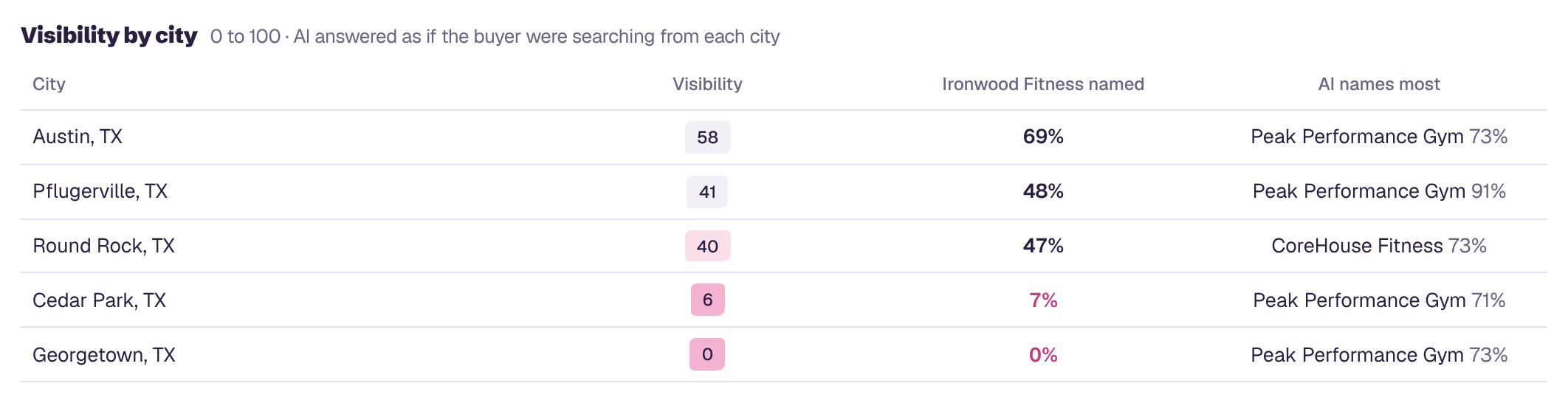
Here's what a Visible Queries report looks like for Ironwood Fitness, the sample strength gym in the Austin area from our guide. The questions are different for salons and barbershops, but the patterns are the same.
It also shows visibility city by city, with the competitor AI names most in each:
The gap is clearest side by side:
If you only fix three things
- Give every specialty its own page. Curls, textured hair, blonding, color correction, extensions and fades, with the stylists who do them.
- Publish starting prices and how consultations work. By service and stylist level.
- Keep stylist bios and specialties current. With their location and booking links.
People are asking AI who can finally get their hair right. The salon or barber AI names will be the one that describes its specialties most clearly.
Part of our guide: Why AI visibility matters for health and wellness businesses
See what AI tells people about your salon or barbershop
Enter your website and get a free AI visibility report. It takes a few minutes, and you'll see:
- Your AI visibility score, overall and for ChatGPT, Gemini, Claude, Perplexity and Google's AI Overviews and AI Mode
- Which salons or barbers AI recommends instead of you, and how often
- Your visibility in every city you serve, and the competitor AI names most in each one
- What AI gets wrong about you, and what to fix first
- Your biggest gaps: the buyer questions where AI leaves you out, and who it recommends instead
- A downloadable PDF you can share with your team