How people choose a gym, studio or salon now, and why AI visibility decides who gets the first visit
People now ask AI which gym, yoga studio, Pilates class, salon or spa to try. Here's how their journey works, what they ask at each step, and how to build a wellness business AI recommends.
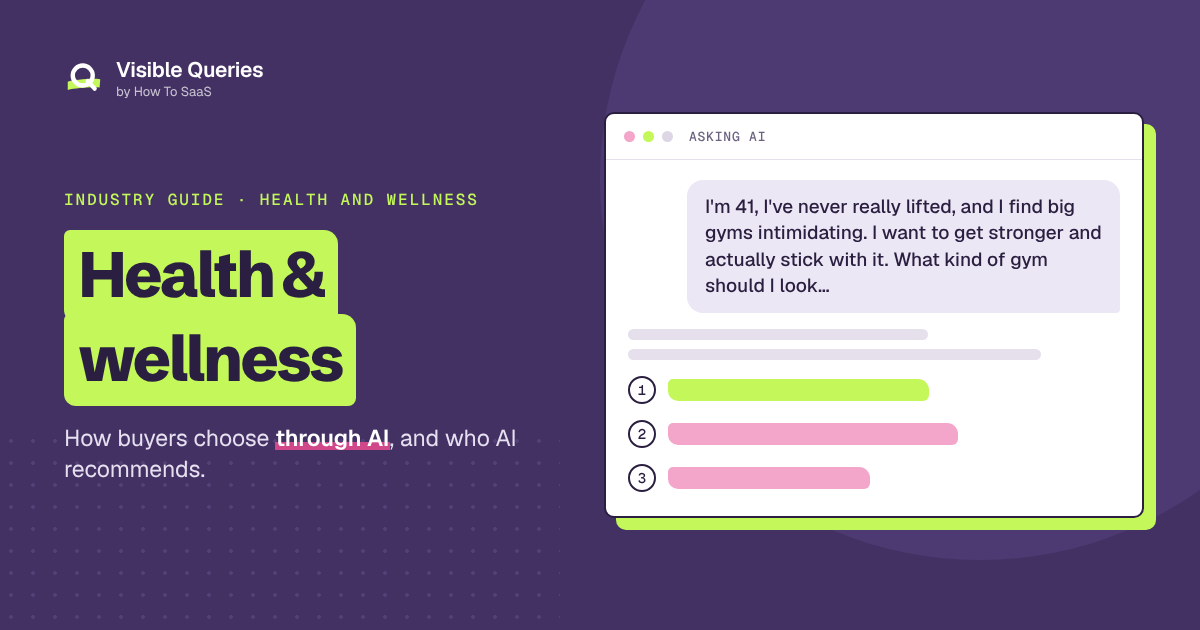
It's the first week of January in Round Rock, Texas. A 41-year-old project manager has just come back from a physical where the doctor said the words "muscle mass" and "you're not getting any younger" in the same sentence. They've had a membership at a big-box gym for three years. They've been maybe eleven times.
A few years ago, they would have searched "gyms near me," looked at the map, and either renewed their current membership out of inertia or signed up wherever was closest.
This time they open ChatGPT and type what they're actually thinking:
"I'm 41, I've never really lifted, and I find big gyms intimidating. I want to get stronger and actually stick with it. What kind of gym should I look for near Round Rock, and which ones are good for beginners?"
The answer explains why coached strength programs tend to work better for beginners than open gyms, what to look for (small-group coaching, an intro session, no long contract), and what that usually costs per month. Then it names three local gyms, with a line on what each one does well.
They book a free intro session at the first one before they've even closed the app.
That's how a growing share of people find a gym, a yoga studio, a Pilates class, a martial arts school, a hairstylist, a barber, a nail salon or a massage therapist now. They describe themselves, their goals and their worries, and AI hands them a short list. The businesses on that list get the first visit. The others never get a chance to make a first impression.
This article walks through how people choose health and wellness businesses today, step by step, with examples from gyms, yoga studios, Pilates and boutique fitness, martial arts, hair salons and barbershops, nail salons, massage and day spas. It covers what people ask AI at each step, what makes AI recommend one business over another, and what the businesses that keep getting recommended tend to do differently. Most of it comes down to being a welcoming, well-run business that's easy to understand from the outside.
Along the way you'll see screenshots from a Visible Queries report for Ironwood Fitness, a sample strength gym in the Austin area. The gym and its competitors are made up, but the report is real. It's exactly what any wellness business sees when it runs its own.
Why the old playbook isn't enough anymore
For years, the playbook for gyms, studios and salons was straightforward. Claim your Google Business Profile, collect reviews, post on Instagram, run a New Year promotion, maybe list on ClassPass or a booking app, and hope the map pack and word of mouth did the rest.
All of that still matters. But it was built for a world where people picked from a map of nearby options. AI changes that, because it doesn't just show what's nearby. It interprets what the person needs and recommends the businesses that seem to fit.
Three things follow from that:
- Fit beats proximity. Someone asking for "a beginner-friendly strength gym with no contract" or "a stylist who's great with curly hair" gets businesses that clearly match, even if they're ten minutes further away.
- The shortlist is tiny. A map shows twenty gyms. An AI answer names three. The businesses on that list get a disproportionate share of first visits.
- Your vibe gets summarized. People ask "Is [studio] intimidating for beginners?" or "Is [salon] good with color correction?" AI answers by reading your reviews, your website and what people say online, then sums up your personality in a sentence or two.
None of this makes Instagram, reviews or word of mouth less important. They're the raw material AI reads. What changes is that your business now has to be clearly understood by an assistant, not just liked by the people who already know you.
The client's journey, step by step
Whether it's a $25 drop-in yoga class or a $250-a-month coaching membership, a $40 haircut or a $300 color correction, the path looks similar. What changes is how much anxiety and commitment is involved.
- Something prompts a change. A New Year, a doctor's advice, a move, a wedding, a bad haircut, or a breakup with their current gym or stylist.
- They figure out what they want. Which type of workout, class or treatment, what to expect and what it costs.
- They build a shortlist. Which places nearby fit their goals, schedule and comfort level.
- They check who to trust. Reviews, contracts, cleanliness, credentials and whether they'll feel welcome.
- They try it. Intro offers, trials, first appointments, pricing and booking.
- They stay, or they don't. Results, community, rebooking, referrals and reviews.
AI now shows up at every one of these steps. Here's what it looks like at each one.
Step 1: Something prompts a change
Wellness decisions are emotional, and they usually start with a moment:
- A New Year's resolution, a doctor's warning, a milestone birthday or a wedding on the calendar (gyms and boutique fitness)
- Back pain from a desk job, or a stressful season at work (yoga, Pilates, massage)
- A kid who needs confidence, discipline or an activity that isn't a screen (martial arts)
- A move to a new city where they don't know anyone (all of them)
- A bad haircut, a stylist who moved away, or a big event coming up (salons and barbershops)
- Their current gym is always packed, or their studio raised prices again (switchers)
The first questions people ask AI are about themselves, not a business:
- "I'm 41 and I've never lifted. Where do I even start?"
- "Is yoga or Pilates better for lower back pain?"
- "Why is my gym always so crowded after work?"
- "How do I find a new hairstylist after moving?"
- "Is martial arts good for a shy 7-year-old?"
The answers shape what they look for next. If AI explains that beginners do better with coached small-group strength training than with an open gym, they're now looking for a very specific kind of gym. The businesses whose content shaped that answer have a head start.
Step 2: They figure out what they want
People at this step are learning the landscape. Wellness has a lot of options and a lot of jargon, and many people are a little nervous about walking in somewhere new.
- "Is a big-box gym good enough if I want to get stronger?"
- "What's the difference between mat Pilates and reformer Pilates?"
- "Hot yoga vs vinyasa: which is better for a beginner?"
- "What should I expect at my first BJJ class?"
- "Balayage vs highlights: what's the difference and how much does each cost?"
- "Deep tissue or Swedish massage for sore shoulders?"
- "How much does a personal trainer cost in Austin?"
AI answers with explanations, comparisons, price ranges and, often, local examples. Businesses whose content explains these things clearly, like "what to expect at your first class" pages, class-type guides and honest pricing, become the ones people trust before they've walked in.
This is also where many wellness businesses lose without knowing it. Their websites are mostly photos, a schedule widget and a "book now" button. There's nothing explaining what makes their approach different, who it's for or what a first visit is like. So AI learns about the category from national chains, booking apps and competitors who did explain it.
Here's what this looks like in a real report. Each row is a topic potential members ask about, with how often it's searched each month and the share of AI answers on that topic that name the gym and each of its top competitors.
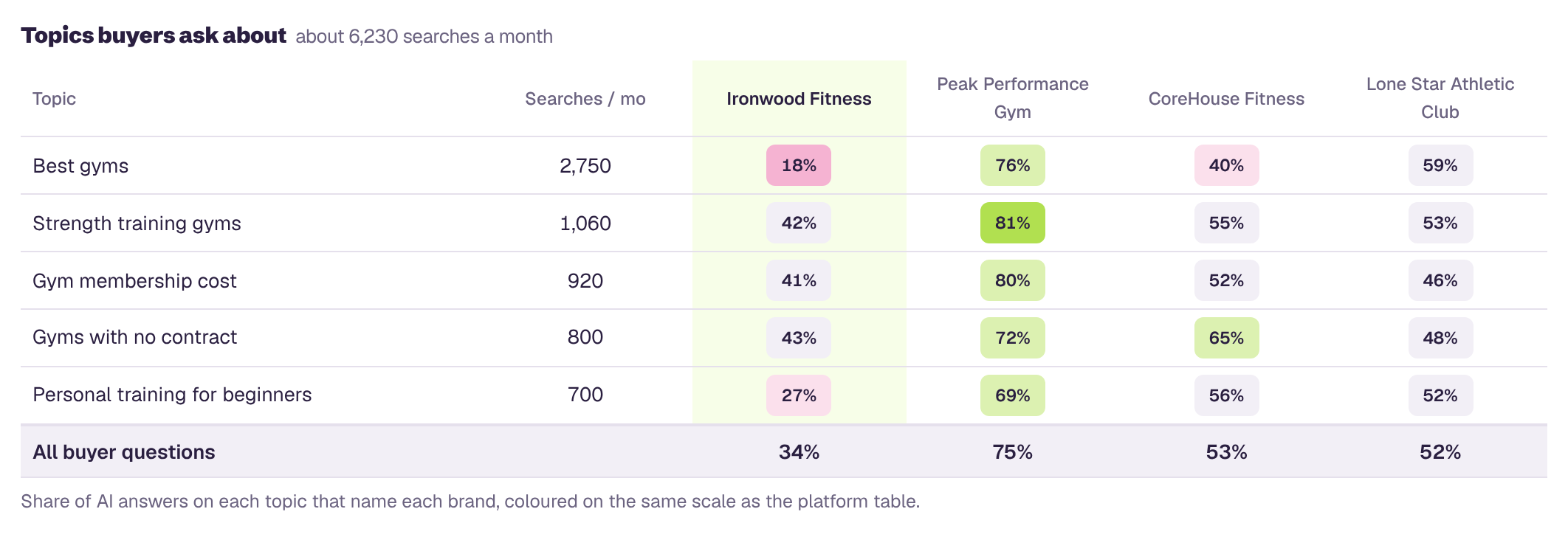
Look at "Strength training gyms." That's where people ask whether a big-box gym is good enough if they want to get stronger. Peak Performance Gym is named in 81% of those answers and Ironwood Fitness in 42%. That's the exact person Ironwood is built for, asking the exact question Ironwood answers, and a competitor is named about twice as often. The "Best gyms" row is starker: 76% for Peak Performance, 18% for Ironwood.
What good wellness businesses do at this step: they explain themselves. What their approach is, who it's for, what a first visit looks like, what to wear, what to bring, how classes or services differ, and what things cost. They write for the nervous beginner, not just the regulars, because the nervous beginner is the one asking AI.
Step 3: They build a shortlist
Now people want names, and they describe their situation in detail:
- "Best beginner-friendly strength gym in Round Rock with no contract"
- "Reformer Pilates studios in Cedar Park with early morning classes"
- "Yoga studios in Austin that are good for people over 50"
- "Kids' martial arts near Pflugerville that focus on confidence, not competition"
- "Best hairstylist in Austin for curly hair"
- "Barbershops in Georgetown that take walk-ins on Saturday"
- "Couples massage spas near me with good reviews"
These answers are local, and they change from neighborhood to neighborhood. A business can be the obvious choice in its own area and almost invisible a few miles away, even when people there would happily drive over.
Here's what that looks like for our sample gym:
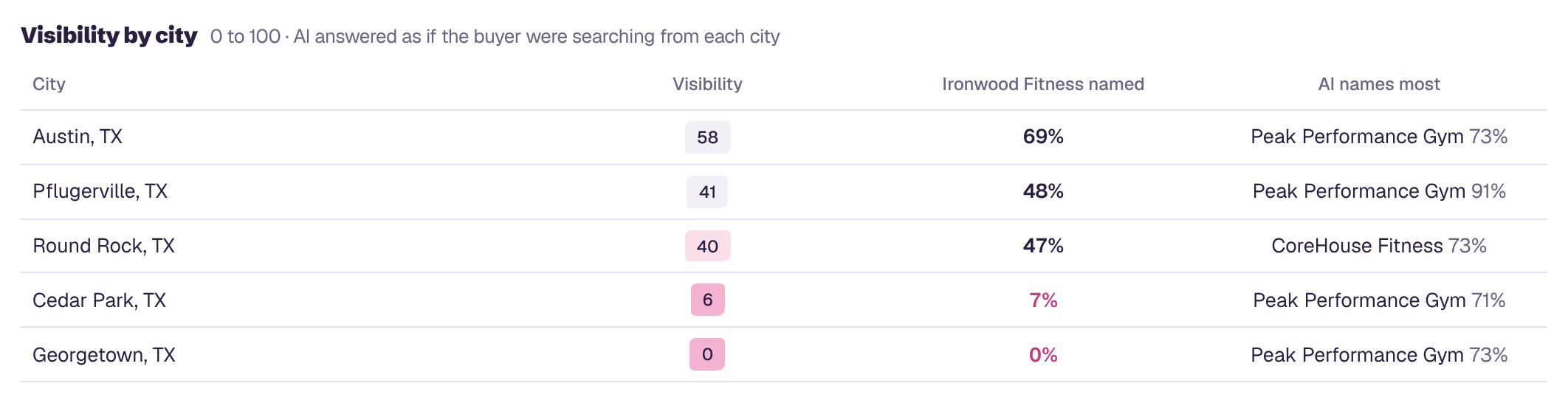
Ironwood Fitness is strongest in Austin, where it scores 58 and is named in 69% of local answers. It does reasonably well in Round Rock and Pflugerville. But in Cedar Park it's named in just 7% of answers, and in Georgetown it never comes up at all.
The same pattern shows up across wellness. A Pilates studio might win "reformer Pilates" and lose "Pilates for back pain." A salon might be known for cuts and invisible for color. A martial arts school might show up for adults and not for kids' classes, which is often the bigger business.
What good wellness businesses do at this step: they're specific about who they serve and where. Pages for each program (beginners, seniors, kids, prenatal, athletes), each service (color, extensions, curly cuts), and each neighborhood or nearby town they draw from. They also make sure their Google Business Profile, booking apps and listings all describe the same services, hours and specialties.
Step 4: They check who to trust
Wellness is personal. People are trusting a business with their body, their appearance, their kids or their limited free time and money. Many have been burned by a gym contract they couldn't cancel or a haircut they cried about. So they vet:
- "Does Ironwood Fitness make you sign a contract?"
- "Is [studio] intimidating for beginners?"
- "How clean is [gym]? Is it crowded at 6 p.m.?"
- "Are the instructors at [Pilates studio] certified?"
- "Is [salon] good at color correction, or should I go somewhere else?"
- "What do parents say about [martial arts school]? Is it safe for kids?"
- "Are the massage therapists at [spa] licensed?"
AI answers by summarizing reviews from Google, Yelp, booking apps, Reddit and local forums, plus your own website. It's very good at picking up themes like "welcoming to beginners," "coaches remember your name," "hard to cancel" or "always runs late." Those themes then get repeated to every person who asks.
This step also exposes a quieter problem: AI getting basic facts wrong.
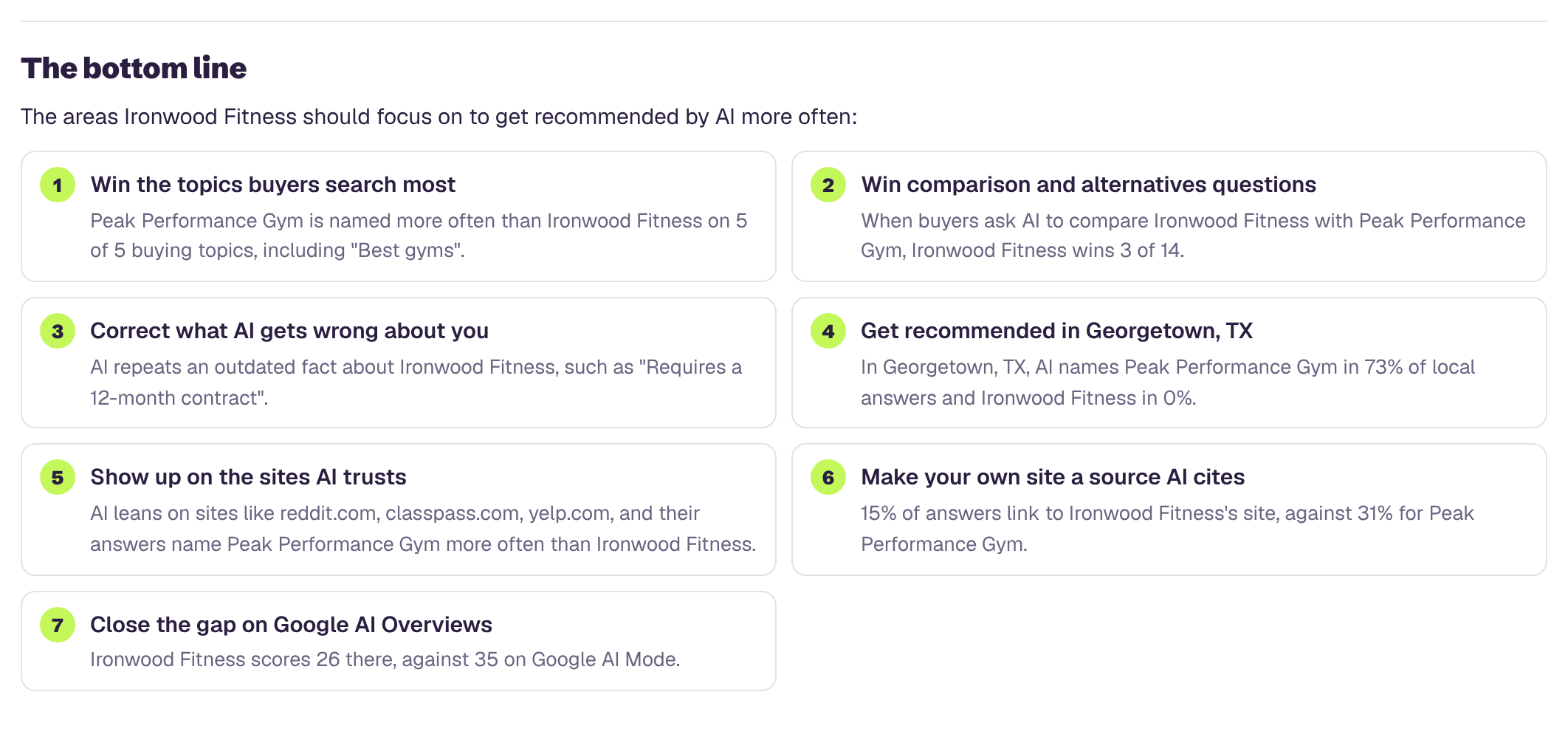
In our sample report, the top gap is a single wrong fact, and it goes straight at the most common fear people have about gyms. AI says Ironwood Fitness "requires a 12-month contract." Ironwood is month-to-month with no contract. Every hesitant beginner who asks about contracts hears exactly the wrong answer. The report's accuracy score, 75% in this sample, shows how often AI gets core facts right.
Wrong facts are common in wellness: old class schedules, prices from three years ago, an instructor who left, a closed second location, a service the salon stopped offering, or confusion with a similarly named business across town.
What good wellness businesses do at this step: they answer the fears directly. Contract and cancellation terms in plain language. Instructor and stylist bios with real credentials and specialties. Cleanliness, safety and beginner support described specifically. Honest "what it's like" content, including busy times. And the same, current facts on their website, Google Business Profile, booking apps and ClassPass. They also respond to reviews, especially critical ones, calmly and specifically.
Step 5: They try it
Now it's about making the first visit easy:
- "Does Ironwood Fitness have a free trial or intro offer?"
- "How much is a monthly membership at [studio] compared with ClassPass?"
- "Ironwood Fitness vs Peak Performance Gym: which is better for beginners?"
- "Can I book a haircut at [salon] online for this Saturday?"
- "Is parking easy at [yoga studio]?"
- "Do I need to bring my own mat?"
Comparisons often come down to concrete details like intro offers, price per class, class times, parking, childcare, amenities and the booking process. If a competitor publishes all of that and your site says "contact us for pricing," AI's comparison tilts their way.
The competitor table shows who's winning these moments overall: how often AI names each business when people ask questions that don't name one. In the sample report, Peak Performance Gym is named in 75% of those answers and Ironwood Fitness in 34%. Someone who asks AI a few questions over a week hears one gym far more often than the other, and that familiarity carries into the first booking.
What good wellness businesses do at this step: they make trying them easy and obvious. Intro offers, pricing, schedules, parking, amenities, what to bring and how to book are all clearly published. They write honest comparison content against the chains and studios they compete with most, explaining who each option is best for.
Step 6: They stay, or they don't
Retention is everything in wellness. A member who stays two years is worth many times what a one-month member is worth, and the same goes for a regular salon client.
- "How long does it take to see results from strength training?"
- "How often should I do Pilates to see a difference?"
- "How do I keep my color from fading between appointments?"
- "Is it normal to feel sore for three days after my first class?"
- "Is it worth switching gyms if mine is always crowded?"
That last question is the switcher question, and it's where businesses win and lose members to each other.
This is also where the reputation loop runs. Members and clients who feel welcomed, see results and become part of a community write specific, glowing reviews, bring friends and post about it. That's exactly the material AI uses to recommend the business to the next nervous beginner. Members who feel ignored or trapped produce the reviews AI warns people about.
What good wellness businesses do at this step: they treat retention as part of their visibility. Onboarding programs for new members, progress check-ins, community events, aftercare guides, rebooking reminders and referral rewards keep people coming back. They ask happy members for reviews that describe their experience and results, which is the most valuable content a wellness business can have.
How the journey plays out across wellness businesses
The six steps hold across health and wellness, but the step that decides the first visit is different for each kind of business. Here's where the weight falls, and what the businesses that win tend to do.
Gyms and fitness clubs
Gym shoppers worry about three things: being intimidated, being trapped in a contract and paying for a place that's too crowded to use. Steps 4 and 5 decide most memberships. People ask "Is [gym] good for beginners?", "How do I cancel [gym]?" and "What's the busiest time at [gym]?"
Gyms that publish clear membership terms, beginner programs, coaching options, amenities and honest information about busy times tend to win the trust questions. Reviews that mention specific coaches and welcoming staff are worth more than any amount of equipment photos.
Full guide: AI visibility for gyms and fitness clubs
Yoga studios
Yoga shoppers ask about styles, levels and fit: "Which yoga studios in Austin are good for complete beginners?", "Is hot yoga safe during pregnancy?", "Yin vs restorative yoga for stress." The educational step is long, and many people are nervous about not being flexible enough.
Studios that explain their class styles, offer clear beginner paths, introduce their teachers and describe the studio's atmosphere tend to show up for the specific, need-based questions that drive first visits.
Full guide: AI visibility for yoga studios
Pilates and boutique fitness
Reformer Pilates, cycling, HIIT and barre studios sell premium classes in a competitive market, often next to franchise chains. Shoppers ask "Is reformer Pilates worth the price?", "Pilates for lower back pain near me" and "Which boutique studios have the best intro offers?"
Studios that are specific about who they help (back pain, postpartum, athletes, beginners), publish intro offers and class-pack pricing, and explain what makes their method different from the franchise down the street tend to win.
Full guide: AI visibility for Pilates and boutique fitness studios
Martial arts studios
Many martial arts customers are parents shopping for their kids, asking about confidence, discipline, bullying and safety: "Is karate or BJJ better for a 7-year-old?", "Kids' martial arts that don't focus on competition." Adults ask about self-defense, fitness and specific disciplines.
Schools that clearly separate kids' and adult programs, explain their curriculum and belt system, introduce their instructors' credentials and describe what a trial class is like give AI the details parents are looking for.
Full guide: AI visibility for martial arts and dance studios
Hair salons and barbershops
Salon clients search by specialty and by stylist: "Best salon for curly hair in Austin," "Who does good blonde balayage near me?", "Barbershops that do fades and take walk-ins." Portfolio, specialty and booking ease decide most choices.
Salons that list services and specialties by stylist, publish price ranges, show real work, and make online booking easy tend to match these specific questions. Reviews that name a stylist and describe the result are extremely valuable.
Full guide: AI visibility for hair salons and barbershops
Nail salons, massage and day spas
People ask about cleanliness, licensing, specific services and occasions: "Clean nail salons near me that use autoclaves," "Best couples massage for an anniversary," "Prenatal massage near Round Rock." Hygiene and licensing questions weigh heavily at step 4.
Businesses that publish their sanitation practices, therapist licensing, full service menus with prices, and gift and package options tend to get recommended for both everyday visits and special occasions.
Full guide: AI visibility for nail salons, massage and day spas
Building a wellness business AI recommends
Put the six steps and the business types together and a pattern comes out. The wellness businesses AI recommends aren't always the biggest or the cheapest. They're the ones whose approach, people and reputation are clearly described and consistent everywhere AI looks.
1. Explain your approach and who it's for. Beginners, seniors, athletes, kids, back pain, curly hair. Specific fit wins specific questions.
2. Write for the nervous first-timer. What to expect, what to wear, what to bring, how the first visit works and how you help newcomers.
3. Publish prices and terms plainly. Memberships, class packs, intro offers, service menus, contracts and cancellation. Hidden pricing makes AI recommend someone else.
4. Introduce your people. Coaches, instructors and stylists with real credentials, specialties and personalities. People choose people.
5. Cover every neighborhood you serve. Make it clear which nearby towns and neighborhoods you draw members from, so AI recommends you beyond your own block.
6. Keep facts identical everywhere. Website, Google Business Profile, booking apps, ClassPass, Yelp and social profiles should show the same services, hours, prices and policies.
7. Earn reviews that tell a story. Ask members and clients to mention what they came for and what changed. "I'd never lifted before and the coaches made me feel at home" is gold.
8. Be part of the community. Local events, charity classes, partnerships with physical therapists or schools, and local press give AI independent signals that you're a real, trusted local business.
9. Deliver an experience people stay for. Welcoming staff, clean spaces, honest policies and real results produce the reviews and referrals AI learns from.
10. Measure it. Most wellness businesses have never seen what AI tells people about them, neighborhood by neighborhood, compared with the studios and gyms nearby.
That last point is where the report comes in. Here's the top of the sample report for Ironwood Fitness:
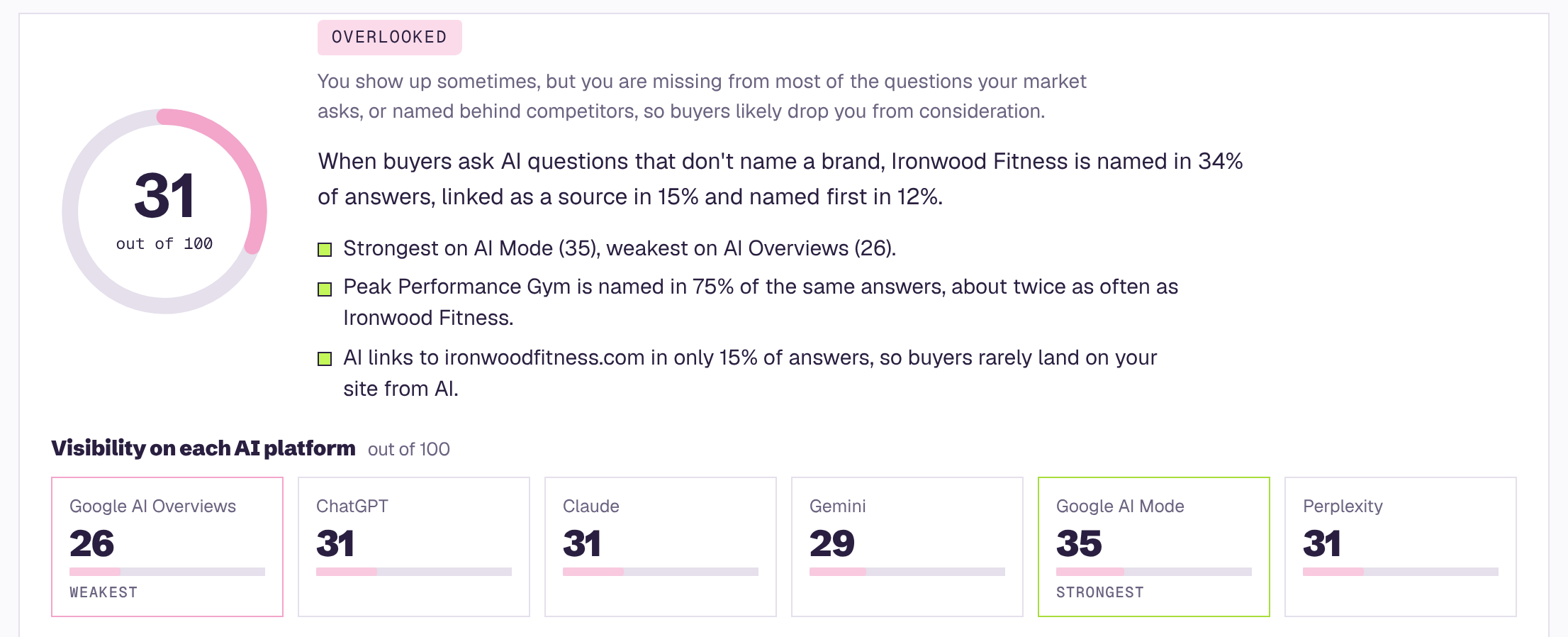
Ironwood Fitness scores 31, in the Overlooked band. That's a pattern many wellness businesses will recognize: AI knows Ironwood Fitness when it's asked by name, but rarely recommends it when people ask where to go. It's named in 34% of answers to questions that don't name a gym, while Peak Performance Gym is named in 75%. Just below, the report breaks it down further:

For wellness businesses, first mention and accuracy deserve special attention. People often book a trial at the first place named, and a single wrong fact about contracts, prices or schedules can scare off exactly the people you want most.
Run the report again after making changes, and you can watch these numbers move in each neighborhood, against the gyms and studios nearby.
People still want to feel better
People still want to get stronger, move better, de-stress and look their best. What's changed is who helps them choose where to go. More and more, it's an AI assistant, and it hands them a short list before they've seen your Instagram or walked past your door.
The good news for great wellness businesses is that AI mostly rewards what members already love: a welcoming place, skilled people, honest policies and real results. The work is making all of that visible, specific and consistent in the places AI reads, and checking that it's working.
Keep learning
- What is AI visibility?
- How to get your business recommended by AI, with guides for ChatGPT, Google AI Overviews, Perplexity, Gemini and Claude
- AI visibility benchmark 2026
- The AI visibility glossary
See what AI tells people about your business
Enter your website and get a free AI visibility report. It takes a few minutes, and you'll see:
- Your AI visibility score, overall and for ChatGPT, Gemini, Claude, Perplexity and Google's AI Overviews and AI Mode
- Which gyms, studios or salons AI recommends instead of you, and how often
- Your visibility in every city you serve, and the competitor AI names most in each one
- What AI gets wrong about you, and what to fix first
- Your biggest gaps: the buyer questions where AI leaves you out, and who it recommends instead
- A downloadable PDF you can share with your team