Parents, adults and the first class: how people choose a martial arts or dance studio through AI
Parents and adults now ask AI which martial art or dance style suits them, what classes cost and whether a studio is safe and welcoming. Here's what AI tells them, and how martial arts and dance studios get named.
A parent in Mississauga has a seven-year-old with lots of energy and not much focus. A teacher suggested martial arts. The parent doesn't know the difference between karate, taekwondo, jiu-jitsu and kung fu, and has heard that some schools lock families into long contracts. They ask ChatGPT:
"My 7-year-old needs help with focus and confidence. Which martial art is best for kids, karate, taekwondo or jiu-jitsu? What should classes cost, should we avoid contracts, and which schools in Mississauga are good with kids?"
AI explains the styles in plain language, what each emphasizes, why the instructor and school culture matter more than the style for young kids, typical monthly costs and uniform or testing fees, and how to judge a trial class. Then it names three schools. The family books a free trial for Thursday.
Martial arts and dance studios share a lot. Many of their students are kids, so parents do the research. Adult students are often nervous beginners. Programs run for years, with belts, levels, recitals and competitions. And trust is everything, because parents are leaving their children in someone else's care.
Our health and wellness guide covers the journey across gyms, studios and salons. This one goes through the questions that decide martial arts and dance students, what AI usually says, and what studios can publish so AI names them.
Here are the questions at a glance:
| The question | What gets you named |
|---|---|
| "Which martial art is best for my child?" | What you teach and who each program suits |
| "What age can kids start?" | Age groups and what each class looks like |
| "How much does it cost? Contracts?" | Tuition, fees and contract terms |
| "Are the instructors qualified?" | Instructor ranks, certifications and safety practices |
| "Recreational or competitive?" | The paths you offer, with time and cost |
| "What does the recital cost?" | Costume, recital and competition fees up front |
Martial arts: the questions that decide enrollment
"Which martial art is best for my child?" or "for self-defense?" or "for fitness?"
What AI usually says: It compares styles by goal: discipline and focus, self-defense, fitness, competition, or confidence for kids who've been bullied. It often notes that the school and instructor matter more than the style.
What to publish: A page explaining your style and how it serves each goal, plus your teaching philosophy. If you teach several styles, compare them honestly.
"What age can kids start?"
What AI usually says: It gives typical starting ages and says many schools have programs for young children that focus on coordination and listening.
What to publish: Your programs by age group, what each class looks like, class size, and how you handle kids who are shy, very energetic or neurodivergent. Parents ask about all of these.
"How much does it cost? Are there contracts?"
What AI usually says: Typical monthly fees, plus uniform, testing and belt fees, and a warning to watch for long contracts and pressure sales.
What to publish: Your tuition, all fees, how belt testing works and what it costs, and your contract or cancellation terms. Transparency here is a competitive advantage, because AI tells parents to look for it.
"Is it safe? Are the instructors qualified?"
What AI usually says: It suggests looking at instructor experience, ranking, background checks, safety equipment and how sparring is managed for kids.
What to publish: Instructor bios, background checks, first-aid training, your approach to sparring and contact, and how you supervise children.
Dance: the questions that decide enrollment
"What style should my child start with?"
What AI usually says: It explains ballet, jazz, tap, hip hop, contemporary and acro, and often suggests creative movement or combination classes for young kids.
What to publish: A clear guide to the styles you teach, by age and level, with what each class looks like.
"Recreational or competitive?"
What AI usually says: It explains the time and cost commitment of competition teams compared with recreational classes, and suggests asking about costumes, travel and rehearsal schedules.
What to publish: Honest information about both paths: hours per week, competition and recital costs, costume fees, travel, and how students move between levels.
"Adult beginner dance classes near me?"
What AI usually says: It names studios with adult programs, social dance classes or beginner series. Many adults ask about salsa, ballroom, swing, ballet for adults, hip hop or wedding dance lessons.
What to publish: Pages for every adult program, with beginner paths, partner policies (do you need to bring one?), drop-ins and private lessons. Wedding first-dance lessons are a distinct, valuable search, so give them their own page.
"What does the recital cost?"
What AI usually says: It notes that recitals and competitions often come with costume, ticket and fee costs and suggests asking upfront.
What to publish: Your recital schedule and every cost involved, explained early. Surprise fees are a common complaint in reviews, and AI repeats complaints.
Visibility by neighborhood
Families choose studios they can get to after school. That makes neighborhood-level visibility critical:
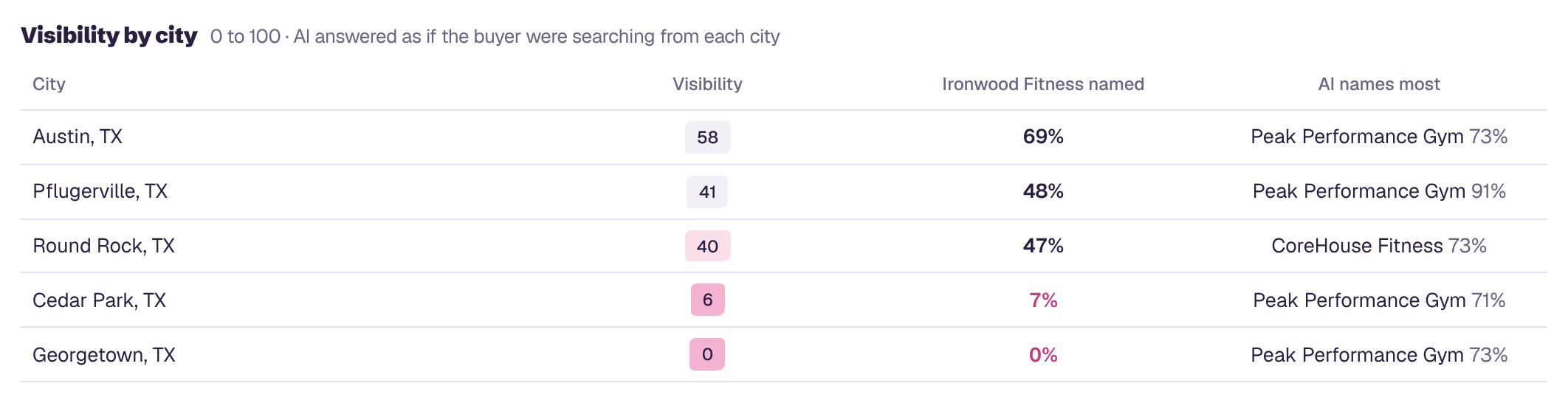
If your studio draws from several suburbs, make sure each one appears on your site, with driving times, nearby schools and any pickup programs.
Camps, birthday parties and after-school programs
Martial arts and dance studios often earn a lot from summer camps, holiday camps, birthday parties and after-school pickup programs. Parents ask AI about each one separately: "kids summer camps in Mississauga," "martial arts birthday party," "after-school programs with pickup from [school]." Give each one a page, with dates, ages, prices and what's included.
What the sample report shows
Here's what a Visible Queries report looks like for Ironwood Fitness, the sample strength gym in the Austin area from our guide. The questions are different for martial arts and dance schools, but the patterns are the same.
The gap is clearest side by side:
If you only fix three things
- Explain your styles and programs by age and goal. Kids, teens, adults, recreational and competitive.
- Publish tuition, fees and contract terms. Including testing, uniforms, costumes and recitals.
- Show parents why your studio is safe. Instructor bios, background checks and how classes are run.
Parents are asking AI where their kids should learn to kick or dance. The studio AI names will be the one that answers those questions most clearly.
Part of our guide: Why AI visibility matters for health and wellness businesses
See what AI tells families about your studio
Enter your website and get a free AI visibility report. It takes a few minutes, and you'll see:
- Your AI visibility score, overall and for ChatGPT, Gemini, Claude, Perplexity and Google's AI Overviews and AI Mode
- Which studios AI recommends instead of you, and how often
- Your visibility in every city you serve, and the competitor AI names most in each one
- What AI gets wrong about you, and what to fix first
- Your biggest gaps: the buyer questions where AI leaves you out, and who it recommends instead
- A downloadable PDF you can share with your team