How guests choose where to eat, stay and celebrate now, and why AI visibility decides who gets the booking
Travelers and diners now ask AI where to eat, stay and host their event. Here's how their journey works, what they ask at each step, and how to build a hospitality business AI recommends.
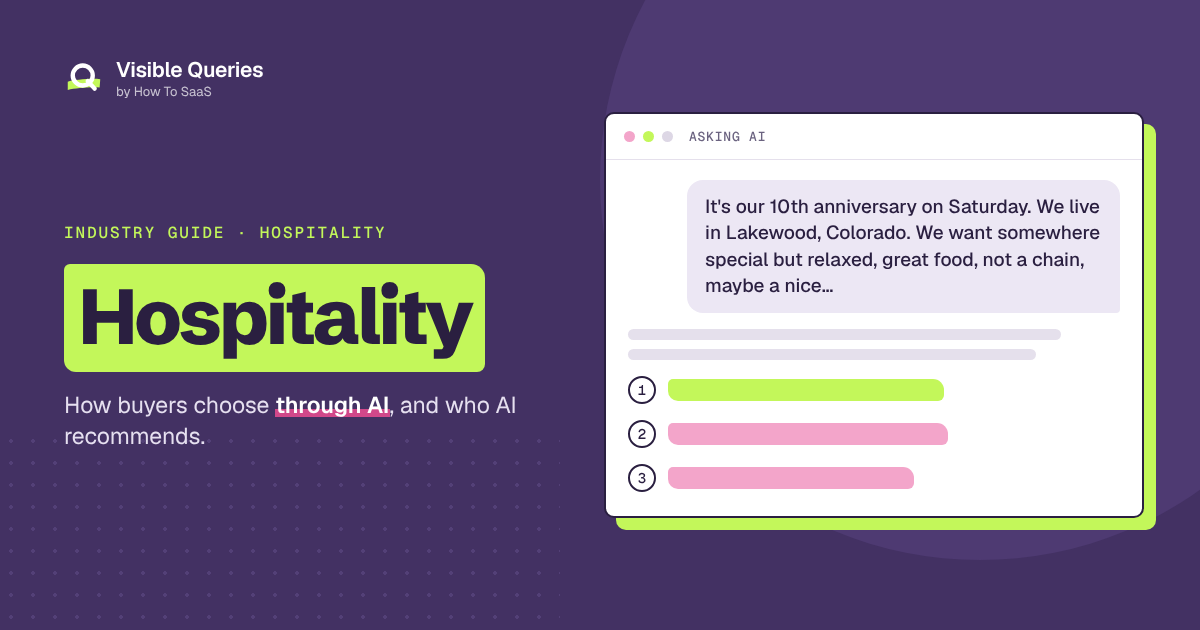
It's Wednesday afternoon, and the anniversary is Saturday. Ten years. The plan was to "figure out dinner," and now it's three days away. They live in Lakewood, they don't want to drive all the way downtown, and they definitely don't want to end up at the same chain restaurant they go to on busy weeknights. It should feel special without being stuffy, and it would be nice not to wait an hour for a table.
A few years ago, they would have scrolled a review app, opened a dozen tabs, checked a reservation site for availability, and settled on whatever had a table.
Today, they open ChatGPT and type:
"It's our 10th anniversary on Saturday. We live in Lakewood, Colorado. We want somewhere special but relaxed, great food, not a chain, maybe a nice patio, and we really don't want a long wait. Where should we go, and can we still get a reservation?"
The answer suggests booking now, because popular places fill up days ahead on Saturdays. It mentions asking for a patio table and letting the restaurant know it's an anniversary. Then it names three places nearby, with a line on what makes each one a good pick.
They book the first one in under a minute.
That's how a growing share of guests now choose restaurants, hotels, vacation rentals, breweries, coffee shops, event venues, caterers and attractions. They describe the occasion, the mood, the budget and what they want to avoid, and AI hands them a short list. The places on that list get the booking. The rest don't get a chance.
This article walks through how guests choose a hospitality business today, step by step, with examples from hotels and resorts, boutique hotels, B&Bs and vacation rentals, restaurants and restaurant franchises, coffee shops, bars and breweries, event venues and caterers, and attractions, entertainment and golf. It covers what guests ask AI at each step, what makes AI recommend one place over another, and what the businesses that keep getting recommended tend to do differently. Most of it comes down to being a place that's clearly described, easy to book and genuinely loved by its guests.
Along the way you'll see screenshots from a Visible Queries report for Ember & Oak Kitchen, a sample restaurant group in the Denver area. The restaurant and its competitors are made up, but the report is real. It's exactly what any hospitality business sees when it runs its own.
Why the old playbook isn't enough anymore
Hospitality has always run on word of mouth, reviews and location. Friends' recommendations, review sites, travel guides, food writers, Instagram, a busy street and a good sign. Marketing filled in with a website, social media, listings on booking and reservation platforms, and sometimes local ads.
All of that still matters. But more and more, the first "friend" a guest asks is an AI assistant. It has read the reviews, the menus, the food blogs, the travel guides and the local news, and it gives a confident, personal recommendation in seconds.
Three things follow from that:
- Guests describe the occasion, not the category. "Somewhere special but relaxed for an anniversary, with a patio, no long wait" gets places that clearly fit. "Contemporary American cuisine" matches nothing in particular.
- The shortlist is tiny. A review app shows hundreds of restaurants. An AI answer names three. Those three get the reservations.
- Your reputation is summarized. Guests ask "Is [restaurant] worth it? Is it loud?" and get a short answer drawn from reviews, articles and whatever's published about you.
None of this replaces great food, great service or great reviews. They're exactly what AI reads. What's changed is that your reputation now reaches guests as a two-sentence summary before they've seen a single photo.
The guest's journey, step by step
Whether it's a $6 latte, a $150 dinner, a $400-a-night hotel or a $30,000 wedding, the path looks similar. What changes is how far ahead people plan and how many people are involved.
- Something prompts the search. An occasion, a trip, a craving, a visitor in town or an event to plan.
- They figure out what they want. The kind of place, the vibe, the budget and the area.
- They build a shortlist. Which places fit, and which ones are near where they'll be.
- They check who to trust. Reviews, photos, menus, policies and what people say about the experience.
- They book. Reservations, availability, prices, cancellation policies and details.
- They come back, or they don't. The experience, the follow-up, return visits, reviews and word of mouth.
AI now shows up at every one of these steps. Here's what that looks like.
Step 1: Something prompts the search
Hospitality searches almost always start with a moment.
- An anniversary, a birthday, a promotion or a first date.
- A trip: a weekend getaway, a family vacation, a work conference, a ski trip.
- Visitors in town who need to be fed, entertained and impressed.
- A wedding, a rehearsal dinner, a company holiday party or a milestone birthday.
- A craving, a rainy Sunday or a Friday night with no plans.
The first questions guests ask AI are about the moment, not about you. "Fun things to do in Denver with teenagers?" "Best area to stay in Boulder for a weekend without a car?" "How far ahead should I book a wedding venue in Colorado?" "Good date night ideas that aren't just dinner?"
This is where AI decides what kind of experience someone is looking for, and that decides which places get considered. If AI suggests a food hall and a brewery crawl for a group of friends, the fine-dining restaurant isn't in the running. If it suggests booking a mountain lodge rather than a downtown hotel, the downtown hotel never gets the inquiry.
The businesses that do well at this step have published content that helps people plan the moment. A hotel with a genuinely useful guide to a weekend in the neighborhood. A restaurant with a page about private dining for celebrations. A venue with an honest planning timeline. A brewery with a page on what's nearby for an afternoon out.
AI leans on content like that when it helps people plan, because it's specific, local and written by people who know the area. Once your guide shapes the plan, your business is part of it.
What good businesses do at this step:
- Write about the occasions and trips that bring guests to you: celebrations, getaways, visitors, events.
- Be a genuinely helpful local guide, even when it means recommending your neighbors.
- Say clearly which occasions you're perfect for: date nights, families, big groups, business dinners, dogs welcome, late-night bites.
Step 2: They figure out what they want
Next, guests narrow down what kind of place fits. This is where they're most open to suggestions.
- "Is a chain restaurant fine for a special anniversary dinner?"
- "Boutique hotel or vacation rental for a family of five in Breckenridge?"
- "Brewery or wine bar for a relaxed first date?"
- "Restaurant private room or event venue for a 60-person rehearsal dinner?"
- "How do you avoid a long wait for a table on a Friday night?"
This is where people decide the kind of experience they want, and that decides who's in the running.
Here's what this step looks like in a real report. These are questions AI was asked about restaurants in the Denver area, and who each platform named in its answer:
Look at the pattern. "Is a chain restaurant fine for a special anniversary dinner?" Claude recommended Ember & Oak, but ChatGPT and Gemini named competitors. "What's better than a chain restaurant for a date night?" Copper Kettle Grill on three of the four platforms. "Why does eating out feel so overpriced lately?" Competitors on every platform. "How do you avoid a long wait for a table on a Friday night?" Copper Kettle Grill twice and Mile High Tavern Co. once.
These are the guests a restaurant like Ember & Oak wants most: people who want something better than a chain, care about value and hate waiting. They're asking AI exactly the questions the restaurant could answer best, and AI is mostly sending them somewhere else.
What moves a business into these answers is being clear about the experience you offer:
- What it feels like: the atmosphere, noise level, dress code, the patio, the view, the music.
- Who it's great for: couples, families, groups, business dinners, solo travelers, dogs.
- How it works: reservations, walk-ins, wait times, parking, price range and what's included.
What good businesses do at this step:
- Describe the experience in specific, honest words, not marketing adjectives.
- Say which occasions and guests you're best for.
- Answer the practical questions people ask: price range, reservations, waits, parking, kids, dogs, accessibility.
Step 3: They build a shortlist
Once guests know what they want, they look for specific places. Location matters a lot. Diners want something nearby or on the way. Travelers want to stay near what they're there to do.
The questions get specific:
- "Best patio restaurant in Lakewood for an anniversary."
- "Dog-friendly brewery in Boulder with food."
- "Hotel near Red Rocks with a shuttle to concerts."
- "Wedding venue near Denver for 150 guests with mountain views."
- "Family-friendly restaurant in Aurora with a kids menu and no long wait."
For groups with several locations, this is where gaps show. AI can recommend you every time in one neighborhood and never in the next. Here's the sample restaurant group across the four cities it serves:
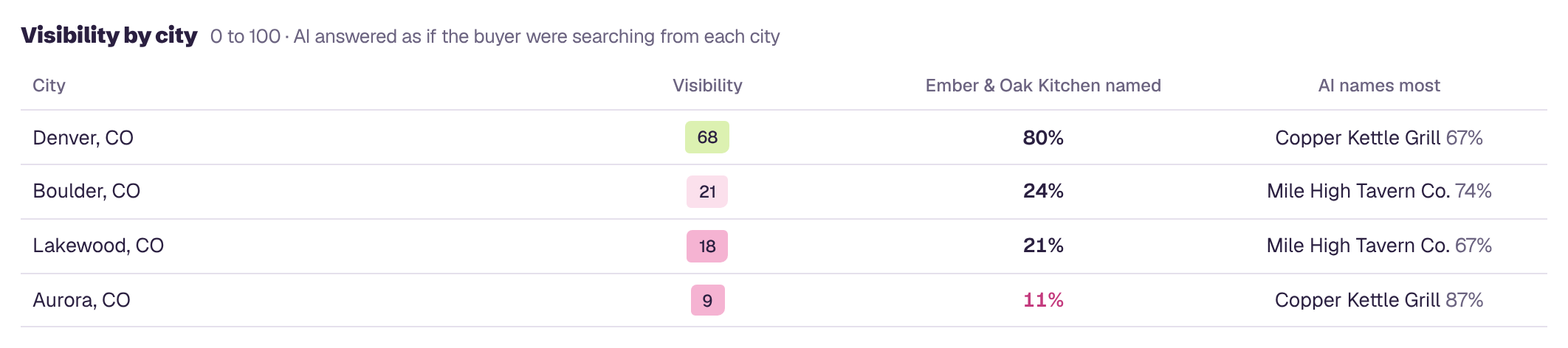
In Denver, Ember & Oak scores 68 and is named in 80% of answers. In Boulder it falls to 21 and is named in about a quarter of answers, while Mile High Tavern Co. is named in 74%. In Lakewood, where the couple in the opening example lives, it scores 18, named in 21%. In Aurora it scores 9 and is named in just 11%, while Copper Kettle Grill is named in 87%.
That's typical for multi-location restaurants, hotel groups and franchises. The original location has years of reviews, food writing and local buzz. The newer ones have a page with an address and hours. AI can't recommend a location it knows almost nothing about.
What good businesses do at this step:
- Give every location its own real page: the menu there, the space, the patio, private dining, hours, parking, nearby landmarks and reviews from that location.
- Build local reputation for each location: local press, neighborhood events, partnerships with nearby hotels and venues.
- Keep every listing accurate: hours, menus, photos and reservation links on Google, reservation platforms and booking sites.
Step 4: They check who to trust
Guests are spending money and, often, a special occasion. They don't want to get it wrong. So they check.
- "Is [restaurant] worth the price?"
- "Is [hotel] actually clean? Any complaints about noise?"
- "What do people say about the food at [venue]'s weddings?"
- "Is [brewery] good for kids, or is it more of a bar?"
- "Does [restaurant] take reservations?"
AI answers these in a couple of sentences. When it's accurate, that's a powerful endorsement. When it's wrong, the guest simply goes somewhere else.
Here's what that looks like in the sample report:
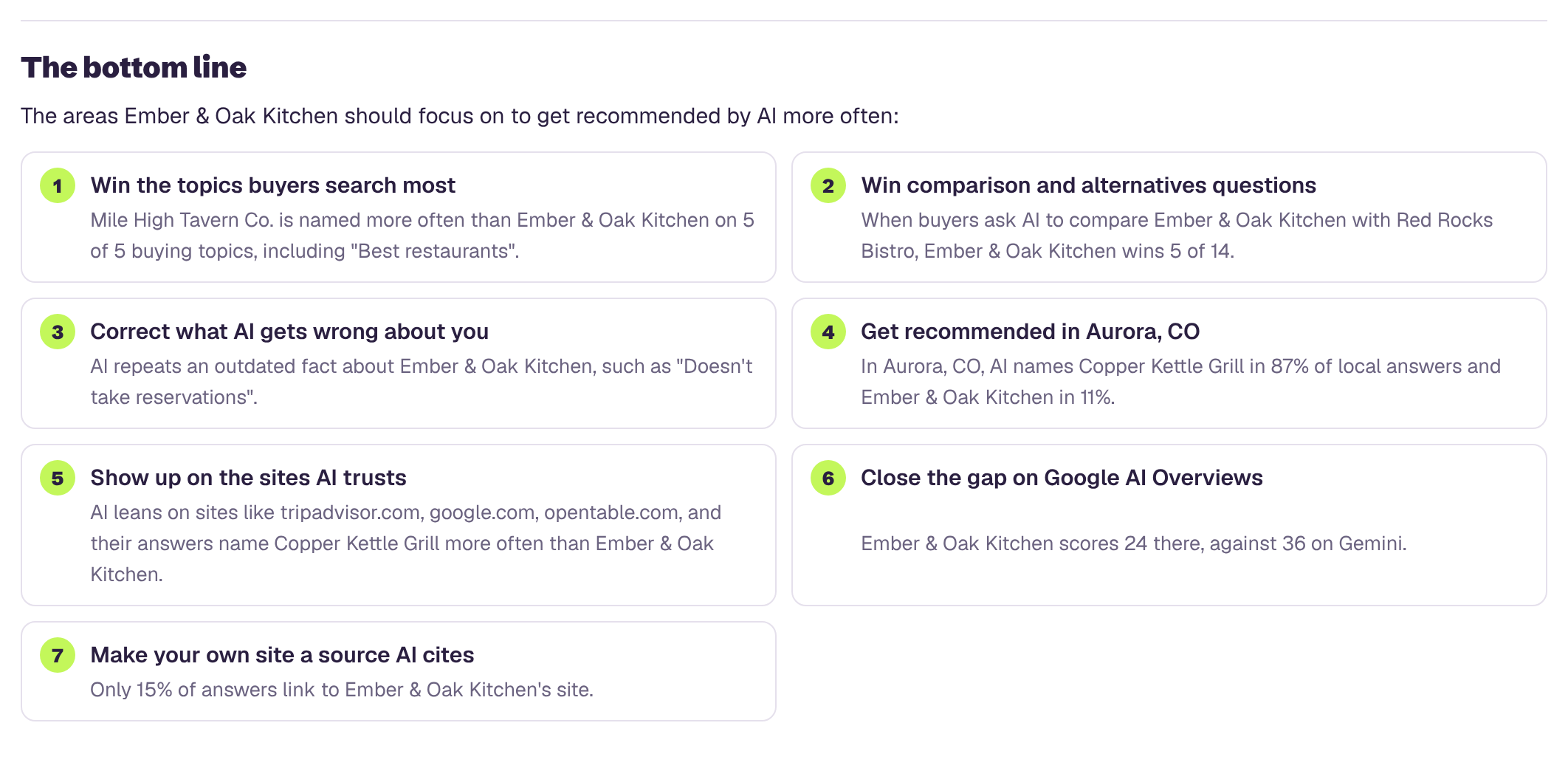
The first gap costs the restaurant exactly the guests it wants. AI tells people that Ember & Oak "doesn't take reservations." In reality, every location takes reservations online. For the couple planning an anniversary, or anyone who hates waiting, that one wrong sentence crosses Ember & Oak off the list.
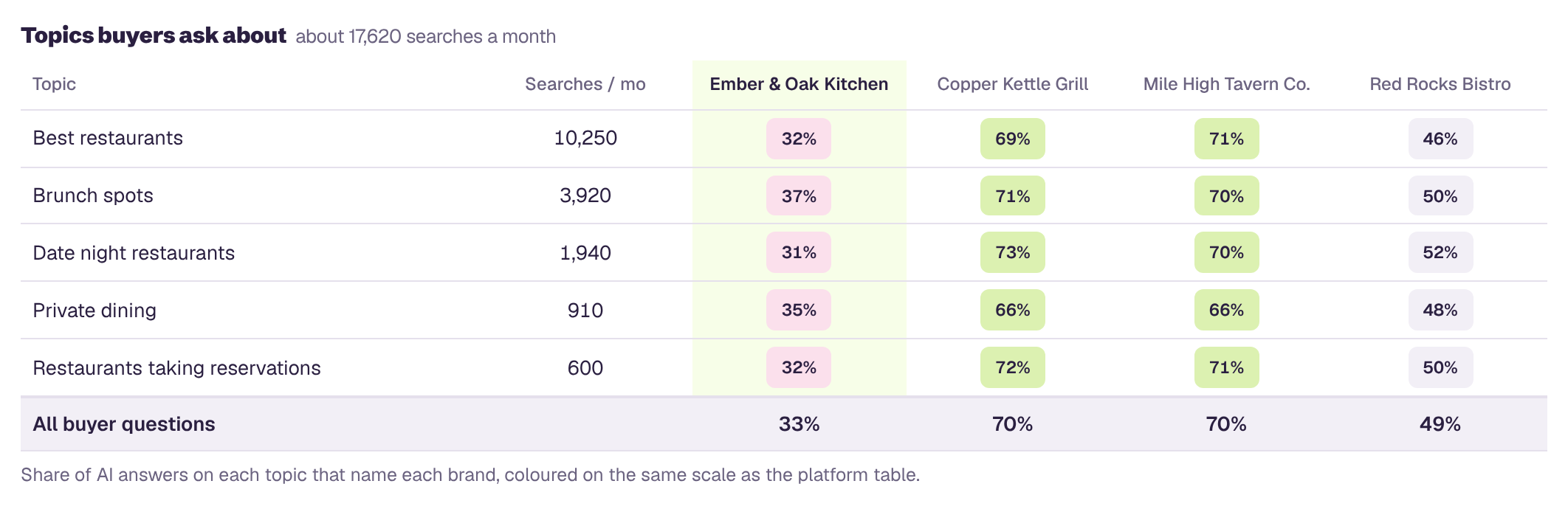
The report also shows Ember & Oak named in only 38% of "best restaurants" answers, and Mile High Tavern Co. named instead in 48% of buyer questions, including "Why are the waits so long at popular restaurants on weekends?" That's a question Ember & Oak should own, because it takes reservations. Overall accuracy is 75%, so a quarter of what AI says about the restaurant is wrong.
Wrong facts in hospitality usually come from a few places:
- Old policies. A restaurant that was walk-in only when it opened, a hotel that used to have a pool or a shuttle, a venue that changed its capacity.
- Outdated listings. Old hours, old menus and old photos on third-party sites.
- Confusion between locations, especially when each location runs differently.
- Silence. If you never state your reservation policy, price range, dress code or pet policy, AI fills the gap with what reviewers said years ago.
What good businesses do at this step:
- Publish the facts guests check, clearly: reservations, walk-ins, price range, dress code, kids, dogs, accessibility, parking and policies.
- Keep every listing and booking platform consistent with your website.
- Respond to reviews, especially negative ones, calmly and helpfully. AI reads responses too.
- Encourage happy guests to mention specifics in reviews, like the dish, the occasion, the server and the room.
Step 5: They book
By now, guests usually have two or three places in mind. They're checking the details that decide it:
- "Ember & Oak vs Copper Kettle Grill for a Saturday anniversary dinner?"
- "Does [hotel] have rooms this weekend under $250?"
- "What's the cancellation policy at [vacation rental]?"
- "Can [venue] handle 150 guests, and what's the food and drink minimum?"
- "Does [restaurant] have a private room for 20?"
Head-to-head questions are where share of voice matters most. If a guest asks AI to compare you with a competitor and AI has much more to say about the competitor, the competitor tends to win.
In the sample report, Mile High Tavern Co. is named in 70% of answers, Copper Kettle Grill in 70% and Red Rocks Bistro in 49%. Ember & Oak is named in 33%. Ember & Oak scores 31 overall, in the Overlooked band, and is the fourth name in most conversations about restaurants in the region.
The businesses that win at this step make booking effortless:
- Book in one click. Online reservations, room booking or event inquiries, linked from every page and every listing.
- Prices are visible. Menus with prices, room rates, event packages, minimums and what's included.
- Policies are clear. Cancellation, deposits, large parties, dietary needs and special requests.
- The special touches are named. The anniversary dessert, the chef's counter, the fire pits, the mountain view room. Say so.
What good businesses do at this step:
- Make booking or inquiring possible in seconds from anywhere guests find you.
- Publish prices and packages wherever you can. AI can't recommend you as good value if it doesn't know your prices.
- Keep availability, hours and policies current everywhere.
Step 6: They come back, or they don't
Hospitality lives on repeat guests and word of mouth. A couple who loved their anniversary dinner comes back for birthdays. A family that loved a resort returns every summer. A company that had a great holiday party books again and refers other companies.
Guests ask AI questions after the visit too:
- "Is it worth going back to [restaurant] or should we try somewhere new?"
- "Better alternatives to [hotel] in Denver?"
- "Is [venue] worth it for our next company event?"
The businesses that keep guests coming back give them reasons to: seasonal menus, events, loyalty programs, return-visit perks, and a genuine relationship. And when guests love the experience, they post photos, write reviews and tell friends. That's exactly what AI reads when it decides who to recommend next.
What good businesses do at this step:
- Give guests a reason to come back, and publish it: seasonal menus, events, packages and loyalty perks.
- Follow up after events and stays, and make it easy to leave a review.
- Ask for reviews at the right moment, like after a celebration, a stay or a great event.
How the journey plays out across hospitality
The six steps are the same everywhere, but what guests ask, and what decides the choice, varies a lot by type of business.
Hotels and resorts
Hotel guests plan around a trip and a location. They ask: "Best area to stay in Denver for a first visit," "family resort in Colorado with a pool," "hotel near the convention center with free parking," "is [hotel] worth the resort fee?"
AI recommends hotels that are clear about location and what's nearby, amenities, room types, real prices including fees, parking, and who the hotel is best for. Neighborhood guides, honest descriptions of rooms and clear policies help AI recommend you for the right guests.
Full guide: AI visibility for hotels and resorts
Boutique hotels, B&Bs and vacation rentals
These guests want character and a specific experience. They ask: "Romantic B&B in the mountains near Denver," "vacation rental in Breckenridge for 10 people with a hot tub," "boutique hotel or Airbnb for a girls' weekend?"
Smaller properties often lose to big booking platforms in AI answers simply because AI knows less about them. The fix is detail: what makes the property unique, who it's perfect for, photos, the host's story, local recommendations, and a clear way to book direct.
Full guide: AI visibility for boutique hotels, B&Bs and vacation rentals
Restaurants and restaurant franchises
This is the journey in the example above. Diners ask about occasions, cuisines, neighborhoods and logistics: "Best tacos in Aurora," "restaurant with a private room for 20 in Denver," "gluten-free friendly restaurants near me," "does [restaurant] take reservations?"
AI recommends restaurants with specific, current information: menus with prices, dietary options, atmosphere, reservations, waits, parking and private dining. For franchises and groups, each location needs its own detail and reviews, or AI defaults to the original location or to a competitor.
Full guide: AI visibility for restaurants and restaurant franchises
Coffee shops, bars and breweries
These are often spur-of-the-moment searches. "Coffee shop with good Wi-Fi to work from in Boulder," "dog-friendly brewery with food trucks," "cocktail bar for a first date downtown," "late-night bar with food near me."
AI recommends places that are clear about the vibe, the hours, what they serve, whether they're laptop-friendly, kid-friendly or dog-friendly, and what's happening this week, like trivia, live music and food trucks. Keeping hours and events current is half the battle.
Full guide: AI visibility for coffee shops, bars and breweries
Event venues and caterers
Event planning is long, detailed and often involves several decision-makers. Couples and planners ask: "Wedding venues near Denver for 150 guests under $20,000," "how far ahead to book a wedding venue," "best caterer for a corporate lunch for 80," "venue with in-house catering vs bring your own."
AI recommends venues and caterers that publish capacity, pricing or starting packages, what's included, availability, vendor policies and real event photos. Venues that hide everything behind an inquiry form leave AI with nothing to say, so it recommends the ones that don't.
Full guide: AI visibility for event venues and caterers
Attractions, entertainment and golf
These searches are about plans and experiences. "Things to do in Denver with kids on a rainy day," "best mini golf near Lakewood," "public golf courses near Boulder with good tee time availability," "escape rooms for team building."
AI recommends attractions that are clear about what the experience involves, how long it takes, ages it suits, prices, booking, parking and accessibility. Clear, current information about hours, seasons and events makes a big difference, especially for seasonal businesses.
Full guide: AI visibility for attractions, entertainment and golf
Building a hospitality business AI recommends
Across every type of hospitality business, the ones AI keeps recommending share the same habits. None of them are tricks. They're what great hospitality businesses already do, written down clearly enough for a guest, or an AI, to understand.
- Describe the experience honestly and specifically. Atmosphere, noise level, views, space and what it feels like to be there.
- Say who you're perfect for. Occasions, group sizes, families, couples, business travelers, dogs.
- Answer the practical questions. Reservations, walk-ins, waits, price range, parking, dress code, accessibility, dietary options.
- Publish prices and packages. Menus with prices, room rates, event packages and minimums.
- Give every location its own page. Menus, spaces, events, hours and local reviews for each one.
- Keep every listing accurate. Hours, menus, photos, policies and booking links, everywhere guests find you.
- Fix wrong facts fast. One wrong line about reservations or prices can cost you every guest who hears it.
- Make booking effortless. One click from every page and listing.
- Be a helpful local guide. Help guests plan the whole occasion, not just the part that involves you.
- Build reviews with specifics. Ask after great moments, and encourage guests to mention the dish, the room, the occasion and the people.
You can see how much these habits matter in the full report. Here's the sample restaurant's overall score and the metrics behind it:
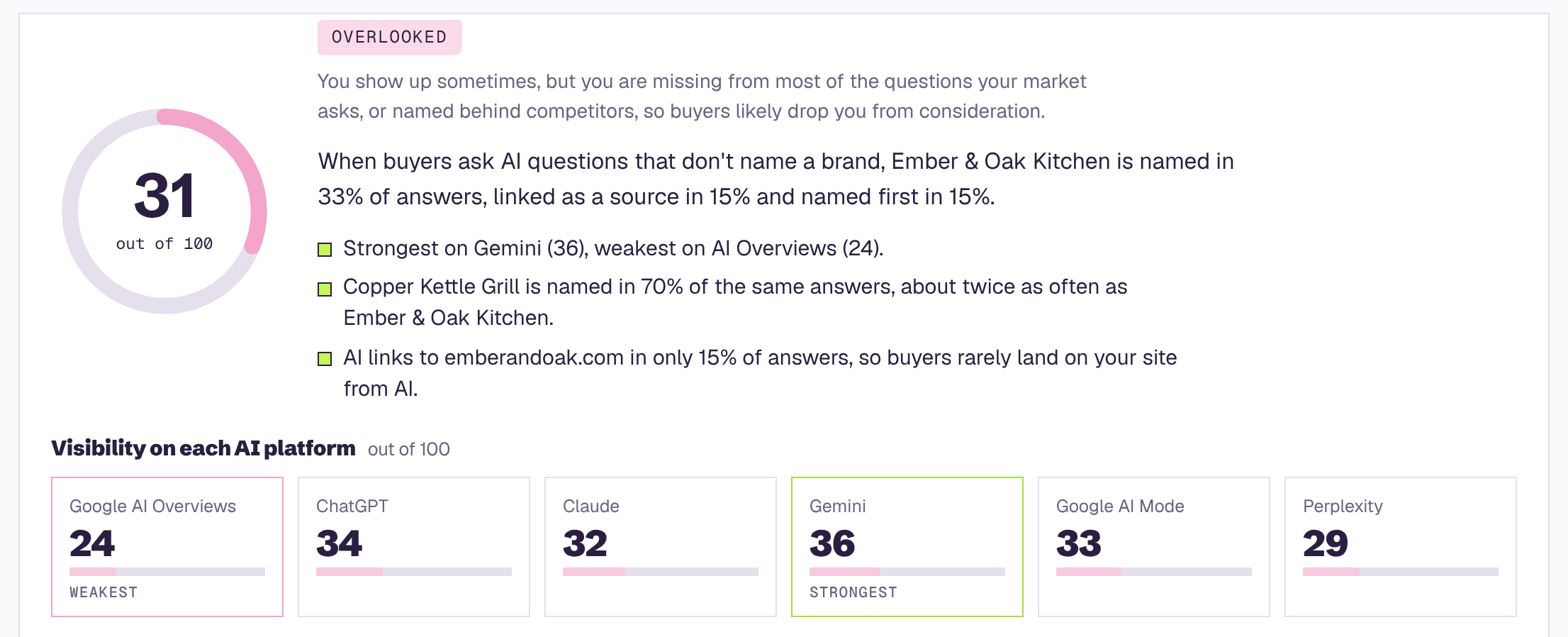

An Overlooked score with 72% accuracy and a 15% citation rate tells a clear story. AI likes Ember & Oak in Denver, but it often gets the facts wrong, rarely sends guests to its website, and barely knows the newer locations exist. The fixes are concrete: correct the reservations fact everywhere it appears, build real pages and local reputation for each location, and own the questions about waits, value and special occasions.
Guests still want somewhere they'll love
Guests have always chosen where to eat, stay and celebrate based on reputation, recommendations and the promise of a great experience. That hasn't changed. What's changed is who they ask first. More and more, it's an AI assistant, and it recommends the places it understands best.
The hospitality businesses that win this shift aren't doing anything exotic. They describe themselves honestly and specifically. They make booking easy. They keep their facts current everywhere. And they make sure what AI says about them is true.
The first step is knowing where you stand today.
Keep learning
- What is AI visibility?
- How to get your business recommended by AI, with guides for ChatGPT, Google AI Overviews, Perplexity, Gemini and Claude
- AI visibility benchmark 2026
- The AI visibility glossary
See what AI tells guests about your business
Enter your website and get a free AI visibility report. It takes a few minutes, and you'll see:
- Your AI visibility score, overall and for ChatGPT, Gemini, Claude, Perplexity and Google's AI Overviews and AI Mode
- Which restaurants, hotels or venues AI recommends instead of you, and how often
- Your visibility in every city you serve, and the competitor AI names most in each one
- What AI gets wrong about you, and what to fix first
- Your biggest gaps: the buyer questions where AI leaves you out, and who it recommends instead
- A downloadable PDF you can share with your team