Contracts, employees and trademarks: how business owners choose a business, employment or IP lawyer through AI
Founders, owners and employees now ask AI how to form a company, protect a brand or handle a workplace dispute. Here's what AI tells them, and how business, employment and IP lawyers get named.
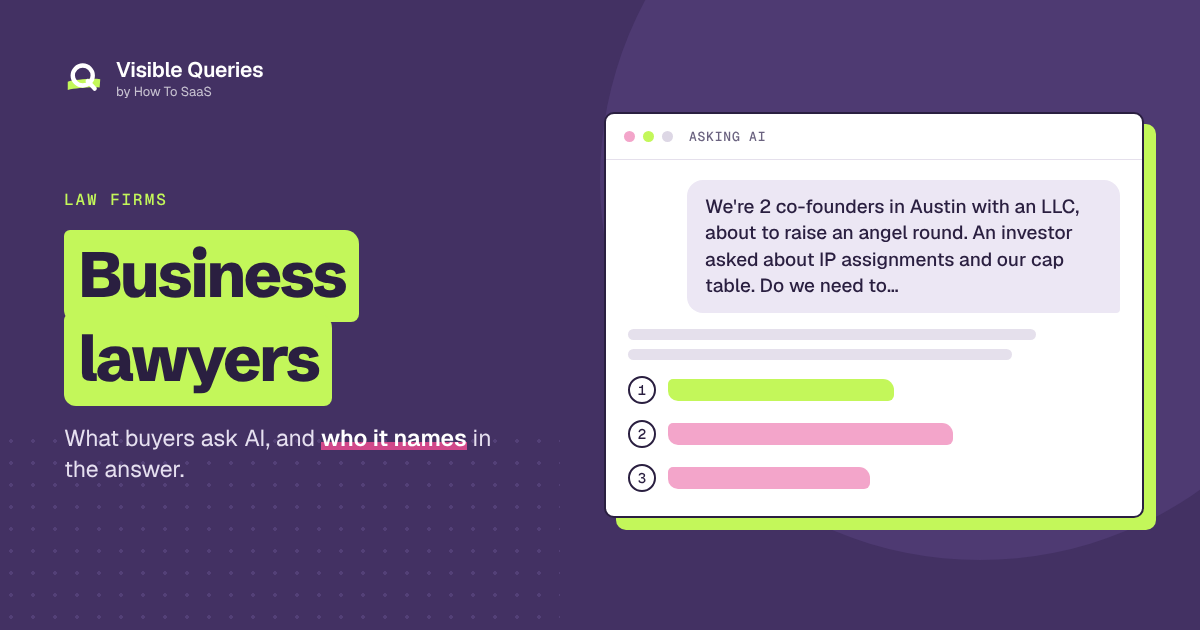
Two co-founders in Austin are about to raise their first round from angel investors. They formed an LLC on a website two years ago, have no founder agreement, and one of their early contractors wrote a lot of the code. An investor just asked about their "cap table and IP assignments." They ask ChatGPT:
"We're 2 co-founders in Austin with an LLC, about to raise an angel round. An investor asked about IP assignments and our cap table. Do we need to convert to a C-corp? What legal work do we need before raising? What do startup lawyers charge, and who's good for early-stage startups in Austin?"
AI explains why many investors prefer certain corporate structures, why founder agreements and IP assignments matter, what typical pre-financing legal cleanup involves, common fee structures for startup lawyers, including fixed-fee packages and deferred fees, and what to look for. It notes that it can't give legal advice. Then it names three firms. The founders book a call with one of them.
Business law covers a lot: forming companies, contracts, financing, buying and selling businesses, employment issues, and protecting intellectual property. The clients range from first-time founders to established companies, and from employers to employees. Many of them now start with AI.
Our legal services guide covers how people choose law firms in general. This one goes through the questions that decide business, employment and IP clients, what AI usually says, and what firms can publish so AI names them.
Here are the questions at a glance:
| The question | What gets you named |
|---|---|
| "LLC or corporation?" | Plain guides to setting up a business |
| "Do I need a lawyer to review this contract?" | When a review is worth it, and what it costs |
| "How much does a business lawyer cost?" | Fee structures and flat-fee services |
| "Was I wrongfully terminated?" | Separate pages for employees and employers |
| "How do I trademark my business name?" | A plain guide to trademarks and patents |
Business law: the questions that decide clients
"LLC or corporation? How do I set up my business?"
What AI usually says: It compares structures by liability protection, taxes, ownership flexibility and investor expectations, and suggests getting advice for anything beyond a simple business.
What to publish: Guides to choosing and setting up a business in your jurisdiction, with who each structure suits.
"Do I need a lawyer to review this contract?"
What AI usually says: It suggests legal review for significant contracts, leases, partnership agreements, acquisitions and financing documents, and lists common risks.
What to publish: Pages for the contracts you review and draft, how you charge for them, and typical turnaround times.
"How much does a business lawyer cost?"
What AI usually says: It explains hourly billing, flat fees and subscription or general counsel arrangements.
What to publish: Your fee structures, packages for common work, and outside general counsel options if you offer them.
Employment law: two different audiences
Employees: "Was I wrongfully terminated?" "Is my employer allowed to do this?"
What AI usually says: It explains general rules, like at-will employment in most US states or reasonable notice in Canada, discrimination and retaliation protections, wage and hour rights, and severance, and suggests talking to an employment lawyer, often noting that many offer free or low-cost consultations or contingency arrangements.
What to publish: Clear guides for employees: wrongful dismissal, severance, discrimination, harassment, wage claims and non-competes, and how you charge.
Employers: "How do I fire someone legally?" "Do I need an employee handbook?"
What to publish: Guides and services for employers: handbooks, terminations, investigations, compliance and disputes. Most firms represent one side or the other, so say clearly which side you're on.
IP law: the questions that decide clients
"How do I trademark my business name?" "Do I need a patent?"
What AI usually says: It explains trademarks, copyrights, patents and trade secrets, typical processes and timelines, and when to hire a lawyer, especially for clearance searches and patents.
What to publish: Guides to each type of protection, your services, flat fees for common filings, and what clients need to prepare.
What the report's headline shows
For many business and IP firms, the report's headline shows a familiar pattern:
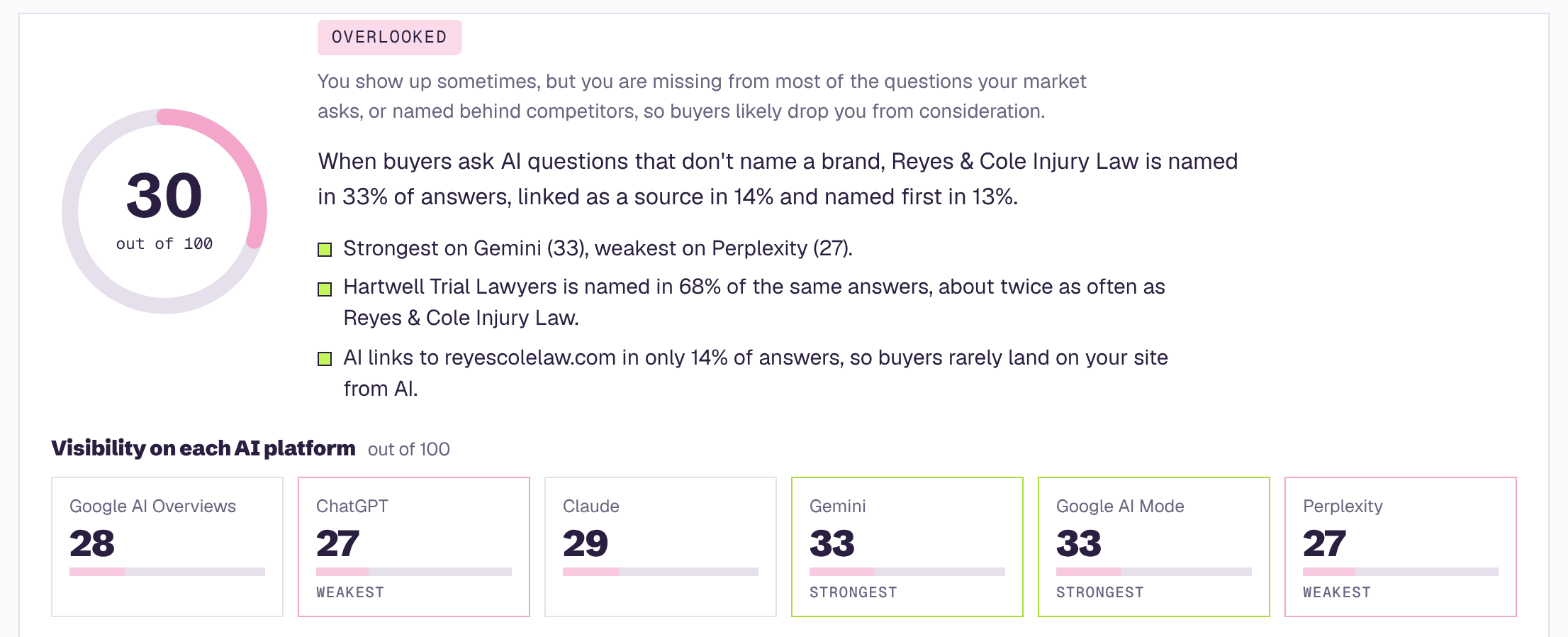
The usual pattern is that AI knows the firm when asked by name, but rarely recommends it when clients ask open questions like "startup lawyer in Austin" or "employment lawyer for severance negotiation." Specific practice and industry pages close that gap.
Here's more from the same kind of report, for Reyes & Cole, a fictional personal injury firm in the Atlanta area.
And it shows the actual questions, platform by platform, with who was named:
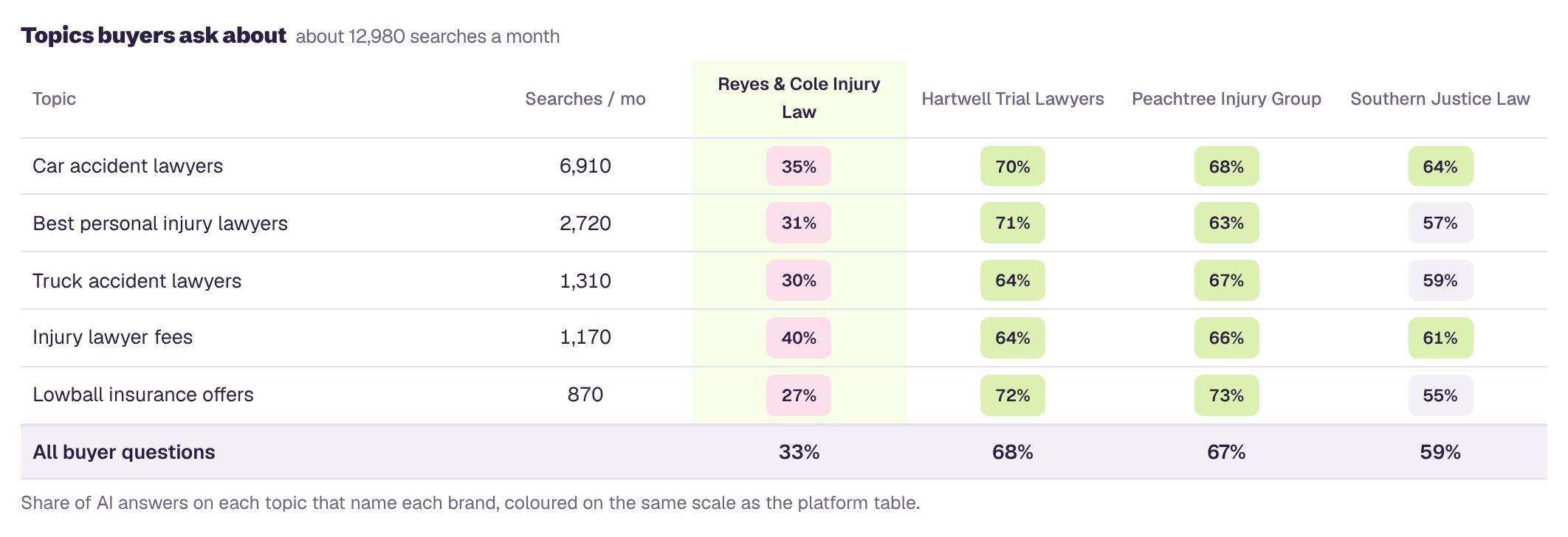
The gap is clearest side by side:
Industries and stages
Business clients search by industry and stage: "lawyer for restaurant owners," "SaaS contract lawyer," "lawyer for buying a dental practice," "M&A lawyer for small businesses," "cannabis business lawyer." Every industry and deal type you serve deserves its own page, with representative work described within your jurisdiction's rules.
If you only fix three things
- Give every practice area and audience its own page. Business, employees, employers and IP.
- Publish fee structures and packages. Flat fees, subscriptions and how you bill.
- Show the industries and stages you serve. With representative work.
Founders, owners and employees are asking AI who can protect them. The firm AI names will be the one that explains its work most specifically.
Part of our guide: Why AI visibility matters for law firms
See what AI tells clients about your firm
Enter your website and get a free AI visibility report. It takes a few minutes, and you'll see:
- Your AI visibility score, overall and for ChatGPT, Gemini, Claude, Perplexity and Google's AI Overviews and AI Mode
- Which firms AI recommends instead of you, and how often
- Your visibility in every city you serve, and the competitor AI names most in each one
- What AI gets wrong about you, and what to fix first
- Your biggest gaps: the buyer questions where AI leaves you out, and who it recommends instead
- A downloadable PDF you can share with your team