How people choose a lawyer now, and why AI visibility decides which firm gets the call
People now ask AI whether they need a lawyer and which firm to call, for injuries, divorces, DUIs, estates, immigration and business issues. Here's how their journey works and how to build a firm AI recommends.
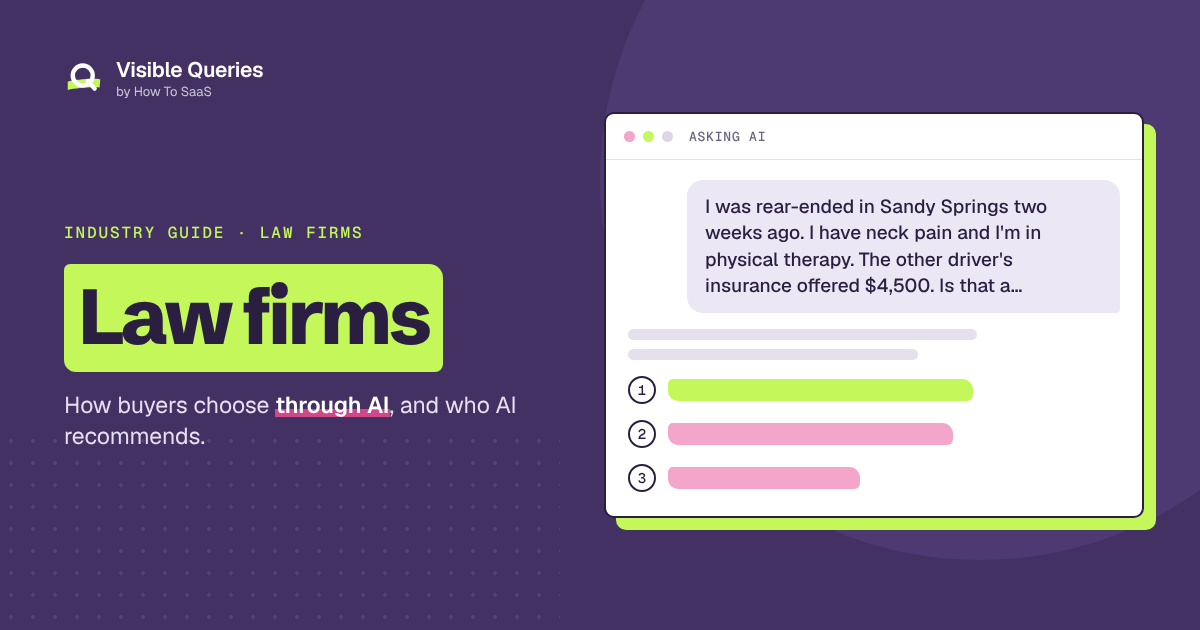
It's two weeks after the accident. The car was rear-ended at a red light on Roswell Road, and it's still in the body shop. The driver's neck and shoulder still hurt, physical therapy is three times a week, and the bills have started to arrive. This morning, the other driver's insurance adjuster called with an offer: $4,500, "to wrap this up quickly." It sounds low. It also sounds like money, and the medical bills are real.
A few years ago, they would have thought of the lawyer on the billboard, or the one from the late-night ad, and called whoever answered.
Tonight, they open ChatGPT and type:
"I was rear-ended in Sandy Springs two weeks ago. I have neck pain and I'm in physical therapy. The other driver's insurance offered $4,500. Is that a lowball offer? Do I need a lawyer, and how much would one cost? Who's good around Atlanta?"
The answer explains that early offers are often made before the full cost of treatment is known, that accepting usually means giving up any future claim, and that most personal injury lawyers work on contingency, so there's no upfront cost. It suggests what to document and what not to say to the adjuster. Then it names three Atlanta-area firms, with a line on each.
They call the first one the next morning.
That's how a growing share of people now find lawyers, for car accidents, divorces, custody disputes, DUIs, wills and trusts, visas and green cards, contracts, employment disputes and business problems. They describe what happened, what they're worried about and what they can afford, and AI gives them a short list. The firms on that list get the consultation. The rest never hear about the case.
This article walks through how people choose a lawyer today, step by step, with examples from personal injury, family and divorce, criminal defense and DUI, estate planning, immigration, and business, employment and IP law. It covers what people ask AI at each step, what makes AI recommend one firm over another, and what the firms that keep getting recommended tend to do differently. Most of it comes down to being a firm that's clear about what it does, what it costs and how it treats clients.
Along the way you'll see screenshots from a Visible Queries report for Reyes & Cole Injury Law, a sample personal injury firm in the Atlanta area. The firm and its competitors are made up, but the report is real. It's exactly what any firm sees when it runs its own.
Why the old playbook isn't enough anymore
Law firms have always grown on referrals and reputation: past clients, other lawyers who refer cases, community ties, and, for some practice areas, a lot of advertising. Marketing filled in with a website, directory listings, Google reviews, search ads, and in personal injury, billboards and TV.
All of that still matters. But more and more, the first "lawyer" someone talks to is an AI assistant. It's free, it's available at 11 p.m., and it doesn't make them feel judged. People tell it things they'd hesitate to tell a stranger on the phone.
Three things follow from that:
- People describe what happened, not a practice area. "I was rear-ended and the insurance offer seems low" or "my ex won't follow the custody schedule" gets firms that clearly handle that situation. A generic "full-service law firm" page matches nothing in particular.
- The shortlist is tiny. A search shows dozens of firms and pages of ads. An AI answer names three. Those three get the calls.
- Your reputation is summarized, including how you charge. People ask "Does [firm] charge upfront? Are they good at trial?" and get a short answer drawn from your website, reviews, directories and anything else AI can find.
None of this replaces referrals or results. They're exactly what AI reads. What's changed is that your reputation now has to be written down clearly enough for AI to repeat it correctly, before a potential client ever calls.
The client's journey, step by step
Whether it's a $500 flat-fee will, a DUI defense, a contested divorce or a contingency injury case, the path looks similar. What changes is how urgent it is and how emotional it feels.
- Something happens. An accident, an arrest, a separation, a death in the family, a visa deadline, a dispute.
- They try to understand where they stand. Their rights, their options and whether they need a lawyer at all.
- They build a shortlist. Which firms nearby handle their kind of case.
- They check who to trust. Experience, results, reviews, fees and how the firm treats clients.
- They choose. Consultations, fee agreements, availability and fit.
- They stay, or they don't, and they talk. Communication during the case, the outcome, reviews and referrals.
AI now shows up at every one of these steps. Here's what that looks like.
Step 1: Something happens
Nobody wakes up wanting a lawyer. Something happens first, and usually it's stressful.
- A car accident, a fall, a dog bite or an injury at work.
- An arrest, a DUI stop or a letter from a prosecutor.
- A separation, a divorce filing or a custody disagreement.
- A parent's death, a diagnosis, a new baby or a new marriage that makes estate planning urgent.
- A visa expiring, a job offer abroad or a family member who wants to immigrate.
- A business partner dispute, an unpaid invoice, a firing that felt wrong, or a competitor copying a product.
The first questions people ask AI are about the situation, not about you. "Can I handle a car accident claim on my own?" "What happens at a first DUI court date in Georgia?" "How is child custody decided?" "Do I need a will if I don't have much money?"
This is the moment that decides whether anyone hires a lawyer at all. If AI explains that early insurance offers are often low and that most injury lawyers work on contingency, the person starts looking for a lawyer. If it tells them small claims are usually easy to handle alone, no firm gets the call.
The firms that do well at this step publish clear, honest, useful answers to the questions people ask right after something happens. An injury firm with a plain-language guide to what to do in the first two weeks after a crash. A family law firm with an honest explanation of how custody is decided in their state. A DUI firm with a step-by-step page on what happens after an arrest. An estate planning firm with a page on who really needs a trust.
AI relies on content like that when it explains a situation, because it's specific, local and written by people who handle these cases. Once your explanation shapes the answer, your firm tends to follow.
What good firms do at this step:
- Write about the situations that bring clients in, in the words people actually use.
- Be honest about when someone doesn't need a lawyer. It builds the kind of trust that gets you recommended when they do.
- Make it local. Laws, deadlines and courts vary by state and county, and AI favors firms that explain how things work where the client lives.
Step 2: They try to understand where they stand
Next, people try to understand their rights and options. This is where they're most open, and where AI does most of the teaching.
- "Should I hire a lawyer instead of handling my accident claim myself?"
- "Mediation vs litigation for a divorce: which is cheaper?"
- "Will a first DUI mean jail time in Georgia?"
- "Will vs living trust: which do I need?"
- "Can my employer fire me for reporting harassment?"
- "How much does a lawyer cost for [situation]?"
This is where people decide whether they need a lawyer and what kind, and that decides which firms are even in the running.
Here's what this step looks like in a real report. These are questions AI was asked about personal injury lawyers in the Atlanta area, and who each platform named in its answer:
Look at where the sample firm wins and where it loses. On "Why does the insurance company keep lowballing my accident claim?", three of the four platforms mentioned Reyes & Cole. That's good. But on "Can I handle a car accident claim on my own?" and "Should I hire a lawyer instead of handling my accident claim myself?", every platform named a competitor, mostly Peachtree Injury Group and Hartwell Trial Lawyers.
Those two questions are the moment someone decides to hire a lawyer. They're the most valuable questions in the whole journey, and Reyes & Cole is absent from every answer. The firm that shows up when someone asks "do I need a lawyer?" is very often the firm they call.
What moves a firm into these answers is the same thing that helps someone understand their situation:
- Clear, honest explanations of when a lawyer helps and when it doesn't, for each kind of case you handle.
- Plain fee information. "Contingency fee, no upfront cost, and you pay nothing if we don't recover," "flat fee for wills starting at...," or "typical retainer for an uncontested divorce." People ask about cost constantly.
- What the process looks like and how long it usually takes, with honest caveats.
What good firms do at this step:
- Publish "do I need a lawyer for this?" content for every kind of case you take, and answer it honestly.
- State how you charge, clearly, on every practice-area page.
- Explain the process in plain language, with realistic timelines.
Step 3: They build a shortlist
Once people decide they need a lawyer, they look for specific firms. Law is local. People want a lawyer who knows their county's courts, judges and procedures, and who they can meet in person if needed.
The questions get specific:
- "Best car accident lawyer in Marietta."
- "Divorce lawyer in Decatur who handles high-conflict custody cases."
- "DUI lawyer near Sandy Springs who's a former prosecutor."
- "Estate planning attorney in Atlanta who does flat-fee trusts."
- "Immigration lawyer in Atlanta for an H-1B to green card."
For firms with more than one office, this is where gaps show. Here's the sample firm across the four cities it serves:
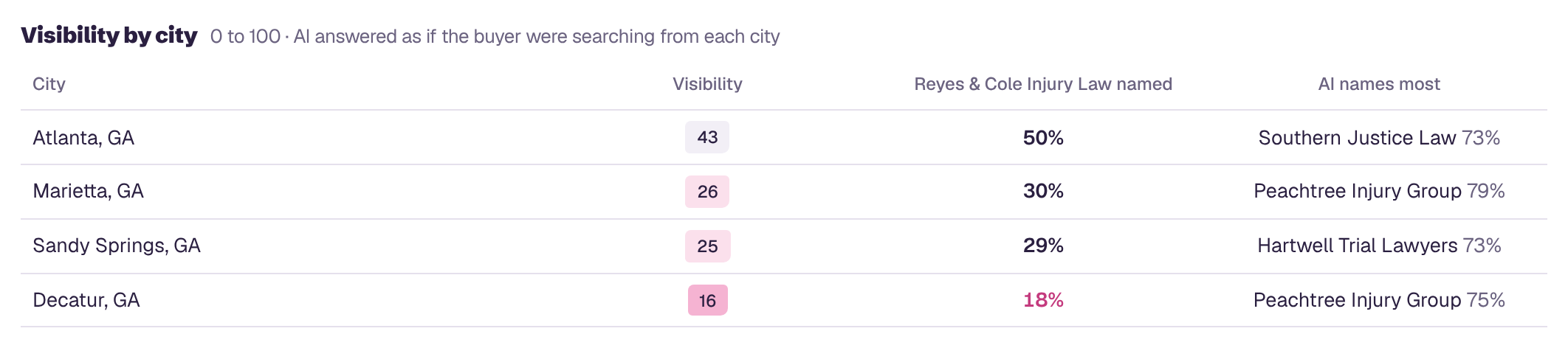
In Atlanta, Reyes & Cole scores 43 and is named in half of answers, while Southern Justice Law is named in 73%. In Marietta it scores 26 and is named in 30%, with Peachtree Injury Group named in 79%. In Sandy Springs, where the driver in the opening example was hit, it scores 25 and is named in 29% of answers. In Decatur it scores 16, named in just 18%.
That pattern is common. A firm's main office has years of results, reviews, press and referrals. Its other offices have an address and a phone number. AI can't recommend an office it knows nothing about.
What good firms do at this step:
- Give each office a real page: the lawyers who work there, the courts they appear in, the cases they handle and reviews from local clients.
- Write about local specifics: the county courts, local procedures, dangerous intersections or common local case types.
- Be specific about your focus. "Trucking accidents," "high-conflict custody," "former prosecutor" and "flat-fee trusts" get recommended for specific questions. "We handle all types of cases" rarely does.
Step 4: They check who to trust
Hiring a lawyer is a big decision made at a bad moment. People are injured, scared, grieving or angry, and they're about to trust a stranger with something that matters enormously. So they check.
- "Is [firm] good? What do clients say?"
- "Does [firm] actually go to trial, or do they settle everything?"
- "How does [firm] charge? Is there an upfront retainer?"
- "Will I talk to the lawyer or just a case manager?"
- "Has [lawyer] been disciplined by the state bar?"
AI answers these in a couple of sentences. When it's accurate, that's a strong endorsement from a source people trust. When it's wrong, the damage is quiet: the person simply calls another firm.
Here's what that looks like in the sample report:
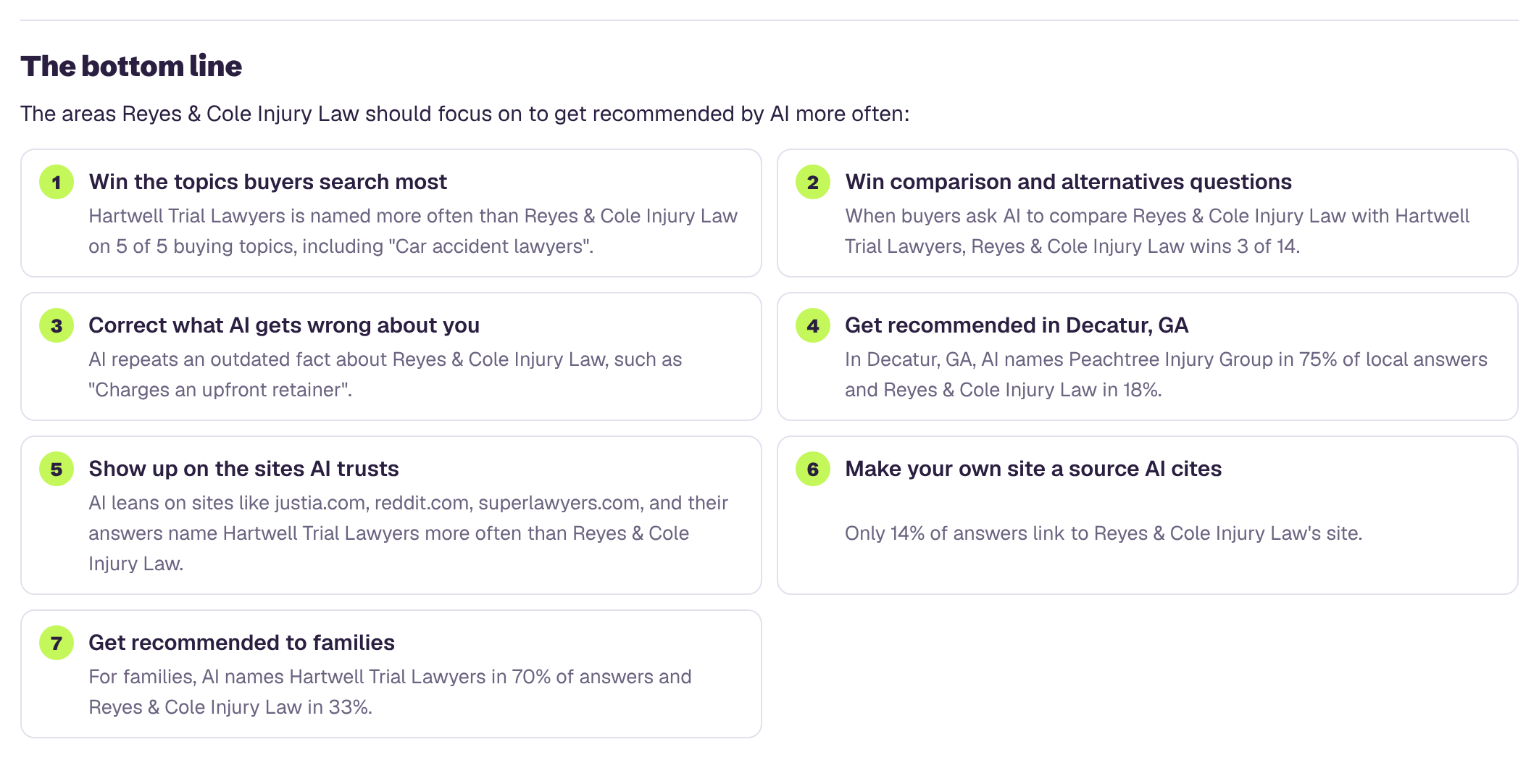
The first gap goes straight to the biggest worry injured people have: cost. AI tells people that Reyes & Cole "charges an upfront retainer." In reality, it works on contingency, with no upfront cost. Someone already worried about medical bills hears that and moves on.
The report also shows Reyes & Cole named in only 19% of "best personal injury lawyers" answers, and Hartwell Trial Lawyers named instead in 47% of buyer questions, including "Why does the insurance company keep lowballing my accident claim?" Overall accuracy is 71%. Nearly three in ten facts AI states about the firm are wrong, and the wrong ones are about money.
Wrong facts about law firms usually come from a few places:
- History. A firm that used to handle other practice areas, changed its name, split from a partner or changed how it charges.
- Directories and legal marketplaces with old or generic profiles.
- Confusion with similar names, which is common when many firms share a surname.
- Silence. If you never state how you charge, who handles the case and what your experience is, AI fills the gap with whatever it can find.
What good firms do at this step:
- State the trust facts in one place: how you charge, who works on the case, your lawyers' experience and bar admissions, and how clients reach you.
- Share results the way your state's advertising rules allow, with the context those rules require.
- Keep every directory and profile consistent with your website.
- Ask satisfied clients for reviews that mention specifics, like communication, how they were treated and how the case was handled.
Step 5: They choose
By now, the person usually has two or three firms in mind. They're comparing the details that decide it:
- "Reyes & Cole vs Hartwell Trial Lawyers for a rear-end collision?"
- "Which Atlanta injury lawyers offer free consultations this week?"
- "What percentage do personal injury lawyers take in Georgia?"
- "Does [firm] handle cases in Spanish?"
- "Can I meet [lawyer] in person or is it all by phone?"
Head-to-head questions are where share of voice matters most. If someone asks AI to compare you with a competitor and AI has far more to say about the competitor, the competitor tends to win.
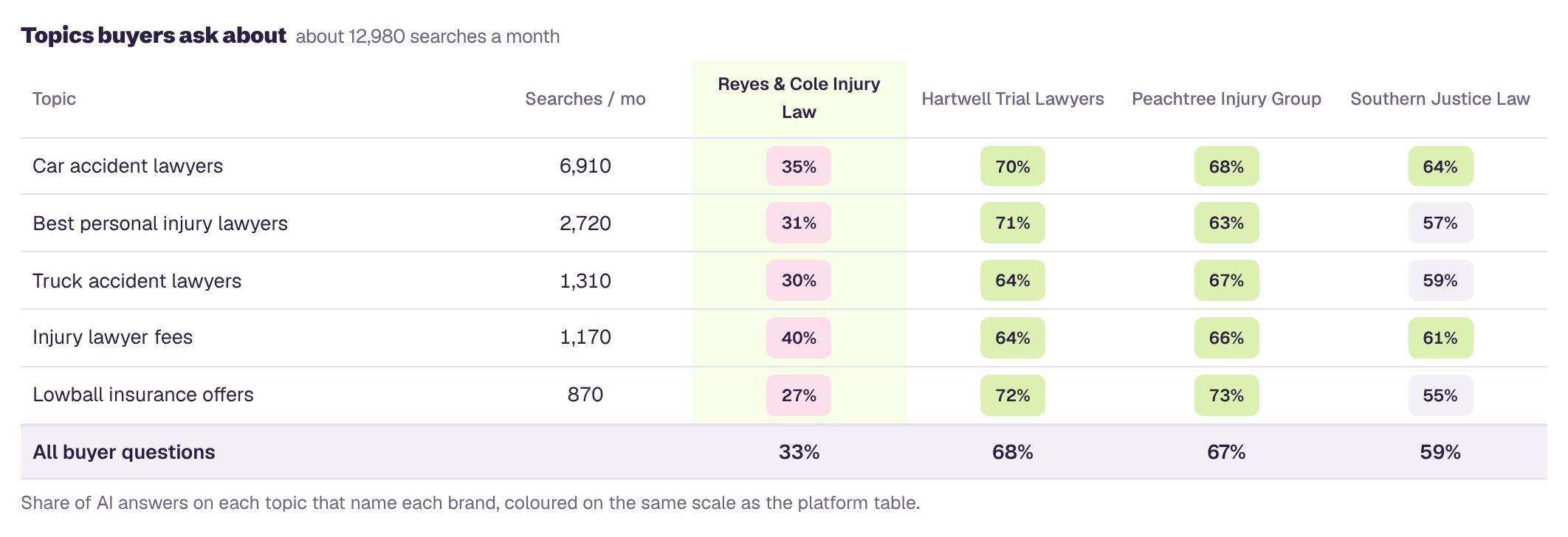
In the sample report, Hartwell Trial Lawyers is named in 68% of answers, Peachtree Injury Group in 67% and Southern Justice Law in 59%. Reyes & Cole is named in 33%. Reyes & Cole scores 30 overall, in the Overlooked band, and is the fourth name in most conversations about injury lawyers in the region.
The firms that win at this step make the decision easy:
- A clear, fast first step. A free consultation with online booking, evening availability, and a promise of how quickly someone will call back.
- Fees in plain words. Contingency percentages, flat fees or typical retainers, and what costs the client might owe either way.
- What happens next. What to bring to the consultation, what the first month of the case looks like, and how often the client will hear from the firm.
- Real differences, named. Trial experience, languages spoken, a focus on one type of case, or a lawyer who answers their own phone. Say so plainly.
What good firms do at this step:
- Make the consultation easy to book and quick to happen.
- Publish a fair comparison of your approach with the alternatives, like handling it alone or using a larger advertising firm. People are already asking AI to compare.
- Keep fees, availability and languages current everywhere.
Step 6: They stay, or they don't, and they talk
Most legal clients don't come back often. But they talk, and in law, referrals and reviews are the lifeblood of a practice. A happy injury client tells everyone at work. A family law client who felt supported through a divorce refers friends going through the same thing. An estate planning client returns for updates and sends their adult children.
Clients ask AI questions during their case, too:
- "Is it normal for a personal injury case to take a year?"
- "My lawyer hasn't called me back in two weeks. Should I switch?"
- "Can I change divorce lawyers in the middle of a case?"
- "Is my settlement offer fair?"
If those answers make clients doubt you, you risk losing the case and the referral. The firms that keep clients happy publish for them too: realistic timelines, what happens at each stage, how communication works and what to expect at the end.
And when clients feel well represented, they say so, in reviews, in community groups and to friends. That's exactly what AI reads when it decides which firms to recommend next.
What good firms do at this step:
- Set expectations in writing about timelines, communication and what happens at each stage.
- Communicate proactively. Most negative reviews of law firms are about communication, not results.
- Ask for reviews at the natural end of a matter, where your state's rules allow.
How the journey plays out across legal services
The six steps are the same everywhere, but what people ask, and what decides the choice, varies a lot by practice area.
Personal injury lawyers
This is the journey in the example above. It's urgent, emotional and heavily advertised. People ask: "Do I need a lawyer after a car accident?" "What percentage do injury lawyers take?" "How long does a settlement take?" "Best truck accident lawyer near me."
Because the category is so crowded with advertising, AI leans hard on specifics: the types of cases a firm handles, how it charges, trial experience, local presence, and reviews that mention communication. Firms that explain the process honestly, including when a case isn't worth pursuing, tend to earn recommendations that billboards can't buy.
Full guide: AI visibility for personal injury lawyers
Family and divorce lawyers
Family law clients are often in the hardest period of their lives. They ask: "How much does a divorce cost in Georgia?" "Mediation vs going to court," "how is custody decided," "can I move out of state with my kids?"
AI recommends firms that are clear about their approach (collaborative, mediation-friendly or litigation-ready), the kinds of cases they handle (high-asset, high-conflict, military, same-sex couples), typical costs and retainers, and how they support clients emotionally as well as legally. Reviews that describe how a lawyer made a hard time easier carry real weight.
Full guide: AI visibility for family and divorce lawyers
Criminal defense and DUI lawyers
Criminal defense searches are urgent, often happening the night of an arrest or the morning after. People ask: "What happens after a first DUI in Georgia?" "Do I need a lawyer for a misdemeanor?" "Can a DUI be reduced?" "Best DUI lawyer near Marietta."
AI favors firms that explain the process in plain language, are clear about fees (often flat fees by charge type), highlight relevant experience like former prosecutors or DUI-specific training, and make it easy to reach someone quickly, including after hours. Clear, calm content helps scared people take the next step.
Full guide: AI visibility for criminal defense and DUI lawyers
Estate planning lawyers
Estate planning journeys are often triggered by a life event: a new baby, a diagnosis, a death in the family or a big purchase. People ask: "Will vs trust," "how much does a living trust cost," "do I need an estate plan if I'm not rich," "what happens if I die without a will in Georgia?"
Firms that get recommended publish flat-fee pricing where they can, explain the documents in plain language, describe the process from first meeting to signing, and say who they serve best: young families, blended families, business owners or retirees. Firms that also handle probate and trust administration should say so clearly, because those are separate searches with a lot of demand.
Full guide: AI visibility for estate planning lawyers
Immigration lawyers
Immigration clients face deadlines, high stakes and complicated rules, often in a second language. They ask: "H-1B to green card timeline," "how to sponsor my spouse," "do I need a lawyer for citizenship," "what happens if my visa expires?"
AI recommends firms that are specific about the case types they handle (family, employment, asylum, removal defense, business immigration), explain the steps and typical timelines, are transparent about fees, and say which languages they work in. Immigration fraud is a real concern, so clear credentials and bar admissions matter even more here.
Full guide: AI visibility for immigration lawyers
Business, employment and IP lawyers
Here the client is usually a business owner, a founder or an employee, and the journey is more analytical. Owners ask: "Do I need a lawyer to form an LLC?" "How to protect a brand name," "what should be in a partnership agreement?" Employees ask: "Was I wrongfully terminated?" "Is my non-compete enforceable?"
Firms that get recommended are clear about who they represent (businesses or employees, startups or established companies), their focus areas, and how they charge, whether that's flat fees, hourly or contingency for some employment cases. Practical guides to common business situations earn citations and trust. The same applies to related practices like bankruptcy and real estate law: the more specific and honest the content, the more often AI recommends the firm.
Full guide: AI visibility for business, employment and IP lawyers
Building a law firm AI recommends
Across every practice area, the firms AI keeps recommending share the same habits. None of them are tricks. They're what well-run firms already do, written down clearly enough for a potential client, or an AI, to understand.
- Be specific about what you handle. Case types, client types, courts and situations. Specific firms get recommended. "We do it all" firms get passed over.
- Answer the questions people ask right after something happens. Honestly, locally and in plain language.
- Be clear about cost. Contingency terms, flat fees, typical retainers and what the client might owe.
- Show who does the work. Lawyers' experience, bar admissions, focus areas and who the client will actually talk to.
- Fix wrong facts fast. One wrong line about how you charge can cost you every cost-conscious client who hears it.
- Give every office its own page. Lawyers, local courts, local case types and local reviews.
- Keep every listing consistent. Website, directories, legal marketplaces and profiles should all tell the same story.
- Make the first step easy. Fast consultations, online booking and quick callbacks, including after hours where it matters.
- Communicate during the case. Most bad reviews are about silence, not outcomes.
- Build reputation on purpose, within the rules. Reviews, referrals, community involvement and local media, all within your state bar's advertising rules.
You can see how much these habits matter in the full report. Here's the sample firm's overall score and the metrics behind it:
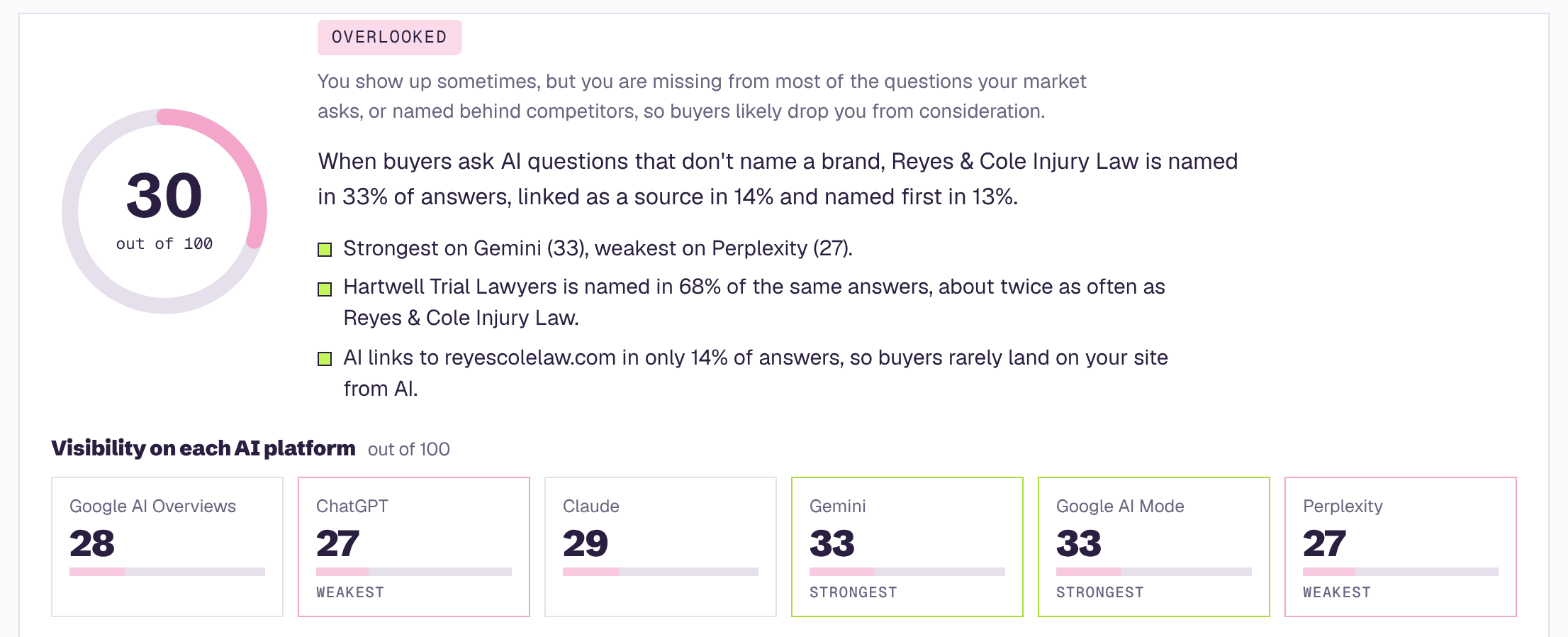

An Overlooked score with 70% accuracy and a 14% citation rate tells a clear story. AI knows the firm, but it often gets the facts wrong and rarely points people to the firm's own website. Competitors are named first and more often, especially on the "do I need a lawyer?" questions that start every case. The fixes are concrete: correct the contingency fee fact everywhere it appears, own the "should I hire a lawyer" questions with honest content, and build real pages and reviews for each office.
People still want a lawyer they can trust
People have always chosen lawyers on trust, reputation and referrals. That hasn't changed. What's changed is who they ask first. More and more, it's an AI assistant, and it recommends the firms it understands best.
The firms that win this shift aren't doing anything exotic. They're clear about what they handle and what it costs. They answer real questions honestly. They keep their facts consistent everywhere. And they make sure what AI says about them is true.
The first step is knowing where you stand today.
Keep learning
- What is AI visibility?
- How to get your business recommended by AI, with guides for ChatGPT, Google AI Overviews, Perplexity, Gemini and Claude
- AI visibility benchmark 2026
- The AI visibility glossary
See what AI tells people about your firm
Enter your website and get a free AI visibility report. It takes a few minutes, and you'll see:
- Your AI visibility score, overall and for ChatGPT, Gemini, Claude, Perplexity and Google's AI Overviews and AI Mode
- Which firms AI recommends instead of you, and how often
- Your visibility in every city you serve, and the competitor AI names most in each one
- What AI gets wrong about you, and what to fix first
- Your biggest gaps: the buyer questions where AI leaves you out, and who it recommends instead
- A downloadable PDF you can share with your team