Divorce, custody and starting over: how people choose a family lawyer through AI
People now ask AI how divorce works, what it costs and whether mediation or litigation fits. Here's what AI tells them, and how family and divorce lawyers get named.
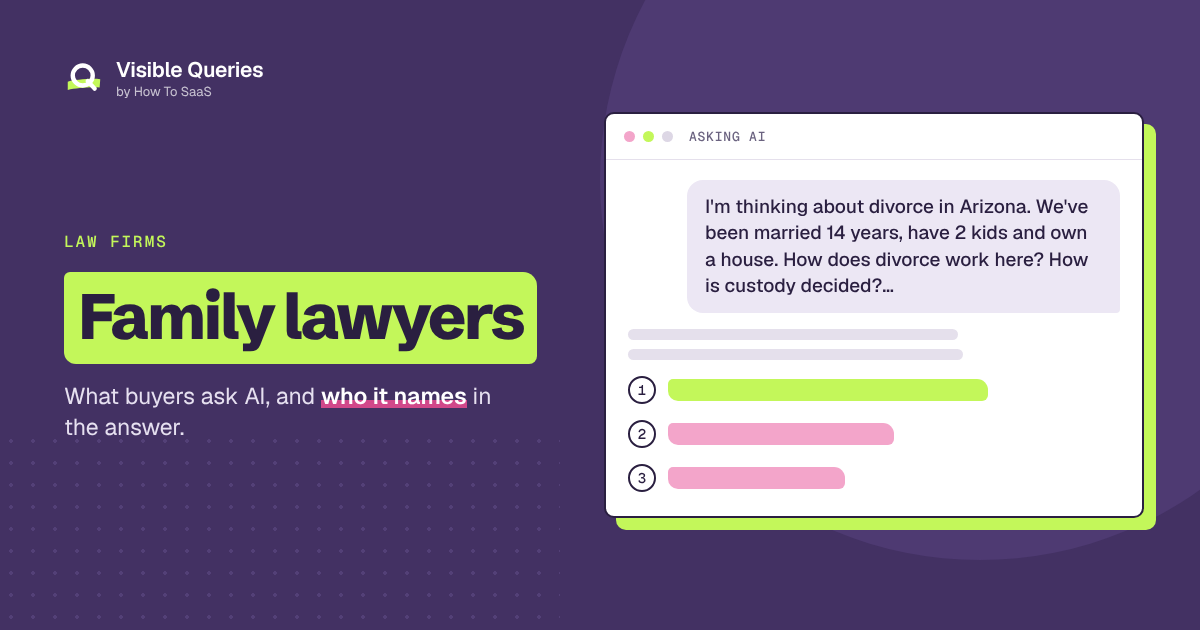
Someone in Scottsdale has been married for 14 years and has two kids, ages 8 and 11. Late one night, after the kids are asleep, they finally ask the question they've been thinking about for a year:
"I'm thinking about divorce in Arizona. We've been married 14 years, have 2 kids and own a house. How does divorce work here? How is custody decided? Should we try mediation? What does a divorce lawyer cost, and how do I find one in Scottsdale who isn't overly aggressive?"
AI explains the general divorce process in the state, how parenting time and decision-making are usually decided based on the children's best interests, how property is typically divided, the differences between mediation, collaborative divorce and litigation, typical cost ranges and retainers, and questions to ask a lawyer. It notes that it can't give legal advice. Then it names three local family law firms. One gets a consultation request the next morning.
Family law clients are going through some of the hardest moments of their lives. They're scared about their kids, their money and their future. They often research privately for months before calling anyone, and AI has become a place they ask the questions they're not ready to say out loud.
Our legal services guide covers how people choose law firms in general. This one goes through the questions that decide family law clients, what AI usually says, and what firms can publish so AI names them.
Here are the questions at a glance:
| The question | What gets you named |
|---|---|
| "How does divorce work here?" | A plain guide to the process in your state or province |
| "How is custody decided?" | How courts decide, explained calmly |
| "Mediation, collaborative or litigation?" | Which approaches you offer and when each fits |
| "How much does a divorce lawyer cost?" | Fee structures and typical ranges |
| "Family lawyer for [situation]" | Pages for the situations you handle |
"How does divorce work here?"
What AI usually says: It outlines the process in the person's state or province: filing, waiting periods, disclosure, temporary orders, negotiation or trial, and final decrees.
What to publish: A plain, step-by-step guide to divorce in your jurisdiction, with timelines and what clients do at each step. Local specificity is what makes AI cite you.
"How is custody decided?"
What AI usually says: It explains that decisions are based on the best interests of the children and lists common factors.
What to publish: Guides to parenting plans, custody and parenting time, relocation, modifications and how you help parents put children first.
"Mediation, collaborative or litigation?"
This is the defining question for the category.
What AI usually says: It compares cost, time, control, privacy and conflict for each path, and says mediation or collaborative divorce can work well when both people can cooperate, while litigation may be necessary in high-conflict cases or where there are safety concerns.
What to publish: Your approach and which paths you offer, with honest guidance on when each fits. Many people specifically search for "non-aggressive divorce lawyers" or "collaborative divorce attorneys." If that's you, say so clearly.
"How much does a divorce lawyer cost?"
What AI usually says: It explains hourly billing, retainers, flat-fee options for uncontested divorces, and what drives cost, like conflict, complexity and whether the case goes to trial.
What to publish: How you bill, typical retainers, flat-fee services if you offer them, and how clients can keep costs down. Cost fear is one of the biggest reasons people delay.
"Family lawyer for [specific situation]"
Specific questions are where firms get named:
- "Divorce lawyer for high-net-worth divorces."
- "Lawyer for fathers' custody rights."
- "Divorce with a business to divide."
- "Military divorce lawyer."
- "LGBTQ+ family lawyer."
- "Lawyer for grandparents' visitation."
- "Prenuptial agreement lawyer."
Each one you truly handle deserves its own page.
Which topics AI gives to competitors
Here's how the report shows which topics a firm wins and loses:
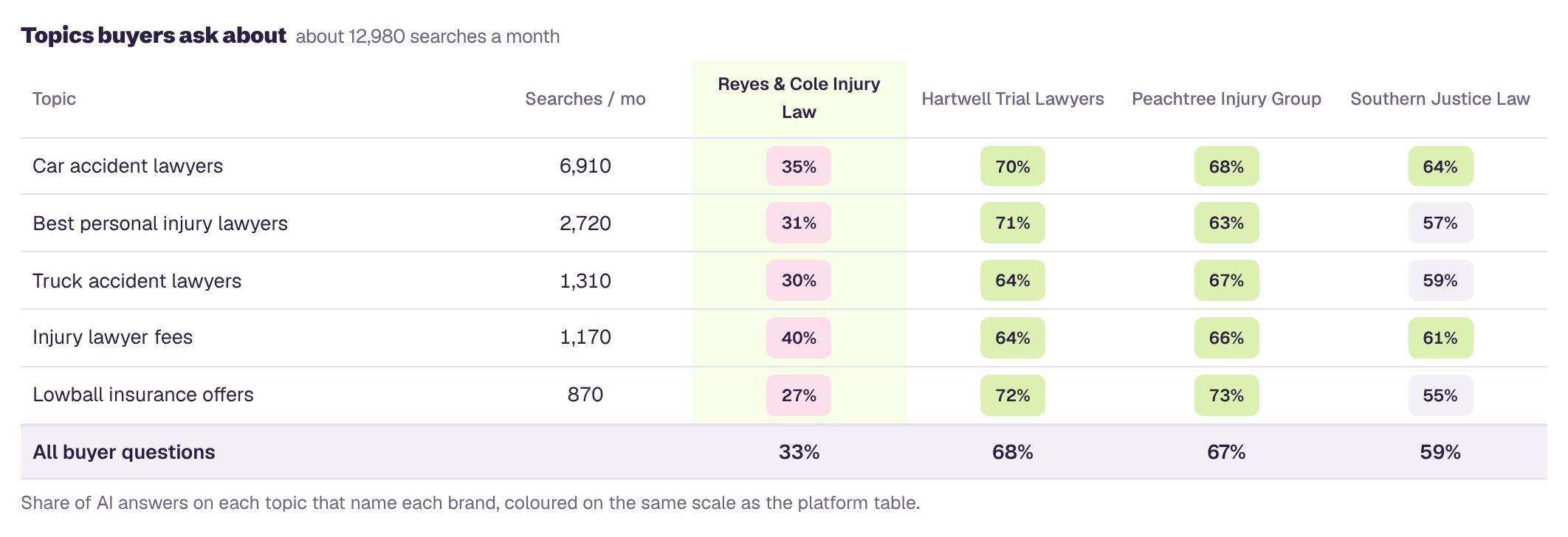
For family law, the topics to watch are often the "approach" questions: "collaborative divorce lawyer," "lawyer who isn't aggressive," "mediator for divorce." That's where people with specific needs choose.
Here's more from the same kind of report, for Reyes & Cole, a fictional personal injury firm in the Atlanta area.
For a business that serves more than one city, the report checks each one separately:
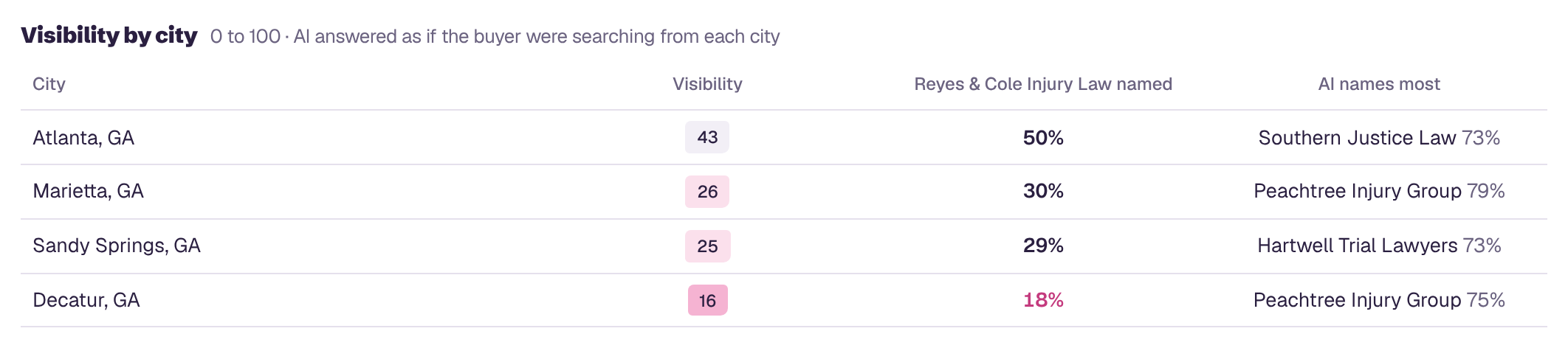
The gap is clearest side by side:
Tone matters
People in family law situations are sensitive to tone. Pages that sound combative, like "we fight to win," can turn away clients looking for a calmer path, while pages that sound too soft can turn away people facing a hostile spouse. Be clear about your approach, and let clients choose. AI picks up on how firms describe themselves.
Safety
Some family law clients face domestic violence. They ask AI about protective orders, emergency custody and how to leave safely. If you handle these cases, publish clear, careful pages, and include safety resources. AI points people to crisis resources first, and to firms that clearly and responsibly handle these cases.
If you only fix three things
- Explain the process in your jurisdiction, step by step. Divorce, custody and support.
- Be clear about your approach and fees. Mediation, collaborative or litigation, and how you bill.
- Give every specific situation its own page. High-asset, military, business owners, prenups and more.
People are asking AI how to get through the hardest change of their lives. The family lawyer AI names will be the one that answers those questions with clarity and care.
Part of our guide: Why AI visibility matters for law firms
See what AI tells people about your family law practice
Enter your website and get a free AI visibility report. It takes a few minutes, and you'll see:
- Your AI visibility score, overall and for ChatGPT, Gemini, Claude, Perplexity and Google's AI Overviews and AI Mode
- Which firms AI recommends instead of you, and how often
- Your visibility in every city you serve, and the competitor AI names most in each one
- What AI gets wrong about you, and what to fix first
- Your biggest gaps: the buyer questions where AI leaves you out, and who it recommends instead
- A downloadable PDF you can share with your team