Arrested last night: how people choose a criminal defense or DUI lawyer through AI
People now ask AI what happens after an arrest, whether they need a lawyer for a DUI and what defense will cost. Here's what AI tells them, and how criminal defense and DUI lawyers get named.
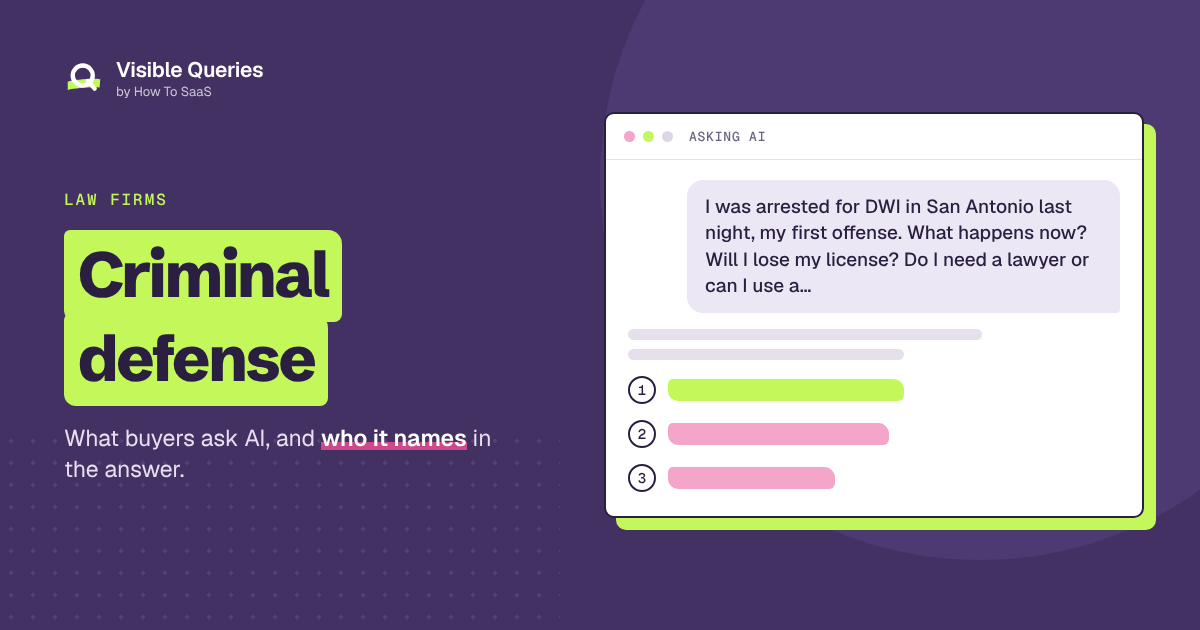
A 34-year-old sales manager in San Antonio was pulled over after a work dinner and arrested for DWI. They were released this morning. They have a court date, their license paperwork is confusing, and they're terrified about losing their job, which requires driving. Sitting in their car, they ask ChatGPT:
"I was arrested for DWI in San Antonio last night, my first offense. What happens now? Will I lose my license? Do I need a lawyer or can I use a public defender? What does a DWI lawyer cost, and how do I find a good one in San Antonio fast?"
AI explains the general process after a DWI arrest, that there are usually two tracks (the criminal case and a separate license proceeding with a short deadline to request a hearing), the possible consequences of a first offense, the differences between public defenders and private lawyers, typical fee structures, and what to look for. It says to contact a lawyer quickly because of deadlines and notes that it can't give legal advice. Then it names three local firms. The person calls the first one before leaving the parking lot.
Criminal defense clients are scared, ashamed and in a hurry. They often have deadlines measured in days. They research privately, at odd hours, and they want someone who knows the local courts. AI is increasingly where that search begins.
Our legal services guide covers how people choose law firms in general. This one goes through the questions that decide criminal defense clients, what AI usually says, and what firms can publish so AI names them.
Here are the questions at a glance:
| The question | What gets you named |
|---|---|
| "What happens now?" | A plain guide to the next steps after an arrest |
| "Public defender or private?" | An honest comparison |
| "How much does a lawyer cost?" | Fee structures by charge type |
| "Will I lose my license? Go to jail?" | Realistic outcomes, explained carefully |
| "DUI lawyer near me" | A page for each charge you defend |
"What happens now?"
What AI usually says: It explains the general steps after an arrest in the person's jurisdiction: release conditions, arraignment, discovery, plea negotiations and trial. It emphasizes talking to a lawyer and not discussing the case with others.
What to publish: Clear, local guides to the criminal process, for each type of charge you handle, written for someone who's just been arrested. Calm, accurate, local information is what AI cites.
"Do I need a lawyer? Public defender or private?"
This is the defining question for the category.
What AI usually says: It explains the right to counsel, how public defenders are appointed, their workloads, and when people choose private lawyers. It doesn't disparage public defenders.
What to publish: An honest explanation of what a private defense lawyer does differently, like time, investigation and availability, without criticizing public defenders. Be specific about what you do in the first days of a case.
"How much does a criminal defense lawyer cost?"
What AI usually says: It explains flat fees and hourly billing, and what drives cost, like the charge, complexity and whether the case goes to trial.
What to publish: How you charge, typical fee ranges by charge type if your rules allow, payment plans and what's included. Cost uncertainty keeps people from calling.
"Will I lose my license? Will I go to jail? Will this show up on background checks?"
What AI usually says: It explains possible consequences in general terms, the separate license process for DUIs, and options like diversion programs, expungement or record sealing where available.
What to publish: Guides to consequences and options for each charge, including license hearings, diversion, expungement and immigration consequences for non-citizens. These questions keep people up at night, and firms that answer them clearly get the call.
"DUI lawyer near me"
What AI usually says: It names firms that clearly handle DUI cases in that area, often noting experience with local courts.
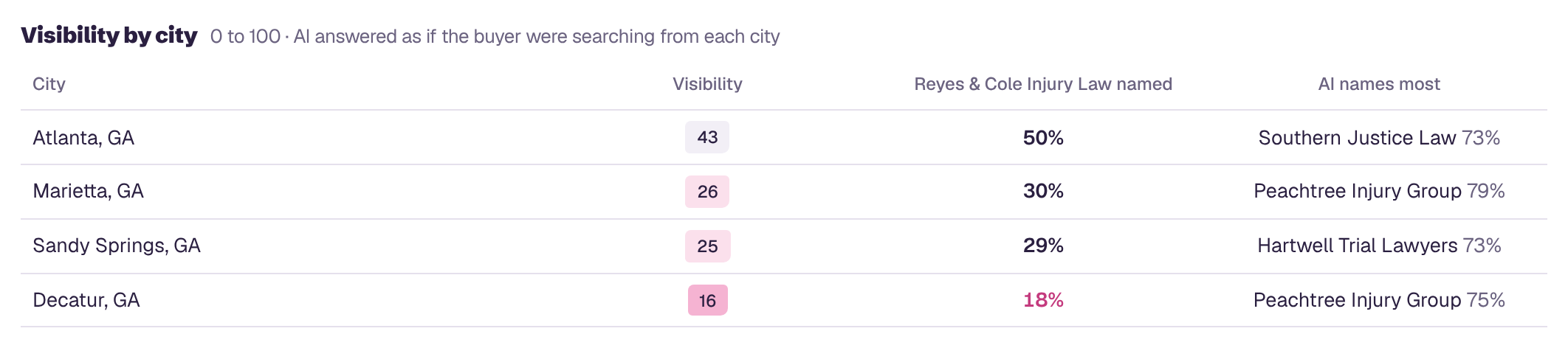
Why it matters: Criminal defense is very local. Each county and court has its own practices. Here's how visibility changes by city in a report:
What to publish: A page for each county or court you regularly appear in, with what clients should know about that court. Local knowledge is a real advantage, and AI recognizes it.
Every charge is its own search
People search for their specific charge: DUI or DWI, drug possession, assault, domestic violence, theft, white collar crimes, federal charges, juvenile cases, sex crimes, weapons charges, probation violations. Each charge you handle deserves its own page, explaining the charge, possible consequences, defenses in general terms, and how you approach these cases.
Fast response matters
People call defense lawyers in a hurry, often at night or on weekends. If you answer calls 24/7 or offer same-day consultations, make that clear everywhere. AI's answers often include "call a lawyer as soon as possible," and you want to be the one who picks up.
What the sample report shows
Here's what a Visible Queries report looks like for Reyes & Cole, the sample personal injury firm in the Atlanta area from our guide. The questions are different for criminal defense firms, but the patterns are the same.
The gap is clearest side by side:
If you only fix three things
- Publish clear, local guides to the process. For each type of charge and court.
- Answer the consequence questions. License, jail, records, immigration and diversion.
- Make fees and availability clear. How you charge and how fast you respond.
People are asking AI what happens after the worst night of their year. The defense lawyer AI names will be the one that answers most clearly and locally.
Part of our guide: Why AI visibility matters for law firms
See what AI tells people about your defense practice
Enter your website and get a free AI visibility report. It takes a few minutes, and you'll see:
- Your AI visibility score, overall and for ChatGPT, Gemini, Claude, Perplexity and Google's AI Overviews and AI Mode
- Which firms AI recommends instead of you, and how often
- Your visibility in every city you serve, and the competitor AI names most in each one
- What AI gets wrong about you, and what to fix first
- Your biggest gaps: the buyer questions where AI leaves you out, and who it recommends instead
- A downloadable PDF you can share with your team