Will, trust or both? How families choose an estate planning lawyer through AI
People now ask AI whether they need a will or a trust, whether online forms are enough and what estate planning costs. Here's what AI tells them, and how estate planning and probate lawyers get named.
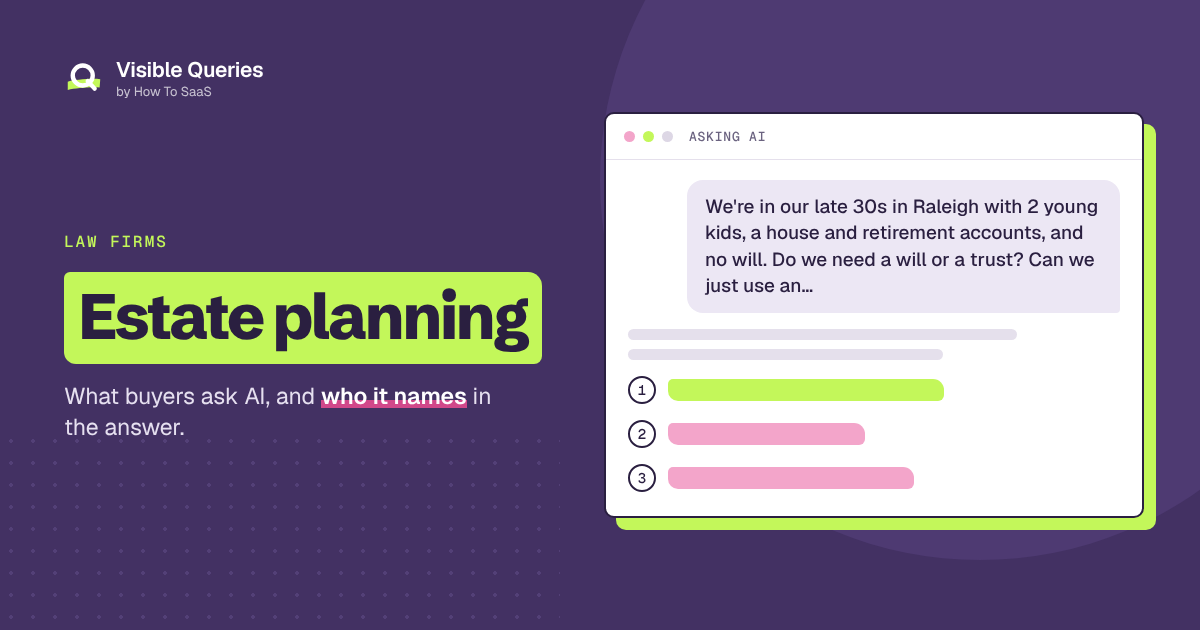
A couple in Raleigh just had their second child. They own a house, have retirement accounts and life insurance through work, and have no will. A friend's parent recently died without a plan, and the family spent a year in probate. They ask ChatGPT:
"We're in our late 30s in Raleigh with 2 young kids, a house and retirement accounts, and no will. Do we need a will or a trust? Can we just use an online service? What should estate planning cost, and how do we find a good estate planning lawyer near us?"
AI explains what wills and revocable living trusts do, what guardianship nominations for minor children are, how beneficiary designations work, what probate generally involves, when online documents may be enough and when a lawyer adds value, typical cost ranges and flat-fee packages, and what to ask. It notes that it can't give legal advice. Then it names three local firms. The couple books a consultation.
Estate planning is something almost everyone knows they should do and most people put off. It's triggered by life events: a baby, a marriage, a diagnosis, a death in the family, a new business or retirement. When it is triggered, people research carefully, and AI is now part of that research.
Our legal services guide covers how people choose law firms in general. This one goes through the questions that decide estate planning and probate clients, what AI usually says, and what firms can publish so AI names them.
Here are the questions at a glance:
| The question | What gets you named |
|---|---|
| "Will or trust?" | A plain guide to which fits when |
| "Can I just use an online service?" | Honest guidance on when a lawyer matters |
| "How much does estate planning cost?" | Flat fees and what they include |
| "What happens in probate?" | A step-by-step guide for families |
| "Estate planning for [situation]" | Pages for blended families, business owners and more |
"Do I need a will or a trust?"
This is the defining question for the category.
What AI usually says: It explains the purpose of each, how trusts can help avoid probate and manage assets, and that the right choice depends on assets, family situation, state law and goals.
What to publish: A plain guide to wills and trusts in your state or province, with examples of which families usually choose which. Local law matters, and AI rewards local clarity.
"Can I just use an online service?"
What AI usually says: It says online documents can work for simple situations, but that blended families, businesses, special needs beneficiaries, significant assets or property in multiple states often benefit from a lawyer.
What to publish: An honest comparison, including when online documents might be enough. Firms that are fair about this attract the clients who need them.
"How much does estate planning cost?"
What AI usually says: It explains that many estate planning lawyers offer flat-fee packages and gives typical ranges.
What to publish: Your packages and prices, what's included (will, trust, powers of attorney, health care directives, funding help) and how updates are handled.
"What happens in probate?" "Someone died, what do we do?"
What AI usually says: It explains the general probate process, timelines, the executor's duties, and when a lawyer helps.
What to publish: Clear guides to probate and estate administration in your jurisdiction, and a calm "first steps after a death" page. Families in this moment are grieving and overwhelmed, and the firm that helps them through it often earns their own estate planning too.
"Estate planning for [specific situation]"
The most valuable searches are specific:
- "Estate planning for blended families."
- "Special needs trust lawyer."
- "Estate planning for business owners."
- "Estate planning for same-sex couples."
- "Planning for long-term care and Medicaid."
- "Estate planning for people who own property in Canada and the US."
Each one you truly handle deserves its own page.
How often AI names you, and how early
Estate planning firms often find they're known, but not named first:

A low citation rate usually means AI is answering "will or trust?" questions from general legal websites. Publishing your own clear, local guides gives AI a reason to cite you instead.
Adult children and aging parents
Many estate planning conversations start with adult children worried about their parents. They ask about powers of attorney, incapacity planning, elder law and how to help their parents get a plan in place. Content for adult children is valuable, and it often brings in two generations of clients.
Referral partners
Financial advisors, accountants and insurance agents refer clients to estate planning lawyers, and they increasingly check options with AI. A page for professional partners, explaining how you work with them, helps you get named.
What the sample report shows
Here's what a Visible Queries report looks like for Reyes & Cole, the sample personal injury firm in the Atlanta area from our guide. The questions are different for estate planning firms, but the patterns are the same.
The report starts with one score out of 100, a score for each AI platform, and the competitor AI names most:
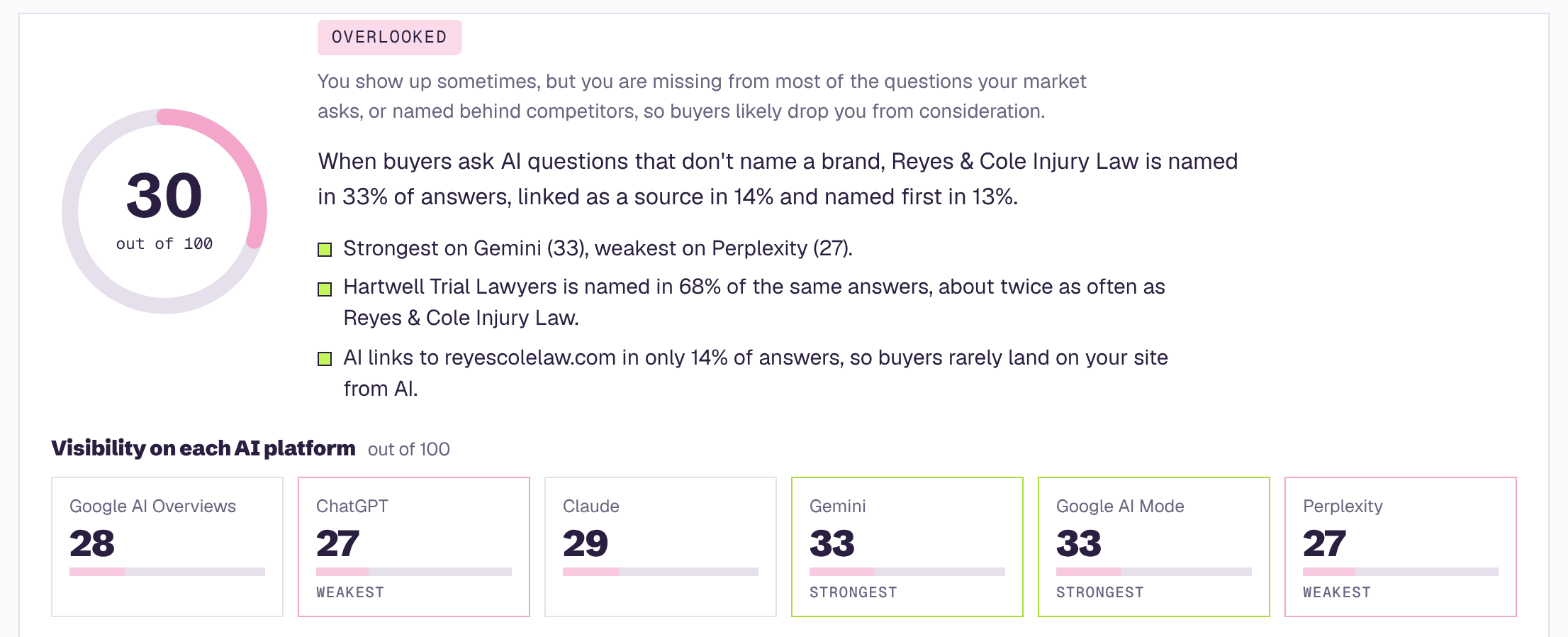
The gap is clearest side by side:
If you only fix three things
- Explain wills, trusts and probate under your local law.
- Publish your packages and prices. What's included and how updates work.
- Give every family situation its own page. Blended families, special needs, business owners and more.
Families are asking AI how to protect the people they love. The firm AI names will be the one that makes the answer clear.
Part of our guide: Why AI visibility matters for law firms
See what AI tells families about your estate planning practice
Enter your website and get a free AI visibility report. It takes a few minutes, and you'll see:
- Your AI visibility score, overall and for ChatGPT, Gemini, Claude, Perplexity and Google's AI Overviews and AI Mode
- Which firms AI recommends instead of you, and how often
- Your visibility in every city you serve, and the competitor AI names most in each one
- What AI gets wrong about you, and what to fix first
- Your biggest gaps: the buyer questions where AI leaves you out, and who it recommends instead
- A downloadable PDF you can share with your team