New patients, nervous patients and the Invisalign question: how people choose a dentist or orthodontist through AI
Patients now ask AI which dentists take their insurance, who's gentle with anxious patients and whether Invisalign or braces is better. Here's what AI tells them, and how dental and orthodontic practices get named.
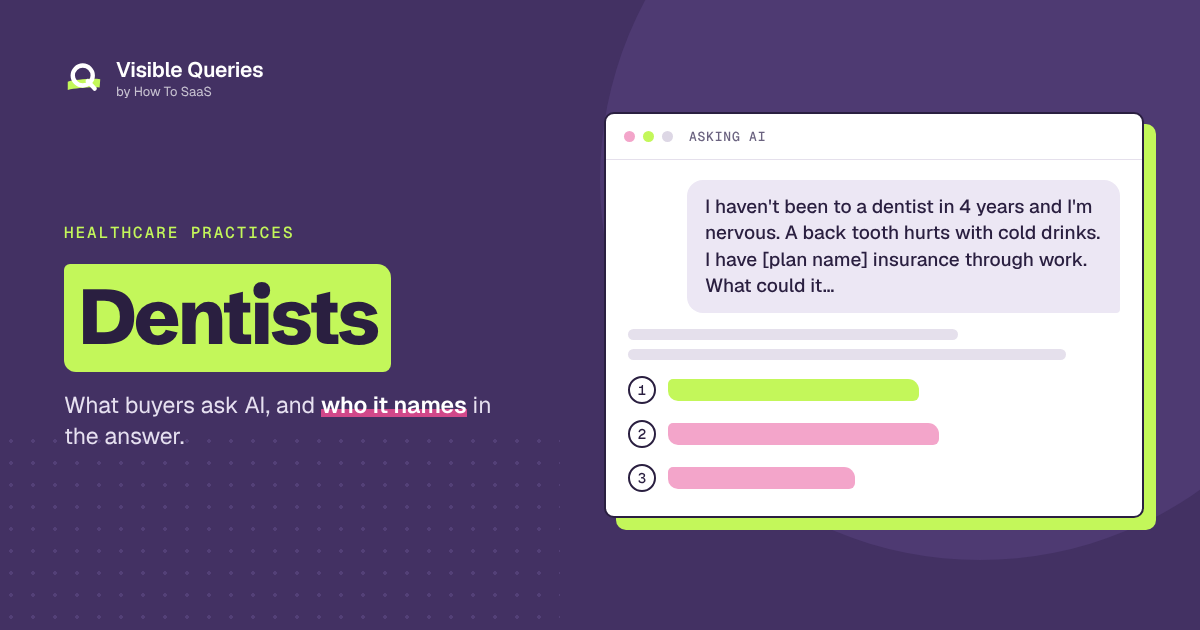
A project manager in Fort Worth hasn't seen a dentist in four years. They're embarrassed about it, a little scared of what they'll hear, and their new job's dental plan is one they've never heard of. A molar has started aching when they drink something cold. They ask ChatGPT:
"I haven't been to a dentist in 4 years and I'm nervous. A back tooth hurts with cold drinks. I have [plan name] insurance through work. What could it be, what will a first visit involve, and which dentists in Fort Worth are good with anxious patients and taking new patients?"
AI explains possible causes of cold sensitivity, why it's worth getting checked soon, what a first visit after a long gap usually involves, how dental insurance commonly works for cleanings and fillings, and what to look for in a dentist for anxious patients, including sedation options. Then it names three local practices. One of them books a new-patient exam for Thursday.
Dentistry runs on new patients, recurring visits and trust. People choose a dentist by location, insurance, availability and how comfortable they'll feel in the chair. Orthodontics adds big, considered decisions, often made by parents. AI is now part of both.
Our healthcare guide covers how patients choose practices in general. This one goes through the questions that decide dental and orthodontic patients, what AI usually says, and what practices can publish so AI names them.
Here are the questions at a glance:
| The question | What gets you named |
|---|---|
| "Which dentists take my insurance?" | The plans you accept, listed by name |
| "Are they accepting new patients?" | A current answer, kept up to date |
| "Which dentist is good with anxious patients?" | How you help nervous patients, including sedation |
| "How much does a crown or implant cost?" | Price ranges and payment options |
| "Invisalign or braces?" | Honest comparisons and when kids should start |
| "Emergency dentist near me?" | Your emergency hours and same-day policy |
"Which dentists near me take my insurance?"
What AI usually says: It explains in-network versus out-of-network care and suggests checking the insurer's directory and calling the office. It may name practices it believes accept the plan.
What to publish: A current list of the plans you're in network with, how you handle out-of-network plans, whether you file claims for patients, and any membership plan for uninsured patients. Membership plans are a common search for people without insurance, so explain yours with prices.
"Are they accepting new patients?"
This is a simple question with a big cost when AI gets it wrong. Here's how that shows up in the report:
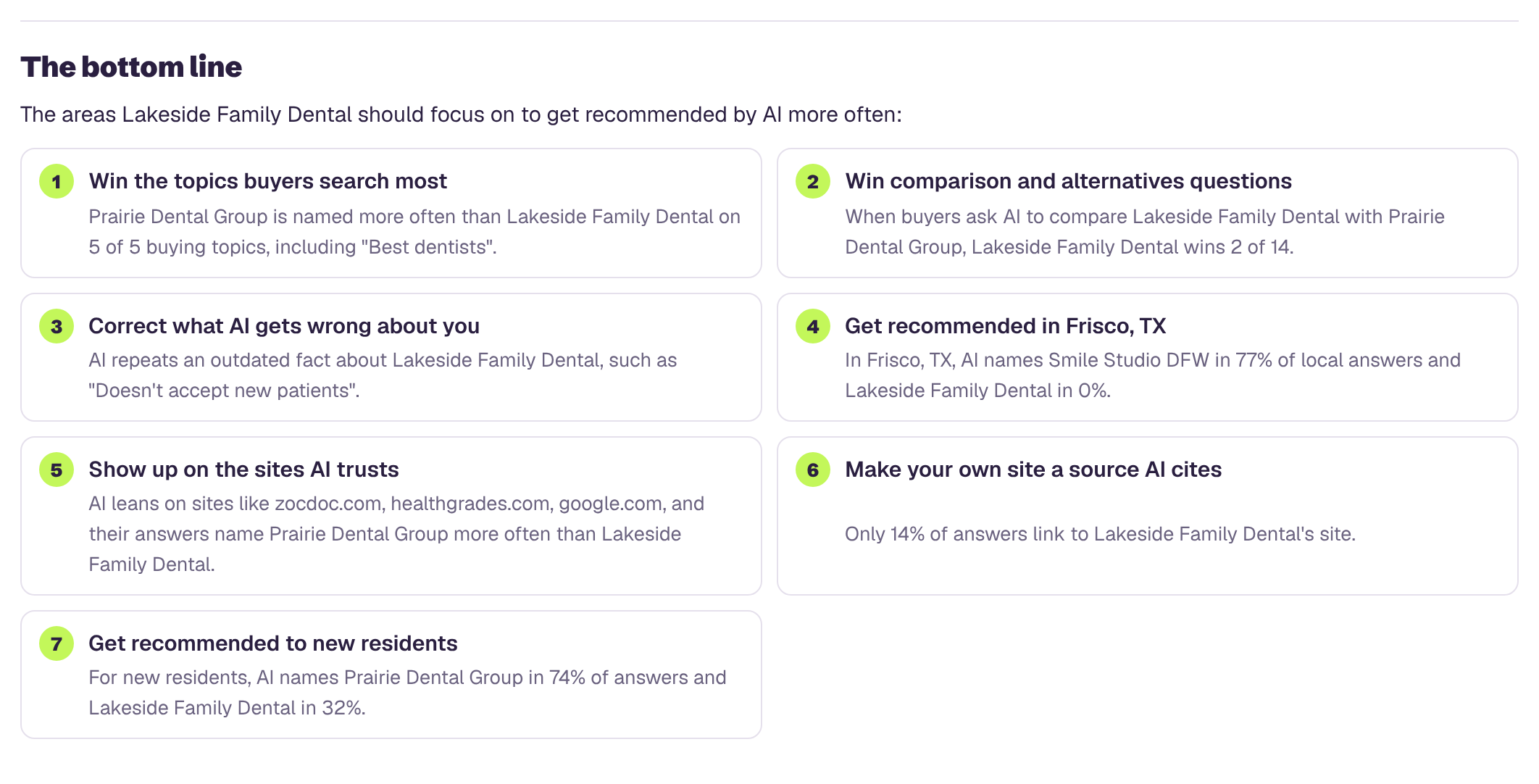
What to publish: A clear "new patients welcome" page with how to book, what to bring, what the first visit includes and how soon you can see them. Keep it current. If AI says you're closed to new patients, every person who asks is sent elsewhere.
"Which dentist is good with anxious patients?"
What AI usually says: It suggests practices that talk patients through each step, offer breaks, numbing options, and sedation such as nitrous oxide or oral sedation, and that have reviews mentioning gentle care.
What to publish: How you care for nervous patients, specifically: what you do on the first visit, the sedation options you offer and who's eligible, and how you handle people who haven't been in years without judgment. Reviews that say "I was terrified and they were wonderful" carry a lot of weight.
"How much does a crown, implant or root canal cost?"
What AI usually says: Wide ranges, what drives them, and what insurance often covers. It suggests getting a written treatment plan.
What to publish: Typical price ranges for common treatments, financing options, and how you explain treatment plans. Dental costs are a major worry, and practices that are open about them earn trust.
"Invisalign or braces?" and "When should my child see an orthodontist?"
What AI usually says: It compares clear aligners and braces by the kinds of cases they suit, cost, treatment time, comfort and discipline needed. For kids, it often mentions that an early orthodontic evaluation around age seven is commonly recommended.
What to publish: Honest comparisons of the options you offer, which cases each suits, typical cost ranges and treatment times, payment plans, and what a free consultation includes. Parent-focused pages on first visits and early treatment are valuable, because parents do the research.
"Emergency dentist near me?"
What AI usually says: It suggests calling local practices with same-day emergency appointments, and when to go to the ER instead.
What to publish: Your emergency policy, same-day availability, after-hours instructions and what counts as a dental emergency. A chipped tooth on a Saturday morning is a new patient waiting to happen.
Cosmetic and specialty dentistry
Veneers, whitening, implants, sleep apnea appliances and full-mouth reconstruction are high-value and heavily researched. People ask AI things like "cost of veneers in Dallas," "dentist who does same-day crowns" or "implant dentist for people with bone loss." Give each specialty its own page, with the dentist's training, the technology you use, cases with descriptions and price ranges.
Many locations, one brand
Group practices and dental service organizations often confuse AI: the brand is known, but which location takes which insurance, who the dentists are and what services each offers can get mixed up. Every location needs its own page, with its dentists, hours, insurance, services and local reviews.
What the sample report shows
Here's what a Visible Queries report looks like for Lakeside Family Dental, the sample family dental group in the Dallas–Fort Worth area from our guide. The questions are different for dental practices, but the patterns are the same.
For a business that serves more than one city, the report checks each one separately:
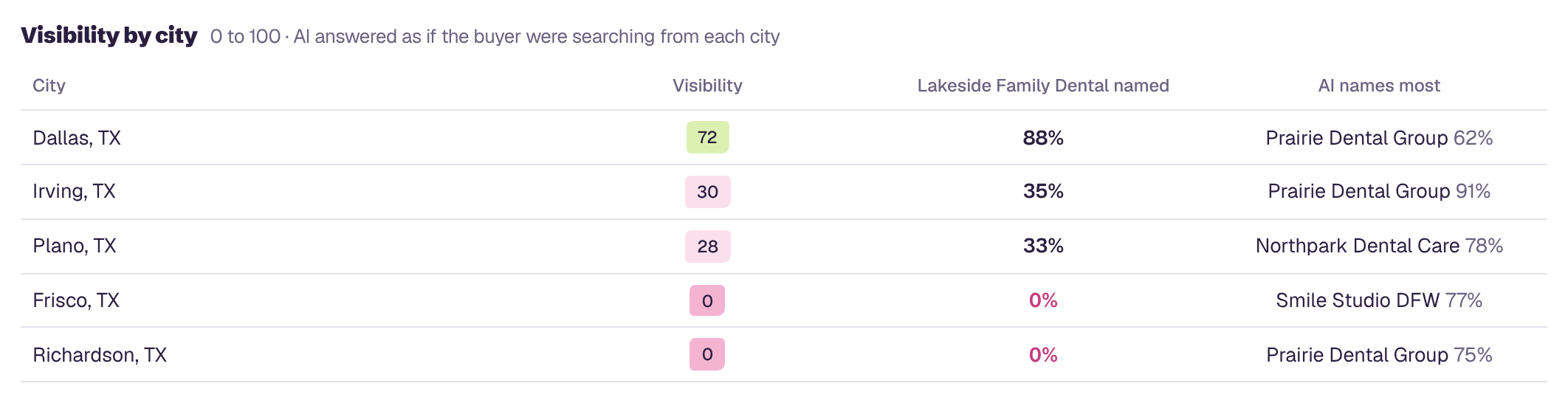
The gap is clearest side by side:
If you only fix three things
- Make new-patient and insurance information clear and current. Accepting new patients, plans in network and membership options.
- Describe how you care for nervous patients. Specifically, with sedation options.
- Publish honest cost ranges and comparisons. For common treatments and orthodontic options.
Patients are asking AI which dentist won't make them feel bad. The practice AI names will be the one that answers that question with care.
Part of our guide: Why AI visibility matters for healthcare practices
See what AI tells patients about your dental practice
Enter your website and get a free AI visibility report. It takes a few minutes, and you'll see:
- Your AI visibility score, overall and for ChatGPT, Gemini, Claude, Perplexity and Google's AI Overviews and AI Mode
- Which practices AI recommends instead of you, and how often
- Your visibility in every city you serve, and the competitor AI names most in each one
- What AI gets wrong about you, and what to fix first
- Your biggest gaps: the buyer questions where AI leaves you out, and who it recommends instead
- A downloadable PDF you can share with your team