Mom can't live alone anymore: how families choose home care, senior care and senior living through AI
Families now ask AI whether a parent needs home care or assisted living, what it costs and how to judge a community. Here's what AI tells them, and how home care agencies, senior care providers and senior living communities get named.
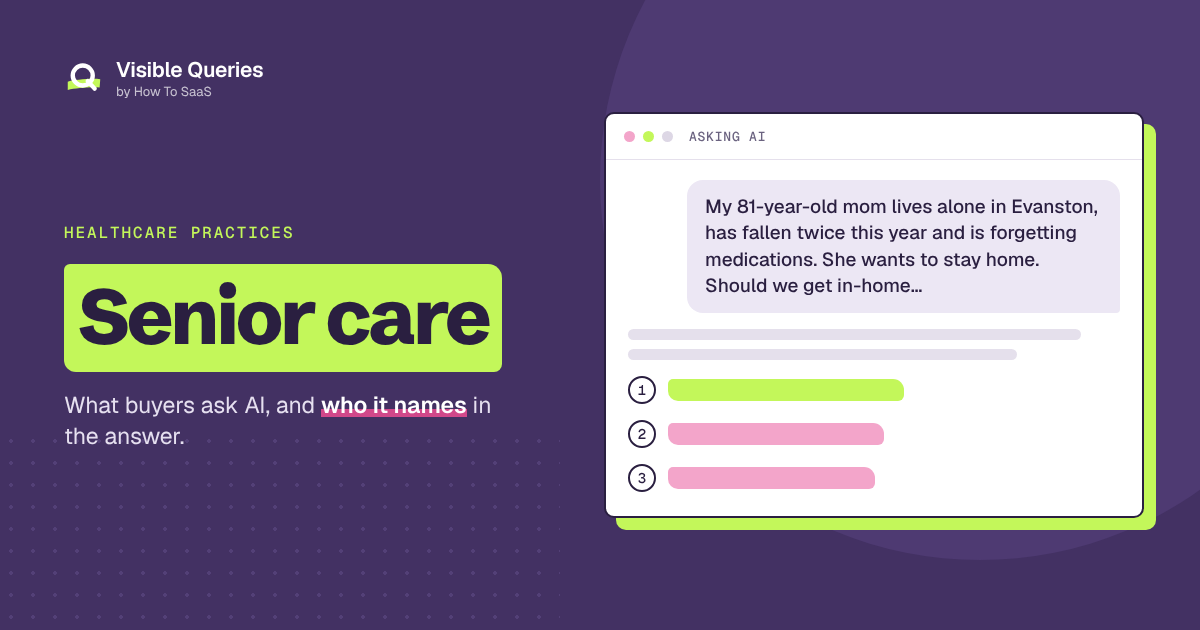
A 52-year-old in Chicago just got a call from their 81-year-old mother's neighbor. Mom fell again. She's okay, but it's the second time this year, and she's started forgetting to take her medication. She lives alone in a house in Evanston and doesn't want to move. Her child lives 40 minutes away and works full time. That night they ask ChatGPT:
"My 81-year-old mom lives alone in Evanston, has fallen twice this year and is forgetting medications. She wants to stay home. Should we get in-home care or look at assisted living? What does each cost in the Chicago area, does Medicare pay for any of it, and how do we pick a good agency or community?"
AI explains the differences between companion care, personal care, home health, assisted living and memory care, what each typically costs in the area, that Medicare generally doesn't pay for long-term custodial care but may cover short-term home health after a hospital stay, how long-term care insurance and veterans' benefits may help, and questions to ask agencies and communities. Then it names a few local options. The family schedules an in-home assessment that week.
Senior care decisions are usually made by adult children, often in a crisis, and often from a distance. They're expensive, emotional and confusing. AI is increasingly where those families start, at night, after the phone call.
Our healthcare guide covers how patients choose practices in general. This one goes through the questions that decide home care, senior care and senior living, what AI usually says, and what providers can publish so AI names them.
Here are the questions at a glance:
| The question | What gets you named |
|---|---|
| "Home care or assisted living?" | An honest guide to which fits when |
| "How much does it cost?" | Real price ranges and what's included |
| "How do I choose a good agency?" | Caregiver screening, training and supervision |
| "How do I choose a community?" | Care levels, staffing, activities and tours |
| "Memory care near me" | Your memory care program, described specifically |
"Home care or assisted living?"
This is the defining question for the category.
What AI usually says: It compares the options by level of care, safety, social life, cost and independence, and suggests a needs assessment. It often notes that many families start with home care and move to a community later.
What to publish: An honest guide to the options, including when your option isn't the right one. A home care agency that says "when someone needs care around the clock, a community may be safer and less expensive" earns more trust, and more referrals.
"How much does it cost?"
What AI usually says: Typical hourly rates for home care, monthly costs for assisted living and memory care, and what drives them. It explains what Medicare, Medicaid, long-term care insurance and veterans' benefits may or may not cover.
What to publish: Your rates or price ranges, minimum hours or levels of care, what's included, how pricing changes as needs change, and which payment sources you accept. Families are comparing, and clear pricing is a big reason they call.
"How do I choose a good agency?"
What AI usually says: It suggests asking about caregiver screening and training, whether caregivers are employees or contractors, how consistent caregivers are, supervision, licensing, insurance, and what happens if a caregiver can't make a shift.
What to publish: Answer every one of those questions on your site: background checks, training, specialties like dementia care, caregiver matching, supervision, backup coverage, and how families communicate with you.
"How do I choose a good senior living community?"
What AI usually says: It suggests touring, asking about staffing levels, care services, activities, dining, safety, how care needs are assessed, what costs extra, and checking inspection records.
What to publish: Detailed pages on levels of care, staffing, a typical day, activities, dining, floor plans, pricing structure, how care fees work and what's included. Photos help families. Written descriptions help AI.
"Memory care near me"
What AI usually says: It explains what memory care communities and dementia-trained home care offer, and suggests asking about staff training, secure environments, programs and how behavioral changes are handled.
What to publish: A dedicated page for dementia and memory care: training, programs, safety features, staffing and how you support families.
When AI gets your facts wrong
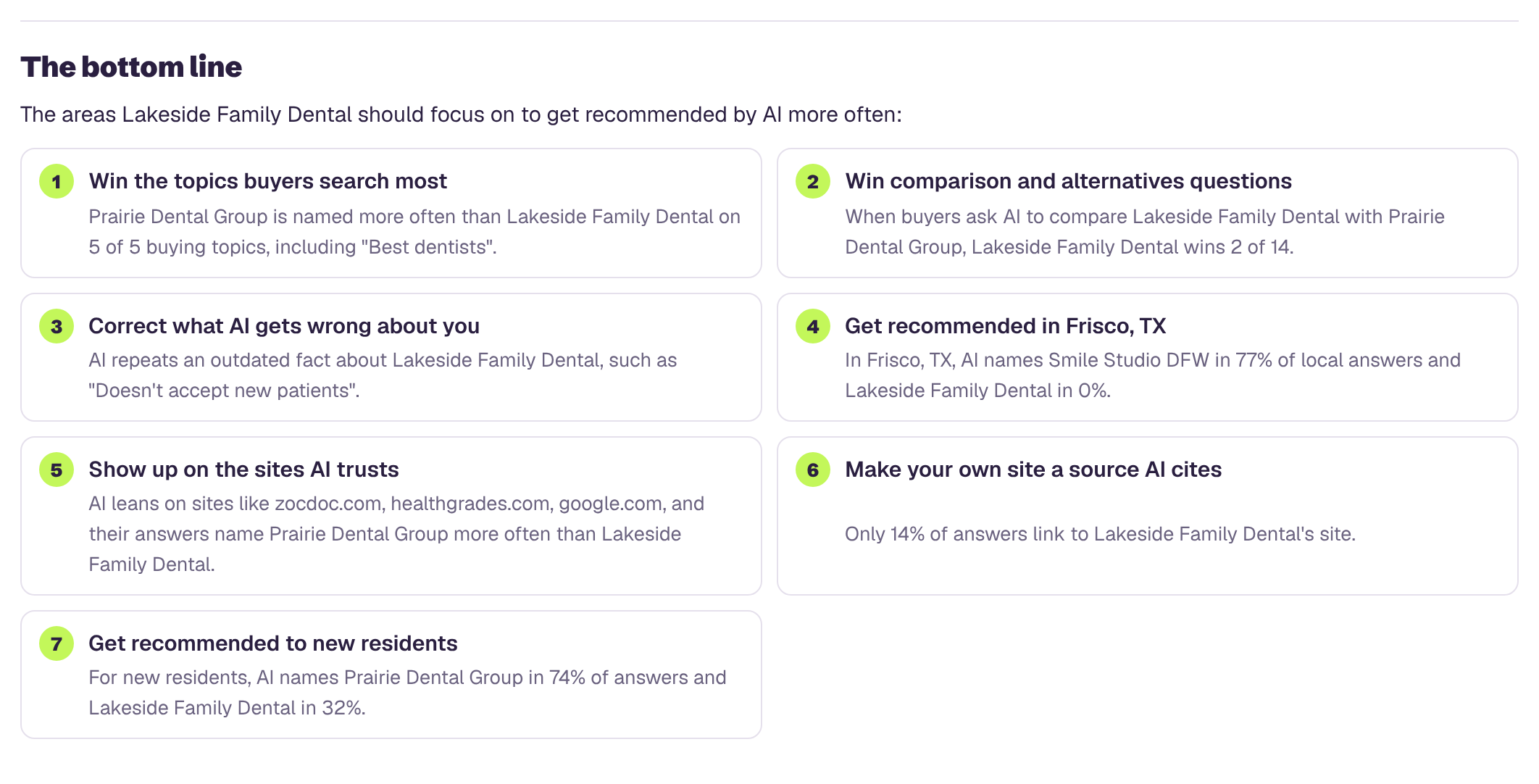
Wrong facts are especially costly here. A community that's described as "assisted living only" when it also has memory care, or an agency described as "no overnight care" when it offers it, loses the families who need exactly that. Here's how the report shows a wrong fact:
Families who live far away
Many adult children research care from another city or province. They ask AI "how do I manage my dad's care from out of state?" or "home care agencies that send updates to family." If you offer family portals, regular updates, care managers or video check-ins, describe them clearly.
Hospital discharge and referral partners
Social workers, discharge planners, doctors and elder law attorneys refer families to agencies and communities. They also use AI to check options quickly. A page for referral partners, with services, response times, payment sources and how to refer, makes you easier to recommend.
What the sample report shows
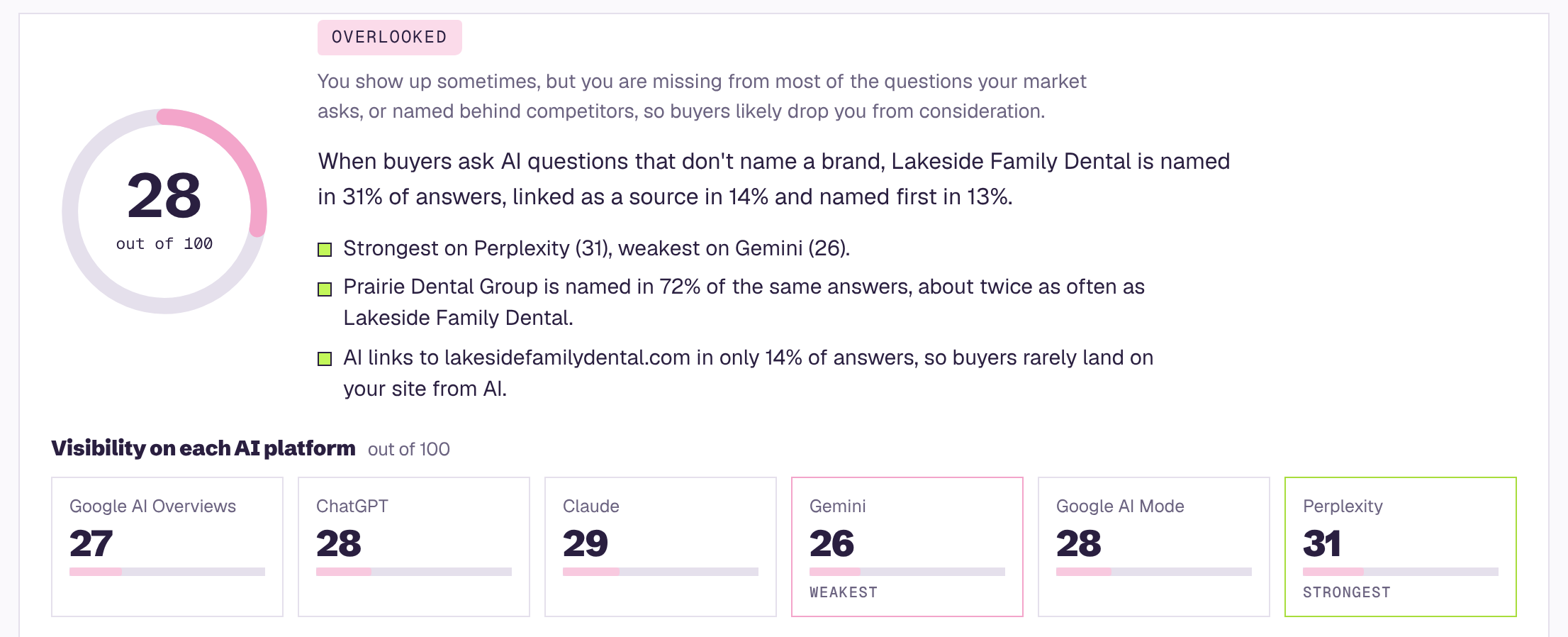
Here's what a Visible Queries report looks like for Lakeside Family Dental, the sample family dental group in the Dallas–Fort Worth area from our guide. The questions are different for home care agencies and senior living communities, but the patterns are the same.
The report starts with one score out of 100, a score for each AI platform, and the competitor AI names most:
The gap is clearest side by side:
If you only fix three things
- Explain the options and costs honestly. Home care vs communities, levels of care and payment sources.
- Answer the families' checklist in full. Screening, training, staffing, consistency and communication.
- Make every service and level of care impossible to get wrong. Memory care, overnight care, respite and more.
Adult children are asking AI what to do about mom or dad. The provider AI names will be the one that answers with clarity and kindness.
Part of our guide: Why AI visibility matters for healthcare practices
See what AI tells families about your community or agency
Enter your website and get a free AI visibility report. It takes a few minutes, and you'll see:
- Your AI visibility score, overall and for ChatGPT, Gemini, Claude, Perplexity and Google's AI Overviews and AI Mode
- Which providers AI recommends instead of you, and how often
- Your visibility in every city you serve, and the competitor AI names most in each one
- What AI gets wrong about you, and what to fix first
- Your biggest gaps: the buyer questions where AI leaves you out, and who it recommends instead
- A downloadable PDF you can share with your team