How patients choose a dentist, clinic or specialist now, and why AI visibility decides who gets the appointment
Patients now ask AI which dentist, clinic, therapist or specialist to see. Here's how their journey works, what they ask at each step, and how to build a practice AI recommends.
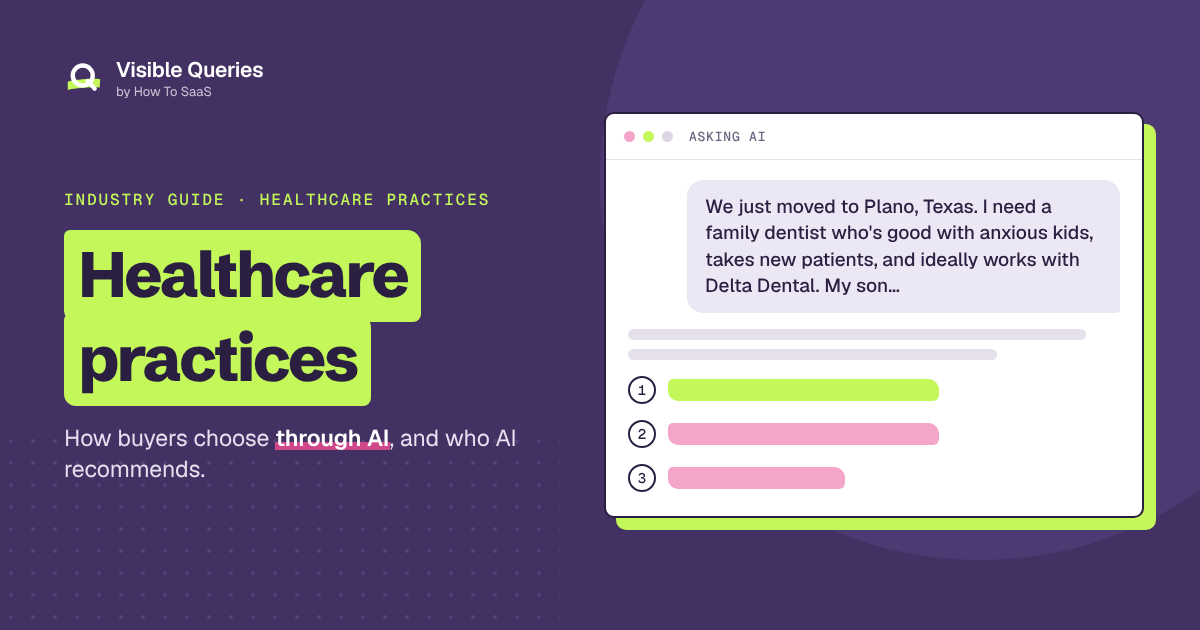
It's a Sunday evening in Plano, three weeks after a cross-country move. The boxes are mostly unpacked, the kids have started school, and one of them has just mentioned that a back tooth hurts when they drink something cold. The family's old dentist is 1,400 miles away. The new insurance cards arrived on Friday. Nobody has any idea where to go.
A few years ago, one of the parents would have logged into the insurance portal, scrolled a list of in-network names with no context, cross-checked a few on Google Maps, and called whichever one had a free slot.
Tonight, they open ChatGPT and type:
"We just moved to Plano, Texas. I need a family dentist who's good with anxious kids, takes new patients, and ideally works with Delta Dental. My son has a tooth that hurts with cold drinks. Is that urgent, and who should we see?"
The answer explains that cold sensitivity can mean a cavity or worn enamel and is worth a visit within a week or two, faster if there's swelling or constant pain. It covers what to look for in a kid-friendly family practice, how to check insurance, and what a new-patient visit usually includes. Then it names three practices nearby, with a line on what each one is known for.
They book the first one online that night.
That's how a growing share of patients now find dentists, physical therapists, dermatologists, med spas, optometrists, veterinarians, therapists, urgent care clinics and specialists. They describe their symptom or their goal, their insurance and their worries, and AI gives them a short list. The practices on that list get the new patient. The rest never hear about it.
This article walks through how patients choose a healthcare provider today, step by step, with examples from dental and orthodontic practices, aesthetics, physical therapy and chiropractic, veterinary clinics, eye and hearing care, urgent and primary care, mental health and addiction treatment, fertility clinics, and home and senior care. It covers what patients ask AI at each step, what makes AI recommend one practice over another, and what the practices that keep getting recommended tend to do differently. Most of it comes down to being a practice that's easy to understand, easy to trust and easy to book.
Along the way you'll see screenshots from a Visible Queries report for Lakeside Family Dental, a sample family dental group in the Dallas–Fort Worth area. The practice and its competitors are made up, but the report is real. It's exactly what any practice sees when it runs its own.
Why the old playbook isn't enough anymore
Practices have always grown on referrals and reputation: a friend's recommendation, a referral from another doctor, the insurance directory, Google reviews and a convenient location. Marketing filled in with a website, a Google Business Profile and maybe some local ads.
All of that still matters. But more and more, the first place a patient goes isn't the insurance directory or the map. It's an AI assistant that answers their health question and recommends a provider in the same breath.
Three things follow from that:
- Patients describe a symptom or a situation, not a specialty. "My knee hurts going down stairs after running" or "a dentist who's good with anxious adults" gets practices that clearly match. A generic "comprehensive care for the whole family" page matches nothing in particular.
- The shortlist is tiny. A directory shows dozens of in-network dentists. An AI answer names three. Those three get the calls.
- Your reputation is summarized. Patients ask "Is [practice] good? Any complaints about billing?" and get a two-sentence answer built from reviews, forums and whatever's published about you.
None of this replaces good care, referrals or reviews. Those are exactly what AI reads. What's changed is that the summary of your practice now reaches patients before you do.
The patient's journey, step by step
Whether it's a cleaning, an Invisalign case, an urgent care visit, a course of physical therapy, or a long-term decision about a parent's care, the path looks similar. What changes is the urgency and how much is at stake.
- Something prompts the search. A symptom, a move, a life change, an insurance change, or a goal like straighter teeth or better sleep.
- They try to understand what's going on. What the symptom might mean, what treatment involves and what it costs.
- They build a shortlist. Which practices nearby fit their need, insurance and schedule.
- They check who to trust. Credentials, reviews, bedside manner, billing and wait times.
- They book. Availability, the new-patient process, insurance and first-visit details.
- They stay, or they don't. The experience, follow-up care, recall visits and referrals.
AI now shows up at every one of these steps. Here's what that looks like.
Step 1: Something prompts the search
Healthcare searches start with a trigger, and the trigger is almost never "I'd like to find a new provider today." It's something that happened.
- A toothache, a rash that won't go away, a sore back after a weekend of yard work.
- A move to a new city, or a new job with new insurance.
- A dentist or doctor who retired, or a practice that was bought and doesn't feel the same anymore.
- A milestone: a child's first dental visit, a 40th birthday and a list of overdue screenings, a parent who can't live alone safely anymore.
- A goal: straighter teeth before a wedding, better skin, getting back to running, finally dealing with anxiety.
- A pet that's limping or stopped eating.
The first questions patients ask AI are about the trigger, not about you. "Is tooth sensitivity to cold serious?" "How long should lower back pain last before I see someone?" "What age should a child first see a dentist?" "Signs my dad shouldn't be living alone anymore."
This is the most important moment you're probably not part of. The answer shapes what the patient believes they need. If AI tells someone with knee pain that a few weeks of physical therapy usually helps more than rest, they start looking for a physical therapist. If it tells them to wait and see, nobody gets the appointment.
The practices that do well at this step are the ones that publish clear, honest, useful answers to the questions patients ask before they're ready to book. A dental practice with a page explaining what cold sensitivity usually means and when it's urgent. A physical therapy clinic with plain-language guides to common injuries and when to get help. A vet with a page on which symptoms need a same-day visit and which can wait.
AI leans on that kind of content when it explains a situation. It's specific, it's written by people who treat the problem, and it reads like expertise rather than advertising. Once your explanation shapes the answer, your practice tends to follow.
What good practices do at this step:
- Write about the symptoms, situations and milestones that bring patients in, in the words patients use.
- Be honest about urgency. "This can usually wait a week, but call us today if..." builds more trust than "book now."
- Have clinicians review it, and say so. Patients and AI both pay attention to who wrote health information.
Step 2: They try to understand what's going on
Next, patients try to understand their options. This is where they're most open, and where AI does most of the teaching.
- "Invisalign vs braces for a 35-year-old: which is better and what do they cost?"
- "Physical therapy or chiropractor for lower back pain?"
- "Botox vs fillers for forehead lines?"
- "Is LASIK worth it, and how much does it cost in Dallas?"
- "Do I need a psychiatrist or a therapist for anxiety?"
- "How much does a dental implant cost without insurance?"
This is where patients decide what kind of care they want, and that decides which practices are even in the running.
Here's what this step looks like in a real report. These are questions AI was asked about family dentists in the Dallas area, and who each platform named in its answer:
Look at what these questions are really about. "Why do I keep getting surprise bills from my dentist?" Two platforms mentioned Lakeside, and the other two named Prairie Dental Group. "Is my current dentist good enough for my whole family?" Every platform named a competitor. "Why do dental bills come in higher than expected?" All four named competitors. "What does avoiding the dentist out of fear really cost you?" Prairie Dental Group, on all four platforms.
These are the patients who are about to switch. They're frustrated with billing, unsure about their current dentist, or anxious about going at all. They're not asking for a dentist by name. They're asking about a problem, and the practice that's clearly solved that problem gets the recommendation.
For a family dental practice, those questions point to the content that matters most: clear pricing and insurance information, honest explanations of what treatment costs and why, and a real approach to anxious patients. The practice that has written about those things, in plain words, is the one AI names.
What good practices do at this step:
- Explain treatment options honestly and compare them fairly, including when a cheaper or simpler option is the right one.
- Publish price ranges, what insurance usually covers, and how billing works. Surprise bills are one of patients' biggest frustrations, and AI favors practices that address it head-on.
- Speak directly to the worries that keep people away: fear, cost, time and embarrassment.
Step 3: They build a shortlist
Once patients know what kind of care they need, they look for specific practices. Healthcare is local, and convenience matters a lot. A patient will drive past three dentists to get to one they trust, but only so far, and only for so long.
The questions get specific:
- "Best family dentist in Plano that takes Delta Dental."
- "Physical therapist near Frisco who specializes in running injuries."
- "Pediatric dentist in Irving who's good with kids with special needs."
- "Dermatologist in Richardson accepting new patients."
- "24-hour emergency vet near me."
For multi-location groups, this is where visibility can fall apart. AI can recommend you confidently in one city and not mention you at all in the next. Here's the sample practice across the five cities it serves:
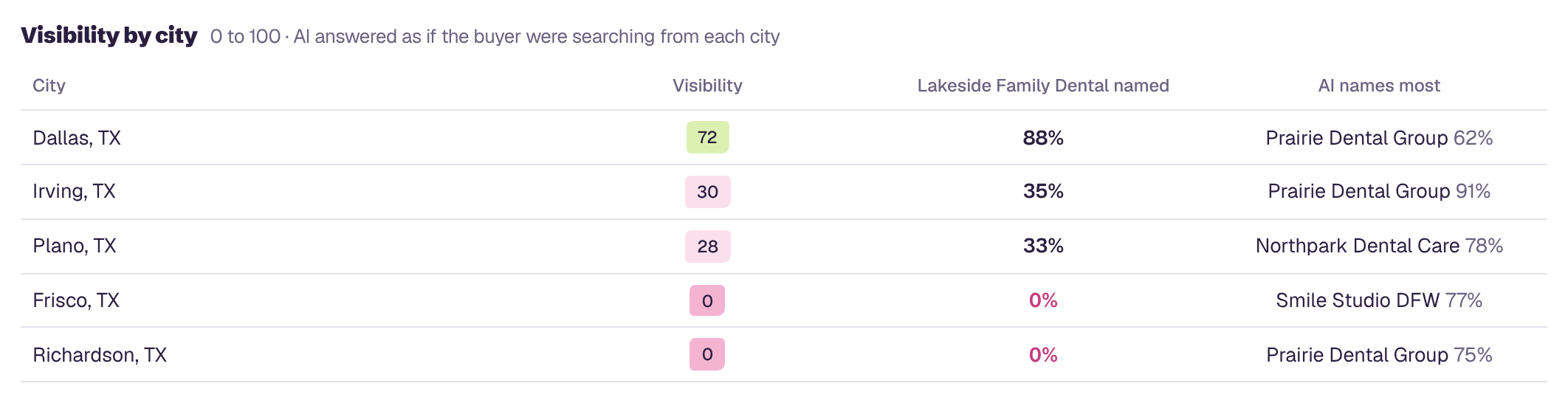
In Dallas, Lakeside scores 72 and is named in 88% of answers. In Plano it drops to 28 and is named in 33%, while Northpark Dental Care is named in 78%. In Irving it scores 30, with Prairie Dental Group named in 91% of answers. In Frisco and Richardson it scores 0. It isn't named in a single answer, even though it has offices there.
Remember the family in the opening example, who just moved to Plano? In this report, they'd probably never hear Lakeside's name.
That pattern is common. A group's flagship office has years of reviews, local press and referrals. The newer offices have a location page with an address, a phone number and a stock photo of a smiling patient. AI can't recommend an office it knows almost nothing about.
What good practices do at this step:
- Give every location a real page: the providers who work there, hours, services, insurance accepted, parking, and reviews from patients at that office.
- Build reviews per location, not just for the brand. Patients in Frisco want to hear from patients in Frisco.
- Say clearly whether each location is accepting new patients, and how soon they can be seen.
Step 4: They check who to trust
Healthcare is personal. Patients are trusting you with their health, their children, their pets, their appearance or their parents. So before they book, they check.
- "Is [practice] good? What do patients say?"
- "Any complaints about [clinic]'s billing?"
- "Is [doctor] board certified?"
- "Does [med spa] have a medical director? Who does the injections?"
- "What's the wait time at [urgent care] on weekends?"
AI answers these in a couple of sentences. When what it's read is accurate and recent, that's a gift: a patient hears a confident, positive summary. When it's wrong, the damage is quiet. The patient just books somewhere else.
Here's what that looks like in the sample report:
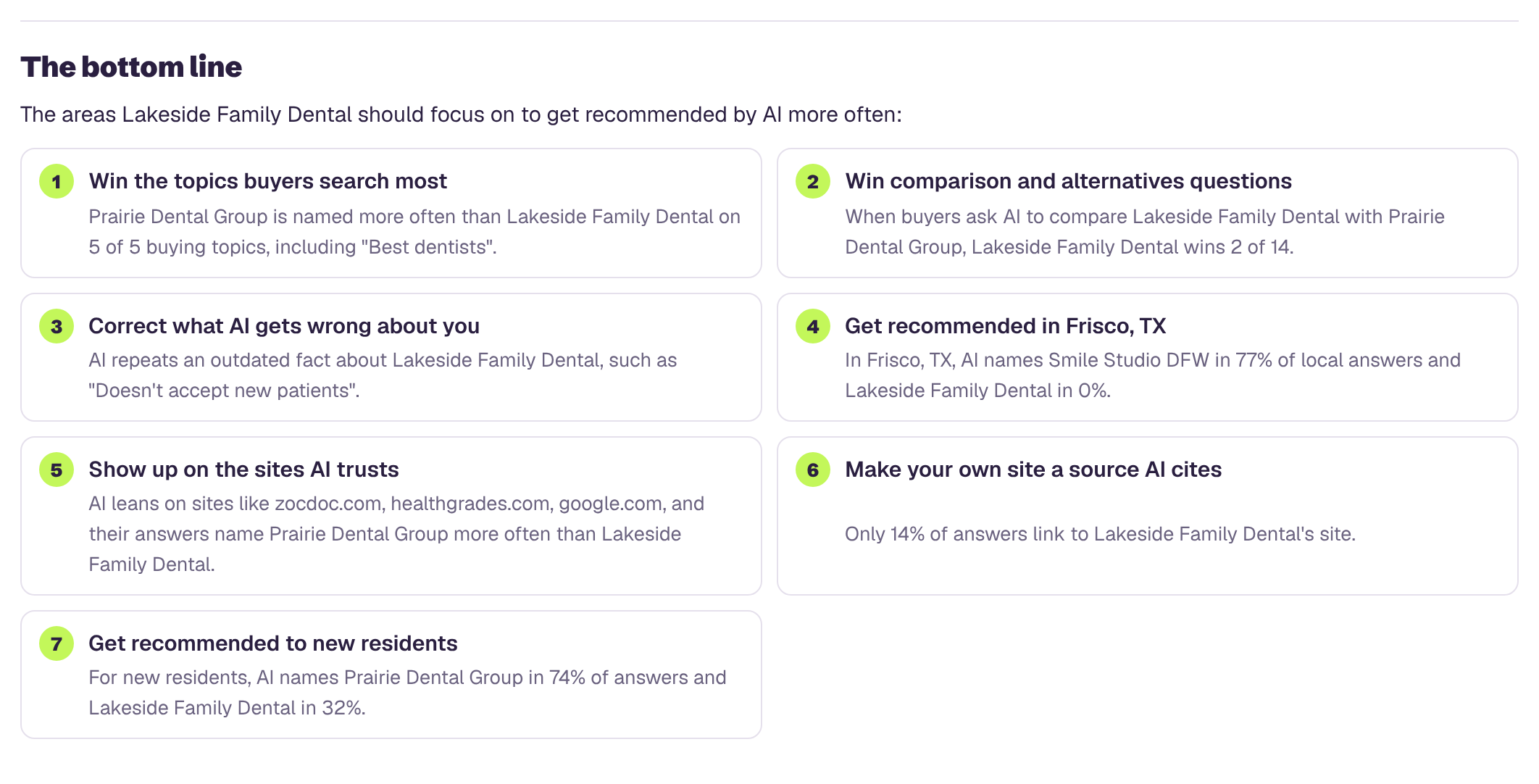
The first gap is about as costly as an error can get. AI tells patients that Lakeside "doesn't accept new patients." In reality, every location is accepting new patients. Every person who hears that answer, which is exactly the new patient the practice wants, crosses Lakeside off the list without calling.
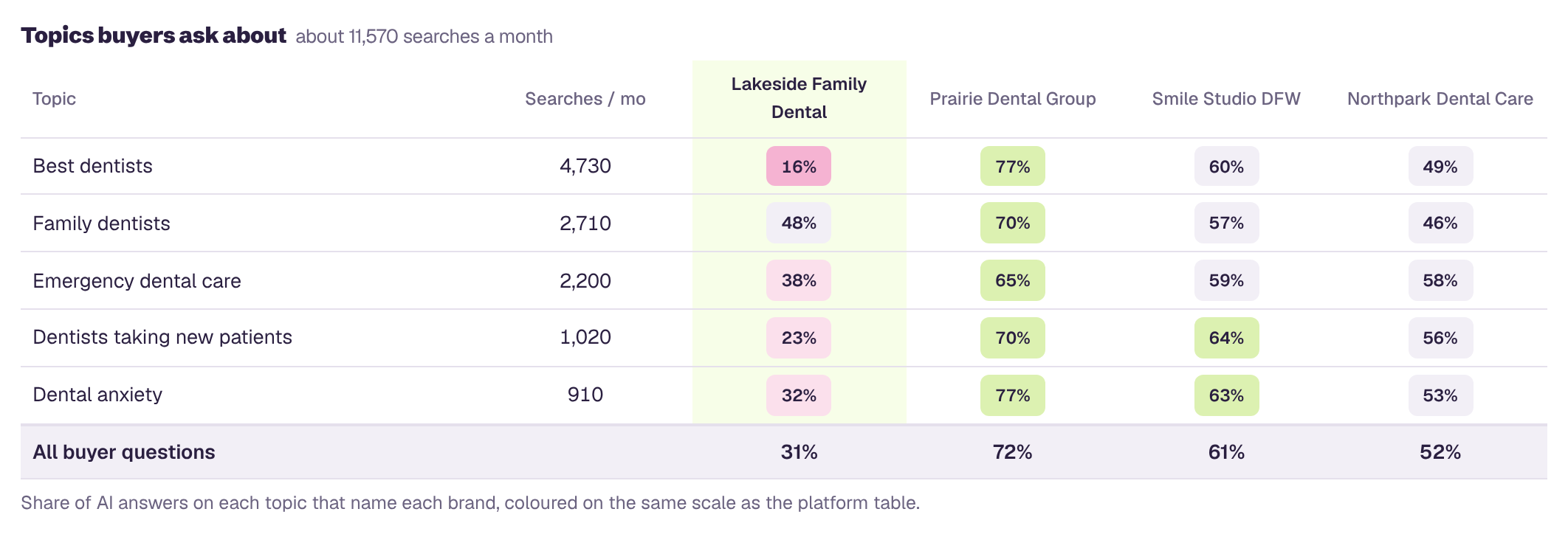
The other gaps follow from it. Lakeside is named in only 31% of answers to "best dentists" questions, and Prairie Dental Group is named instead in 51% of buyer questions. Overall accuracy is 83%, which sounds good until you remember that the other 17% includes "they're not taking new patients."
Wrong facts about practices usually come from a few places:
- Old information that never got updated. A practice that paused new patients during a busy year, a provider who left, an office that moved, hours that changed.
- Directory and insurance listings that are out of date or inconsistent with your website.
- Name confusion. Practices with similar names, or a group that was acquired and renamed.
- Silence. If you never state your credentials, insurance, new-patient status or emergency policy, AI fills the gap with whatever it can find.
What good practices do at this step:
- State the facts patients check, plainly and in one place: providers and their credentials, insurance accepted, new-patient status, hours, emergency availability and payment options.
- Keep every listing consistent: your website, Google Business Profile, insurance directories, health directories and social profiles.
- Ask happy patients for reviews that mention specifics, like the provider, the problem and how they were treated. Specific reviews are the ones AI repeats.
- Respond to negative reviews calmly and helpfully. AI reads responses too, and a thoughtful reply often softens the summary.
Step 5: They book
By now, the patient usually has two or three practices in mind. They're weighing the details that decide it:
- "Can I get a same-week appointment at [practice]?"
- "Does [clinic] offer evening or Saturday hours?"
- "Lakeside Family Dental vs Prairie Dental Group for a family with two kids?"
- "Does [dermatologist] take my insurance?"
- "Does [practice] offer sedation for anxious patients?"
Head-to-head questions are where share of voice matters most. If a patient asks AI to compare you with a competitor and AI has far more to say about the competitor, the competitor usually wins.
In the sample report, Prairie Dental Group is named in 72% of answers, Smile Studio DFW in 61% and Northpark Dental Care in 52%. Lakeside is named in 31%. Despite a solid position in Dallas, Lakeside scores 28 overall, in the Overlooked band, and is the fourth name in most conversations about dentists in the region.
The practices that win at this step make booking easy and low-risk:
- Online booking, with real availability, for new patients.
- Clear new-patient information. What the first visit includes, how long it takes, what to bring and what it costs with and without insurance.
- Answers to the deciding questions. Evening hours, weekend hours, sedation options, kid-friendly rooms, languages spoken, accessibility.
- Pricing transparency where it's possible. Membership plans for uninsured patients, self-pay prices and financing options.
What good practices do at this step:
- Let new patients book online, and make that obvious on every page.
- Publish a clear "your first visit" page for each type of care you offer.
- Make the details that tip the decision easy to find, because they're exactly what patients ask AI to compare.
Step 6: They stay, or they don't
Healthcare relationships can last decades. A family that likes its dentist stays for 20 years and sends their friends. A physical therapy patient who recovers well comes back the next time they get hurt. A pet owner trusts the same vet for every pet they ever own. That lifetime value is what most practices are built on.
Patients ask AI questions after they start care, too:
- "Is it normal for physical therapy to take eight weeks?"
- "Should I get a second opinion on a root canal?"
- "How often do I really need a dental cleaning?"
- "Is my therapist a good fit, or should I try someone else?"
If those answers make patients doubt their care or point them to another practice, you lose patients you've already earned. The practices that keep patients publish for them too: what to expect during treatment, how long recovery usually takes, why recall visits matter, and what to do if something doesn't feel right.
And when patients stay and feel well cared for, they talk about it, in reviews, neighborhood groups, school parent chats and forums. That's the raw material AI uses to decide who to recommend next.
What good practices do at this step:
- Set expectations in writing for treatment length, recovery and follow-up.
- Make recall, reminders and rebooking easy, and explain why they matter.
- Ask for reviews at natural moments, like the end of a treatment plan, a great checkup or a pet's recovery.
How the journey plays out across healthcare
The six steps are the same everywhere, but what patients ask, and what decides the choice, varies a lot by type of practice.
Dentists and orthodontists
Dental is the classic "I just moved" or "I'm unhappy with my dentist" journey, and it's driven by trust, convenience and cost. Patients ask: "Family dentist near me that takes [insurance]," "dentist good with anxious adults," "how much do implants cost," "Invisalign vs braces for teens." For orthodontists, parents often start with "what age should my child see an orthodontist?"
The practices that get recommended are clear about insurance, pricing, payment plans and new-patient availability, and they speak directly to dental anxiety. Orthodontists do well when they explain the options honestly, publish typical treatment lengths and price ranges, and show real before-and-after cases.
Full guide: AI visibility for dentists and orthodontists
Aesthetics: dermatology, med spas and plastic surgery
Aesthetics patients research for weeks and care deeply about safety, results and who's doing the treatment. Questions sound like: "Botox vs Dysport," "best med spa in Dallas for natural-looking filler," "is a medical director required at a med spa," "how much does a tummy tuck cost in Texas?"
AI is careful here, because the category mixes medical and cosmetic work. Practices that get recommended name their providers and credentials, explain who performs each treatment, publish price ranges, and show real results with honest expectations. Reviews that mention a specific injector or surgeon by name carry a lot of weight.
Full guide: AI visibility for dermatology clinics, med spas and plastic surgeons
Physical therapy and chiropractic
These patients usually start with pain. "My shoulder hurts when I lift my arm," "sciatica that won't go away," "physical therapy vs chiropractor for neck pain." Then they ask about logistics: "Do I need a referral for physical therapy in Texas?" "Does my insurance cover PT?"
Clinics that get recommended explain the conditions they treat best, how many visits a typical case takes, what happens at the first appointment, and whether a referral is needed. Specialization helps a lot. "Running injuries," "post-surgical knee rehab" and "pelvic floor therapy" are much easier for AI to recommend than "all conditions."
Full guide: AI visibility for physical therapy and chiropractic clinics
Veterinary clinics
Pet owners are emotional and often urgent. "My dog is limping but still eating, is it an emergency?" "Vet near me open Sunday," "best vet for cats in Plano," "how much does a dental cleaning cost for a dog?"
AI recommends clinics that are clear about hours, emergency and urgent care availability, the animals they treat, pricing for common procedures, and how they handle anxious pets. Fear-free certifications, cat-friendly practices and clear after-hours instructions are exactly the details pet owners ask about.
Full guide: AI visibility for veterinary clinics
Eye care and hearing clinics
These journeys often start with a change. Blurry vision, trouble hearing in restaurants, a child struggling to see the board. Then patients compare options: "LASIK vs PRK," "where to get an eye exam that takes VSP," "are expensive hearing aids worth it," "over-the-counter hearing aids vs audiologist."
Clinics that get recommended explain the options and the trade-offs, publish prices for exams and devices where they can, and make insurance and vision-plan coverage clear. For hearing clinics, explaining the difference between over-the-counter and fitted hearing aids honestly is one of the best ways to earn trust.
Full guide: AI visibility for eye care and hearing clinics
Urgent care and primary care
Urgent care is the fastest journey in healthcare. Someone is sick or hurt right now: "Urgent care open now near me," "urgent care or ER for a deep cut," "how long is the wait at [clinic]?" Primary care is the slowest: "Best primary care doctor in Frisco accepting new patients," "is concierge medicine worth it?"
For urgent care, AI favors clinics with clear hours, wait times or online check-in, the conditions they treat, and pricing for self-pay patients. For primary care, it favors practices that are clear about new-patient availability, the doctors and their approach, appointment access and, for concierge practices, exactly what the membership includes.
Full guide: AI visibility for urgent care and primary care practices
Mental health and addiction treatment
This is the most sensitive journey in healthcare, and often the hardest first step. Patients ask: "How do I find a therapist who takes my insurance," "therapist for anxiety near me," "CBT vs EMDR," "inpatient vs outpatient rehab," "how much does rehab cost?" Many are asking on behalf of someone they love.
AI is cautious, and it should be. The practices and programs it recommends are clear about their clinicians' credentials, the approaches they use, what they treat, insurance and costs, and what the first appointment or intake looks like. Programs that are vague about outcomes, costs or licensing tend to get warnings instead of recommendations.
Full guide: AI visibility for mental health and addiction treatment
Fertility clinics
Fertility patients research deeply, often for months, and the decision carries enormous emotional and financial weight. Questions include: "IUI vs IVF," "how much does IVF cost in Texas," "best fertility clinic in Dallas for women over 38," "does my insurance cover fertility treatment?"
Clinics that get recommended publish their pricing and financing options, explain treatment paths clearly, describe their approach to patient support, and share outcomes honestly with context. AI pays attention to how a clinic talks about success rates, and clear, careful context earns more trust than big numbers.
Full guide: AI visibility for fertility clinics
Home care, senior care and senior living
This is usually an adult child searching for a parent, often in a crisis. "Signs my mom needs help at home," "home care vs assisted living," "how much does memory care cost in Dallas," "best home care agency in Plano for dementia."
AI recommends providers that are clear about the levels of care they offer, how caregivers are screened and trained, pricing and minimum hours, what insurance or long-term care policies cover, and how they communicate with families. A clear, compassionate explanation of the options is often the first thing a worried family reads.
Full guide: AI visibility for home care, senior care and senior living
Building a practice AI recommends
Across every type of healthcare practice, the ones AI keeps recommending tend to share the same habits. None of them are tricks. They're what good practices already do, written down clearly enough for a patient, or an AI, to understand.
- Be specific about who you treat and what you're best at. Conditions, procedures, patient types and specialties. Specific practices get recommended. Generic ones get passed over.
- Answer the questions that start the search. Symptoms, milestones and worries, in the words patients use, reviewed by your clinicians.
- Be clear about cost. Price ranges, insurance accepted, what's usually covered, self-pay options and financing.
- State the trust facts. Providers, credentials, certifications and policies, all on clear, current pages.
- Keep new-patient status current everywhere. One outdated line saying you're not accepting new patients can cost you every new patient who hears it.
- Give every location its own page. Providers, hours, services, insurance and local reviews, so AI can recommend each office, not just the flagship.
- Make booking easy. Online scheduling, a clear first-visit page and real availability.
- Keep your listings consistent. Website, Google Business Profile, insurance directories and health directories should all say the same thing.
- Build specific reviews. Ask at natural moments, and encourage patients to mention the provider, the problem and the outcome.
- Address the worries that keep people away. Fear, cost, time and embarrassment, honestly and kindly.
You can see how much these habits matter in the full report. Here's the sample practice's overall score and the metrics behind it:
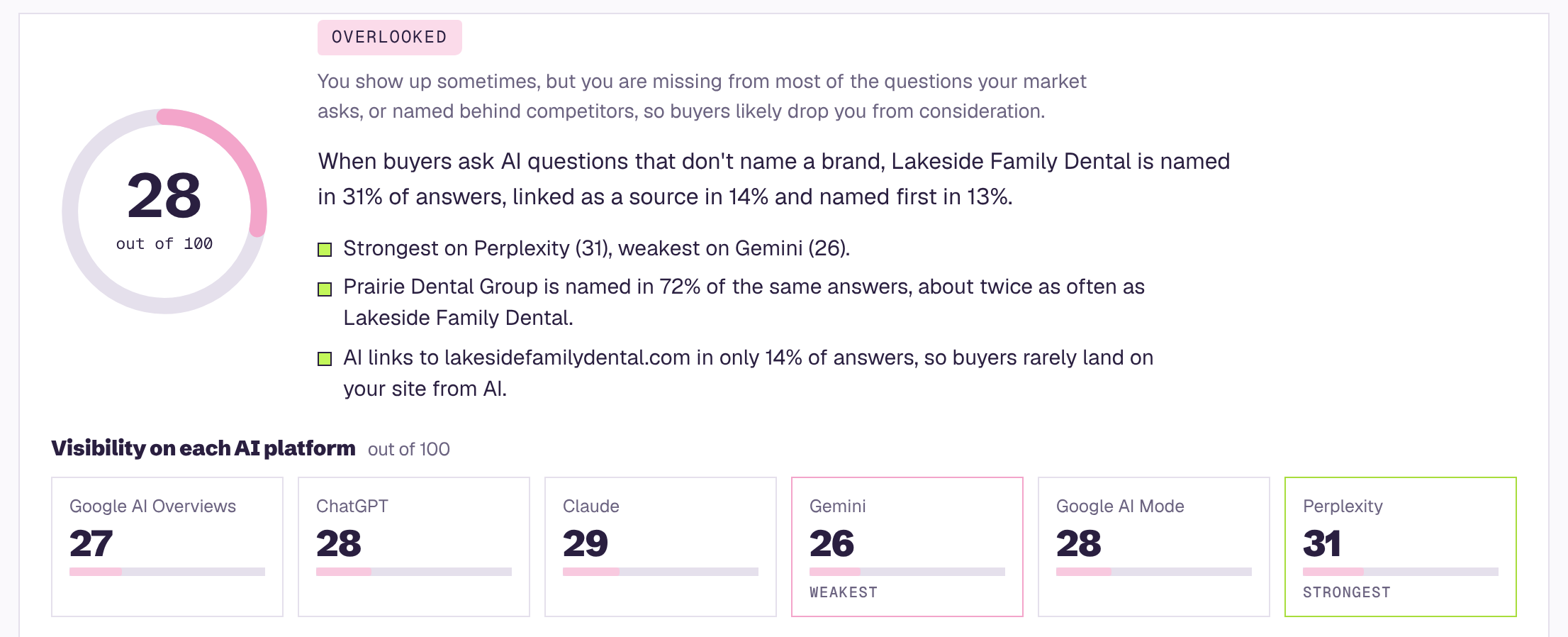

An Overlooked score with a 31% mention rate and a 14% citation rate tells a clear story. Lakeside is known and well regarded where it's been longest, but competitors are named far more often across the region, AI rarely sends patients to its website, and one wrong fact is turning away exactly the patients it wants. The fixes are concrete: correct the new-patient status everywhere it appears, build real pages and reviews for every office, and publish honest answers about cost and billing.
Patients still want a provider they trust
Patients have always chosen providers on trust, convenience and reputation. That hasn't changed. What's changed is who they ask first. More and more, it's an AI assistant, and it recommends the practices it understands best.
The practices that win this shift aren't doing anything exotic. They explain clearly who they help and how. They're honest about cost. They keep their facts current. They make booking easy. And they make sure what AI says about them is true.
The first step is knowing where you stand today.
Keep learning
- What is AI visibility?
- How to get your business recommended by AI, with guides for ChatGPT, Google AI Overviews, Perplexity, Gemini and Claude
- AI visibility benchmark 2026
- The AI visibility glossary
See what AI tells patients about your practice
Enter your website and get a free AI visibility report. It takes a few minutes, and you'll see:
- Your AI visibility score, overall and for ChatGPT, Gemini, Claude, Perplexity and Google's AI Overviews and AI Mode
- Which practices AI recommends instead of you, and how often
- Your visibility in every city you serve, and the competitor AI names most in each one
- What AI gets wrong about you, and what to fix first
- Your biggest gaps: the buyer questions where AI leaves you out, and who it recommends instead
- A downloadable PDF you can share with your team