Success rates, costs and hope: how patients choose a fertility clinic through AI
Patients now ask AI how to read IVF success rates, what treatment costs and how to choose a fertility clinic. Here's what AI tells them, and how fertility clinics get named.
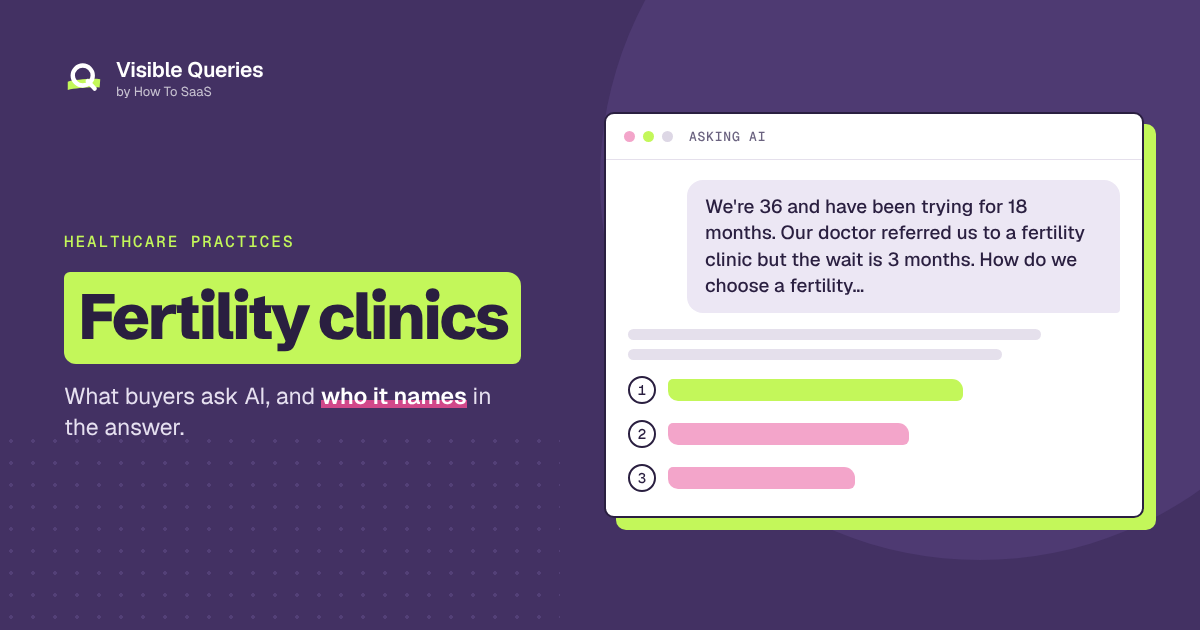
A couple in Toronto has been trying to conceive for 18 months. They're both 36. Their family doctor ordered some basic tests and gave them a referral, but the wait for the clinic they were sent to is three months. They've heard that clinics differ a lot, and that costs can be overwhelming. One evening they ask ChatGPT:
"We're 36 and have been trying for 18 months. Our doctor referred us to a fertility clinic but the wait is 3 months. How do we choose a fertility clinic in Toronto? How do we compare success rates? What does IVF cost in Ontario and what's publicly funded? Which clinics are well regarded?"
AI explains when people usually seek fertility help, what initial testing involves, how to read success rate data carefully (by age group and per transfer or per cycle), what Ontario's funding program typically covers and what it doesn't, the costs of medication and add-ons, and questions to ask at a consultation. Then it names several clinics. The couple books consultations at two of them.
Fertility treatment is emotional, expensive and deeply researched. Patients spend months reading, comparing clinics, joining forums and asking questions they might not ask anyone else. AI is now one of the places they ask.
Our healthcare guide covers how patients choose practices in general. This one goes through the questions that decide fertility patients, what AI usually says, and what clinics can publish so AI names them.
Here are the questions at a glance:
| The question | What gets you named |
|---|---|
| "How do I choose a fertility clinic?" | Your doctors, lab, approach and support |
| "How do I read success rates?" | Your published rates, with context |
| "What does IVF cost? What's covered?" | Prices, packages and coverage |
| "What are my options?" | Every path you offer, explained plainly |
"How do I choose a fertility clinic?"
What AI usually says: It suggests comparing success rates carefully, the doctors' experience, the lab, wait times, communication, costs, location and how the clinic supports patients emotionally.
What to publish: A clear guide to what makes your clinic different: your physicians and their focus, your lab and embryology team, your patient support, wait times for a first consultation, and how you communicate during treatment.
"How do I read success rates?"
This is the defining question for fertility clinics.
What AI usually says: It explains that success rates should be compared by age group and by measure (live births per transfer, per cycle started, cumulative), that clinics treating more complex cases may have lower raw rates, and that patients should look at official reporting where it exists.
What to publish: Your outcomes explained honestly, in the same terms official reporting uses, with clear context. Don't cherry-pick. AI and patients both notice when a clinic's numbers look too good, and transparency is far more persuasive.
"What does IVF cost? What's covered?"
What AI usually says: It gives typical cost ranges for a cycle, medications, genetic testing, embryo freezing and storage, and explains what public programs or insurance mandates may cover in the patient's state or province.
What to publish: Your full pricing, what's included in each package, medication cost estimates, financing, multi-cycle or refund programs if you offer them, and how you work with public funding or insurance. Cost is often the deciding factor, and clear pricing builds trust.
"What are my options?"
What AI usually says: It explains IUI, IVF, egg freezing, donor eggs or sperm, gestational carriers and fertility preservation, and who each is commonly recommended for.
What to publish: A page for every treatment you offer, written for patients: who it's for, what the process looks like, timelines, costs and what to expect emotionally.
Who's asking
Fertility patients are not one group. Each has its own questions:
- Single people and LGBTQ+ couples ask about donor programs, reciprocal IVF and inclusive care.
- People freezing eggs ask about the best age, cost and storage.
- Cancer patients ask about urgent fertility preservation before treatment.
- People with PCOS, endometriosis or recurrent miscarriage ask about specialized care.
- People traveling for treatment ask about clinics that support out-of-town patients.
Each group needs a page that speaks to them directly. AI matches these specific questions to clinics that clearly serve them.
Where you're named, city by city
Fertility patients will often travel, but most start close to home. AI's answers can differ a lot between nearby cities:
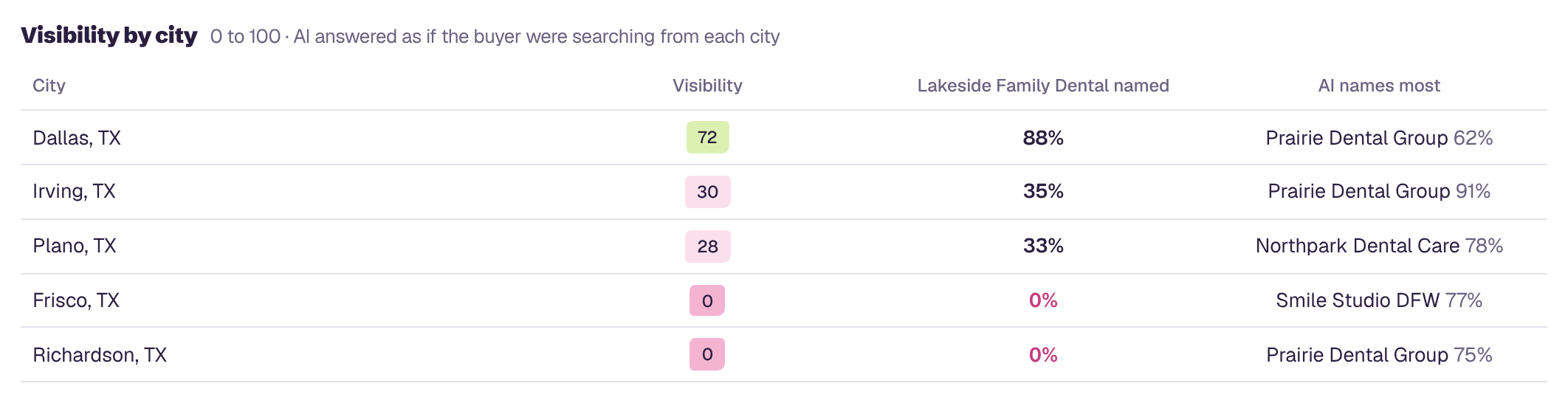
Clinic networks with several locations or satellite monitoring offices should make sure each one has its own page, with services, doctors and hours.
Support matters
Fertility treatment is hard on people. Patients ask AI about counseling, support groups, how to cope with failed cycles, and how to manage treatment with work. Clinics that offer counseling, patient navigators or support programs should describe them clearly. They're a real reason people choose one clinic over another.
What the sample report shows
Here's what a Visible Queries report looks like for Lakeside Family Dental, the sample family dental group in the Dallas–Fort Worth area from our guide. The questions are different for fertility clinics, but the patterns are the same.
The report starts with one score out of 100, a score for each AI platform, and the competitor AI names most:
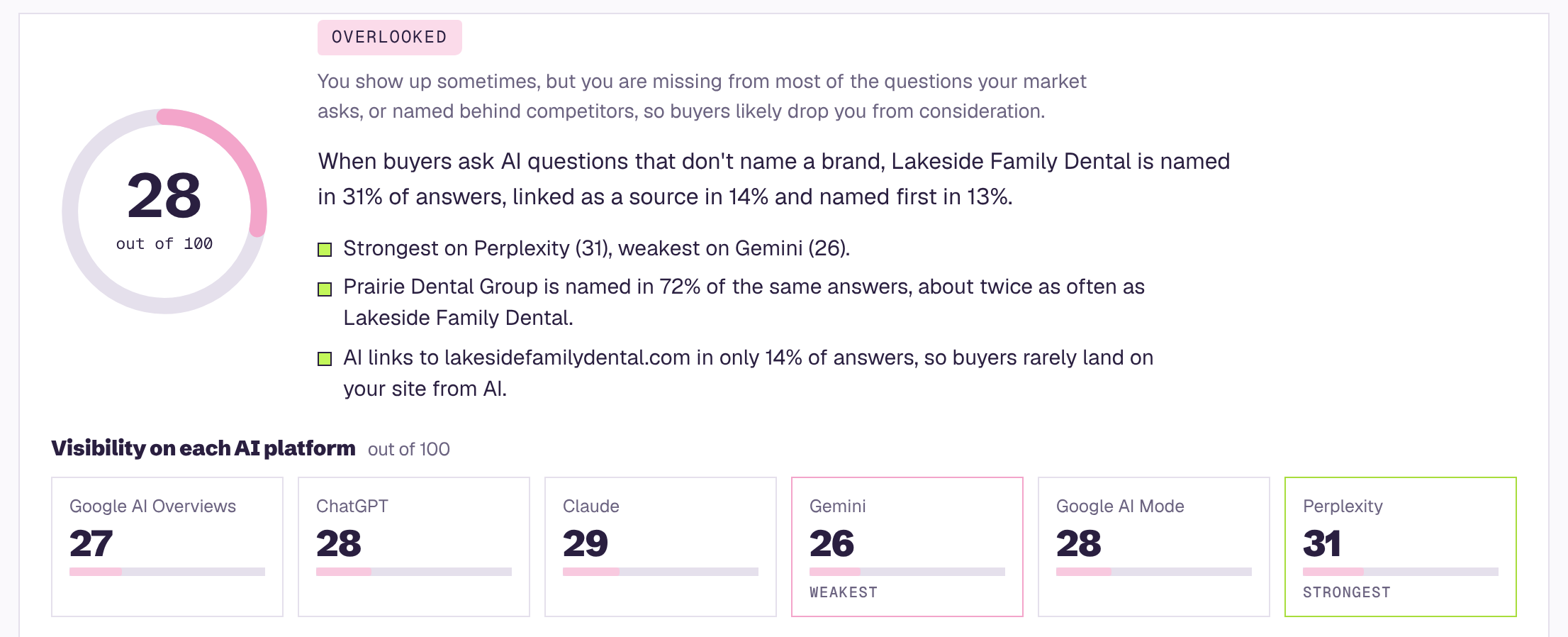
The gap is clearest side by side:
If you only fix three things
- Explain your success rates honestly and in context. By age and measure, matching official reporting.
- Publish full pricing and coverage information. Including medications, packages and financing.
- Write for every kind of patient. Single parents, LGBTQ+ families, egg freezing, preservation and specific conditions.
Patients are asking AI where to place their hope and their savings. The clinic AI names will be the one that's most honest with them.
Part of our guide: Why AI visibility matters for healthcare practices
See what AI tells patients about your fertility clinic
Enter your website and get a free AI visibility report. It takes a few minutes, and you'll see:
- Your AI visibility score, overall and for ChatGPT, Gemini, Claude, Perplexity and Google's AI Overviews and AI Mode
- Which clinics AI recommends instead of you, and how often
- Your visibility in every city you serve, and the competitor AI names most in each one
- What AI gets wrong about you, and what to fix first
- Your biggest gaps: the buyer questions where AI leaves you out, and who it recommends instead
- A downloadable PDF you can share with your team