Who's qualified, what it costs, and will it look natural: how patients choose a dermatologist, med spa or plastic surgeon through AI
Patients now ask AI who's qualified to do Botox, what a laser treatment should cost and which plastic surgeons get natural results. Here's what AI tells them, and how dermatology clinics, med spas and plastic surgeons get named.
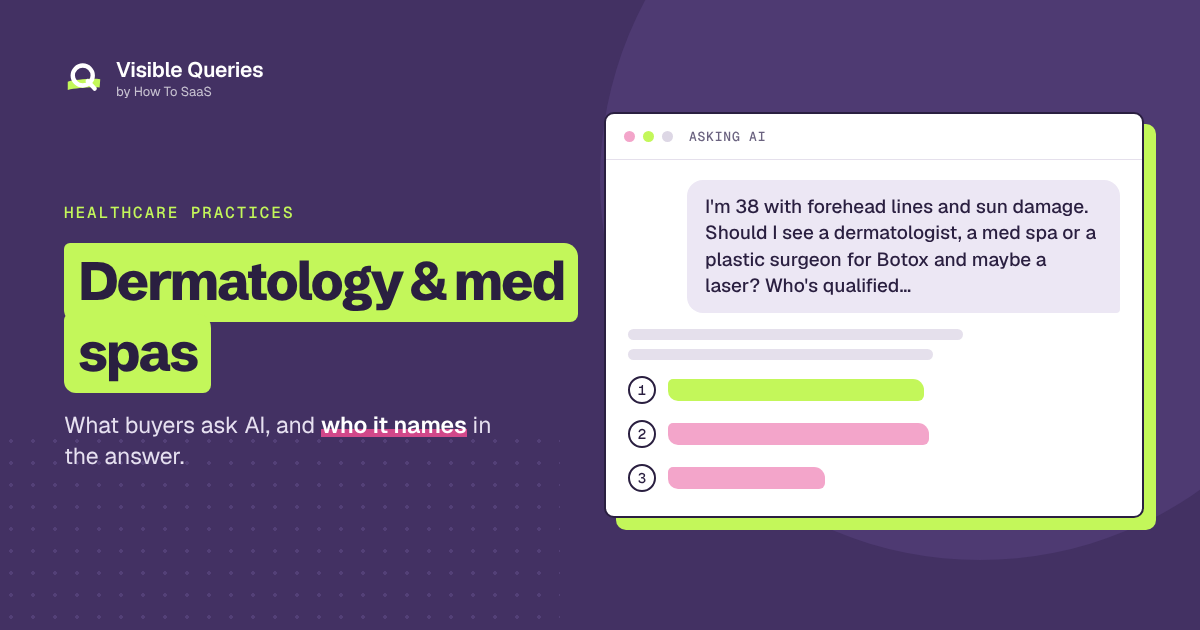
Someone in San Diego is 38 and starting to notice forehead lines and some sun damage from years of surfing. They're interested in Botox and maybe a laser treatment, but they've seen too many frozen faces and they don't know whether to go to a dermatologist, a med spa or a plastic surgeon. They ask ChatGPT:
"I'm 38 with forehead lines and sun damage. Should I see a dermatologist, a med spa or a plastic surgeon for Botox and maybe a laser? Who's qualified to inject, what should it cost in San Diego, and how do I find someone who gets natural results?"
AI explains the differences between the three kinds of providers, who is typically allowed to inject, what training and supervision to look for, typical pricing for neurotoxins and common laser treatments, why consultations matter, and how to judge natural results from before-and-after photos. It also mentions that a dermatologist should check sun damage for skin cancer. Then it names three providers. One books a consultation that week.
Medical aesthetics and dermatology are where healthcare meets consumer choice. Patients pay out of pocket, compare providers carefully, worry about safety and results, and do a lot of research before booking. AI is now part of that research, and it's often the one sorting providers into "qualified" and "not sure."
Our healthcare guide covers how patients choose practices in general. This one goes through the questions that decide dermatology, med spa and plastic surgery patients, what AI usually says, and what practices can publish so AI names them.
Here are the questions at a glance:
| The question | What gets you named |
|---|---|
| "Dermatologist, med spa or plastic surgeon?" | Who does what in your practice, and when to see whom |
| "Who's qualified to do this?" | Who performs each treatment, with credentials |
| "How much does Botox or laser cost?" | Price ranges by treatment |
| "Will it look natural?" | Before-and-after photos and honest expectations |
"Dermatologist, med spa or plastic surgeon?"
What AI usually says: It explains what each does: dermatologists treat skin conditions and also do cosmetic work, med spas offer cosmetic treatments under medical supervision, and plastic surgeons perform surgery and often non-surgical treatments too. It usually suggests matching the provider to the treatment and checking credentials.
What to publish: Who you are, who's on your team, their training and board certifications, and what you treat. If you're a med spa, explain your medical director, who performs each treatment and their qualifications.
"Who's qualified to do this?"
This is the defining question in aesthetics.
What AI usually says: It encourages patients to check credentials, ask who will perform the treatment and how experienced they are, and be cautious of very low prices.
What to publish: A page for every provider, with their credentials, training, how long they've done each treatment and what they specialize in. Patients look for this, and so does AI.
"How much does Botox, filler or laser cost?"
What AI usually says: Typical ranges, with notes on how pricing works (per unit, per syringe, per area, per session), and how many sessions are usually needed.
What to publish: Your pricing, or at least starting prices and how you price each treatment, plus memberships and packages. Aesthetic patients compare, and AI fills gaps with averages that may not reflect your prices.
"Will it look natural?" "Can I see results?"
What AI usually says: It suggests looking at before-and-after photos, reviews that mention results and consultations where the provider explains the plan.
What to publish: Before-and-after galleries with written descriptions: the treatment, the area, the number of sessions and the time between photos. Photos alone don't help AI much. Descriptions do.
Medical dermatology is a different search
Not every patient wants cosmetic work. Many ask about acne, eczema, psoriasis, rosacea, hair loss or a mole that looks different. They ask "dermatologist for adult acne in San Diego," "how long does it take to get a dermatologist appointment?" or "skin cancer screening near me." These patients care about insurance, wait times, and the dermatologist's focus.
What to publish: Pages for the conditions you treat, insurance accepted, how to get an appointment and typical wait times, and any same-week or urgent options for concerning moles.
Which topics AI gives to competitors
Practices in this category often find they win some kinds of questions and lose others:
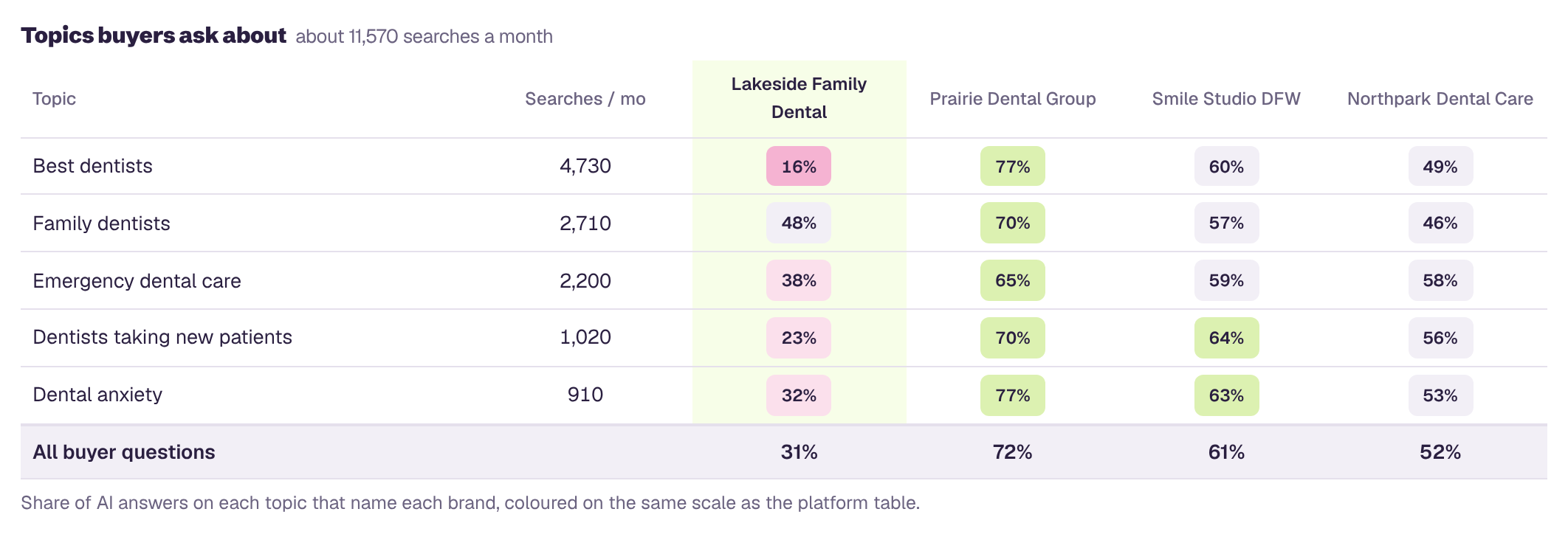
A common pattern for aesthetics is being named when patients ask about one popular treatment, and missing when they ask about others that the practice also offers. Every treatment needs its own page for AI to connect you to it.
Here's more from the same kind of report, for Lakeside Family Dental, a fictional family dental group in the Dallas–Fort Worth area.
It also shows visibility city by city, with the competitor AI names most in each:
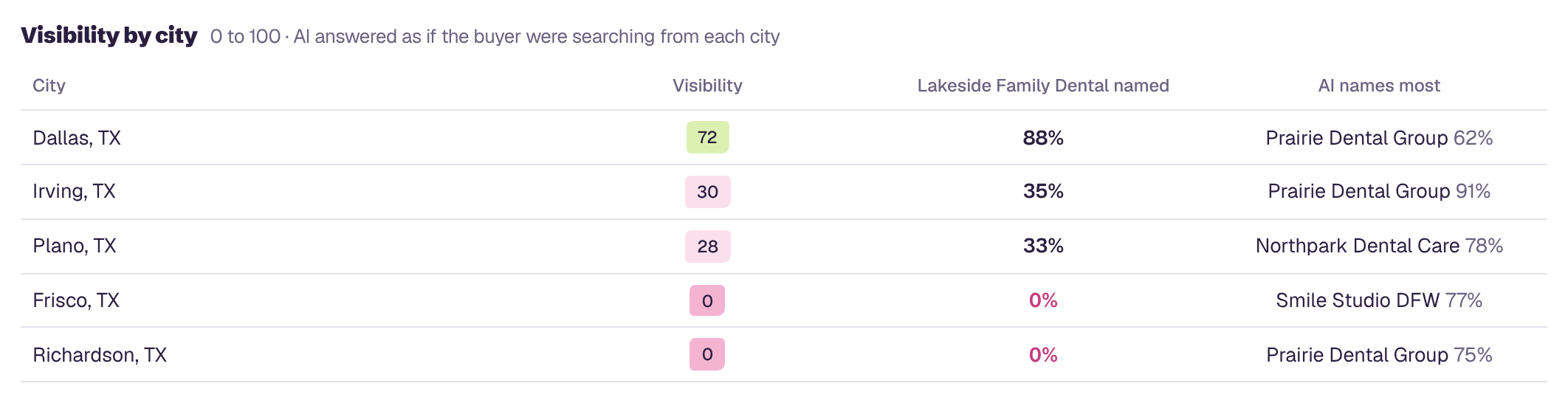
The gap is clearest side by side:
Plastic surgery: bigger decisions, longer research
Surgical patients research for months. They ask about specific procedures, recovery time, risks, costs, financing, travel and the surgeon's experience. Give every procedure its own detailed page, explain your consultation process, show your surgeon's credentials, and write honest recovery guides. Patients often ask about revision surgery too, so if you do revisions, say so.
If you only fix three things
- Show who performs each treatment and their qualifications. On every provider and treatment page.
- Publish pricing and how it works. Per unit, per area, per session, plus memberships.
- Turn galleries into descriptions. Treatment, area, sessions and time between photos.
Patients are asking AI who they can trust with their face. The practice AI names will be the one that makes qualifications and results easy to see.
Part of our guide: Why AI visibility matters for healthcare practices
See what AI tells patients about your practice
Enter your website and get a free AI visibility report. It takes a few minutes, and you'll see:
- Your AI visibility score, overall and for ChatGPT, Gemini, Claude, Perplexity and Google's AI Overviews and AI Mode
- Which practices AI recommends instead of you, and how often
- Your visibility in every city you serve, and the competitor AI names most in each one
- What AI gets wrong about you, and what to fix first
- Your biggest gaps: the buyer questions where AI leaves you out, and who it recommends instead
- A downloadable PDF you can share with your team