The hardest search: how people choose a therapist or addiction treatment program through AI
People now ask AI how to find a therapist who takes their insurance, which kind of therapy fits and how to choose a treatment program for a loved one. Here's what AI tells them, and how mental health and addiction treatment providers get named.
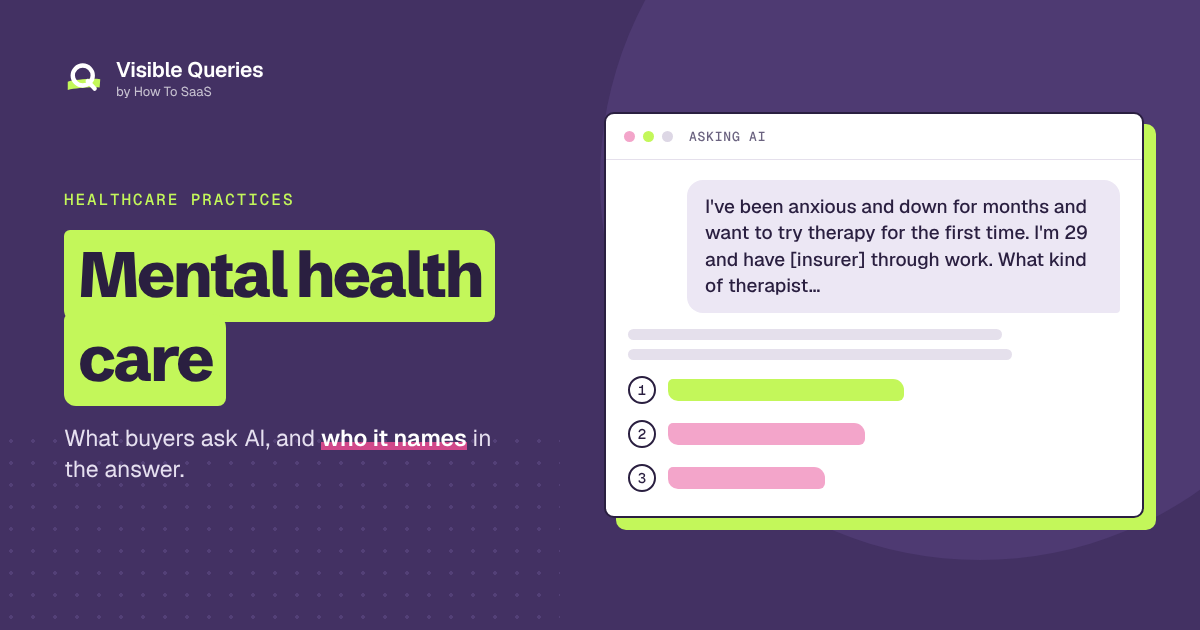
Someone in Phoenix has been feeling flat and anxious for months. They finally decided to talk to someone, but they don't know where to start. Their insurance website lists hundreds of names with no way to tell them apart. Late one night, they ask ChatGPT:
"I've been anxious and down for months and want to try therapy for the first time. I'm 29 and have [insurer] through work. What kind of therapist should I look for, what's the difference between CBT and other types, and how do I find someone in Phoenix who takes my insurance and has openings?"
AI explains the differences between psychologists, licensed counselors, clinical social workers and psychiatrists, describes common approaches like CBT, ACT and psychodynamic therapy, suggests looking for someone who specializes in anxiety and depression, explains how to check insurance coverage and what a first session is like, and encourages them to reach out. It also gives crisis resources in case things get worse. Then it suggests a few practices. The person sends an inquiry the next morning.
Mental health and addiction treatment are the most sensitive searches in healthcare. People ask AI because it feels private and doesn't judge. Sometimes they're asking for themselves, sometimes for a child, a partner or a parent. The stakes are high, the options are confusing, and trust is everything.
Our healthcare guide covers how patients choose practices in general. This one goes through the questions that decide mental health and addiction treatment, what AI usually says, and what providers can publish so AI names them responsibly.
Here are the questions at a glance:
| The question | What gets you named |
|---|---|
| "What kind of therapist do I need?" | Plain explanations of the approaches you offer |
| "Which therapists take my insurance?" | The plans you accept and self-pay rates |
| "Who has openings?" | Current availability and waitlist times |
| "Therapist for [specific need]" | A page for each need you specialize in |
| "What level of care does my loved one need?" | A clear guide to levels of care |
| "Is this rehab legitimate?" | Licensing, accreditation and outcomes, stated plainly |
A note on how AI handles these questions
AI is careful here. When someone describes a crisis, AI points them to emergency and crisis resources first. For everything else, it tends to recommend providers whose credentials, approach and policies are clear and verifiable, and it's cautious about programs with aggressive marketing or vague claims. That caution works in favor of providers that are transparent.
Therapy: the questions that decide the first appointment
"What kind of therapist do I need?"
What AI usually says: It explains the different licenses and what each provider can do, and matches them to needs: talk therapy, medication, testing or specialized care.
What to publish: Clear bios for every clinician: license, training, approaches, specialties, the people they work best with, and languages spoken. Patients and AI both match on these details.
"Which therapists take my insurance? What does it cost without insurance?"
What AI usually says: It explains in-network and out-of-network care, superbills and sliding scale fees.
What to publish: The insurers you're in network with, self-pay rates, sliding scale options, and how out-of-network reimbursement works. This is one of the most common barriers to starting therapy.
"Who has openings?" "Is there a waitlist?"
What to publish: Current availability, how quickly new clients are usually seen, telehealth options and how intake works. Even a simple "we're accepting new clients for evening telehealth" helps.
"Therapist for [specific need]"
People search for very specific help: "therapist for postpartum anxiety," "trauma therapist who does EMDR," "therapist for teens with OCD," "LGBTQ-affirming couples counselor," "therapist for first responders." Each specialty you truly offer deserves its own page, with the clinicians who provide it.
Addiction treatment: the questions that decide admissions
"What level of care does my loved one need?"
What AI usually says: It explains detox, inpatient or residential treatment, partial hospitalization, intensive outpatient and outpatient care, and that a clinical assessment determines the right level. It often mentions medication for opioid and alcohol use disorders.
What to publish: Clear descriptions of the levels of care you offer, who each suits, how assessment works and how you coordinate transitions between levels.
"How do I know if a rehab is legitimate?"
This is the defining question for addiction treatment.
What AI usually says: It suggests checking licensing and accreditation, the credentials of clinical staff, the use of evidence-based treatment including medication where appropriate, transparent pricing, and family involvement. It warns about patient brokering, promises of guaranteed cures and pressure tactics.
What to publish: Your licenses and accreditations, clinical team and credentials, treatment approaches, outcomes you measure (without exaggeration), insurance and pricing, and aftercare. Being specific is how you earn AI's trust in a category it treats cautiously.
"Does insurance cover rehab?"
What to publish: Insurers you work with, how verification works, what out-of-pocket costs may look like, and financing or self-pay options. Families often ask this first.
Which topics AI gives to competitors
Here's how the report shows which topics a provider wins and loses:
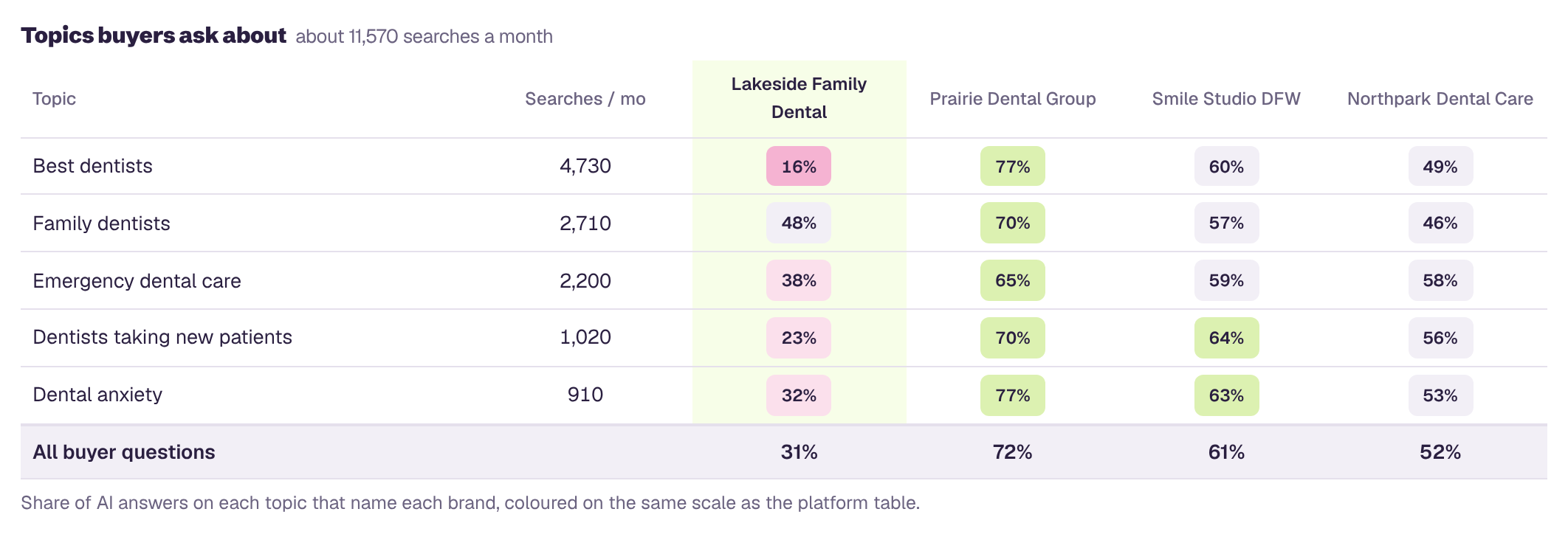
For mental health practices, the most valuable rows are usually specific needs and insurance questions. For treatment programs, they're the trust and legitimacy questions.
Here's more from the same kind of report, for Lakeside Family Dental, a fictional family dental group in the Dallas–Fort Worth area.
For a business that serves more than one city, the report checks each one separately:
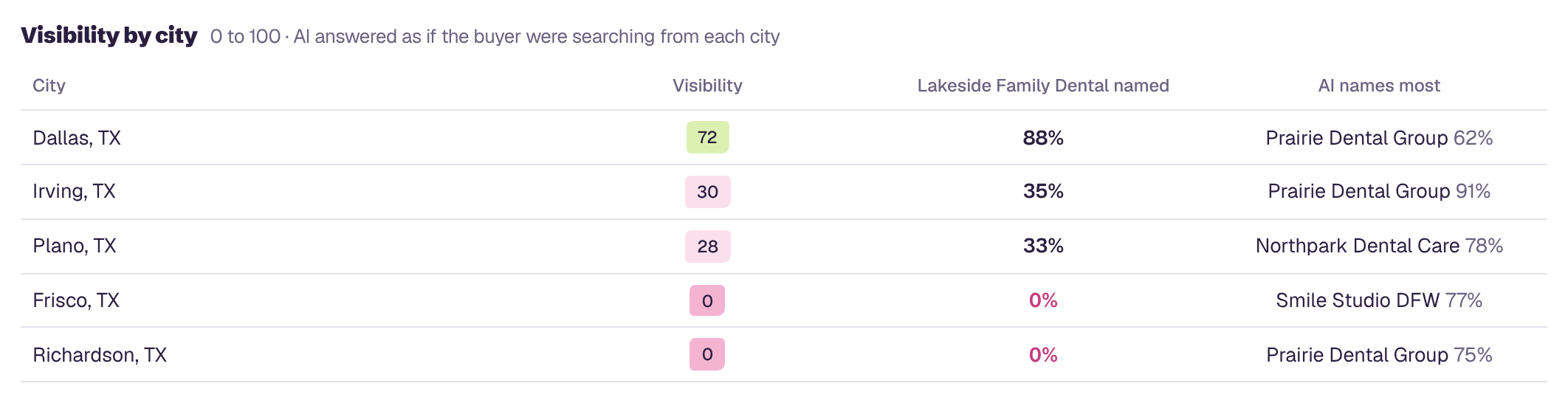
The gap is clearest side by side:
Writing for families
Many of these searches come from someone other than the patient: a parent worried about a teenager, a spouse, an adult child. Pages for families, covering how to talk to a loved one, what happens at intake, how families are involved and how to support recovery, are both genuinely helpful and the kind of content AI recommends.
If you only fix three things
- Make credentials and approach clear. For every clinician and every program.
- Publish insurance, costs and availability honestly. Including sliding scales and waitlists.
- Give each specialty and level of care its own page. With who it's for and how it works.
People are asking AI for help at some of the hardest moments of their lives. The providers AI names will be the ones that are clearest about who they are and how they help.
Part of our guide: Why AI visibility matters for healthcare practices
See what AI tells people about your practice or program
Enter your website and get a free AI visibility report. It takes a few minutes, and you'll see:
- Your AI visibility score, overall and for ChatGPT, Gemini, Claude, Perplexity and Google's AI Overviews and AI Mode
- Which providers AI recommends instead of you, and how often
- Your visibility in every city you serve, and the competitor AI names most in each one
- What AI gets wrong about you, and what to fix first
- Your biggest gaps: the buyer questions where AI leaves you out, and who it recommends instead
- A downloadable PDF you can share with your team