Letting someone into your home: how people choose a house cleaning service through AI
People now ask AI what house cleaning should cost, whether a service is safe and insured, and who to hire for recurring or move-out cleans. Here's what AI tells them, and how cleaning companies get named.
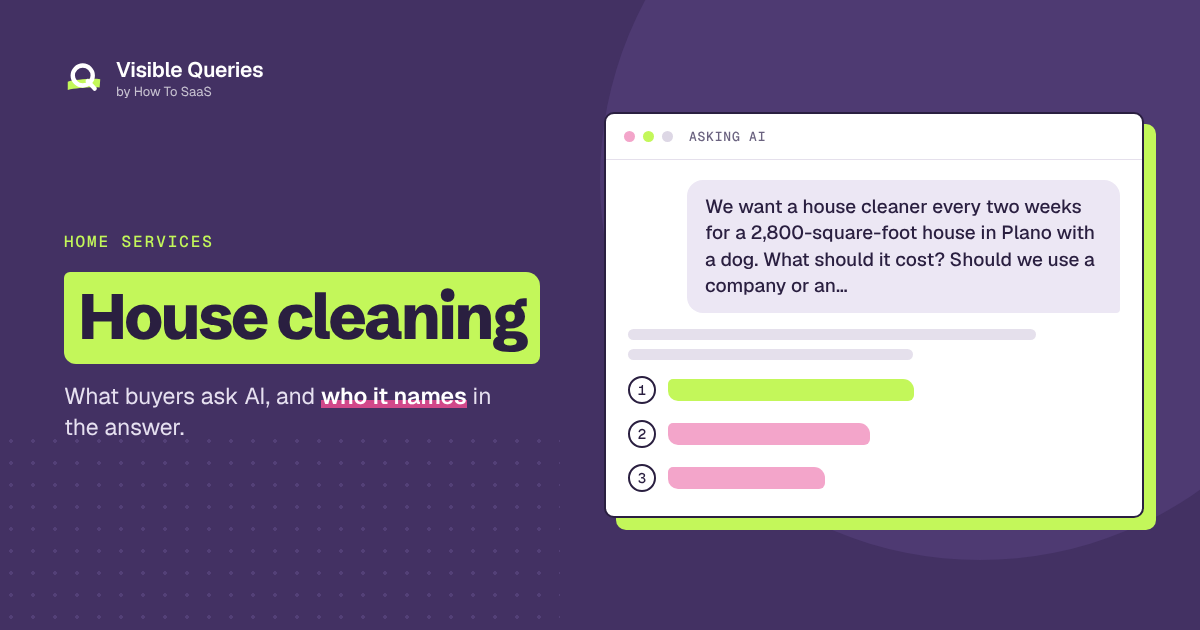
A two-income family in Plano has finally admitted that weekends are disappearing into laundry, bathrooms and floors. They want help, but they're nervous: someone would have keys to their home, be around their dog and see their stuff. They ask ChatGPT:
"We want a house cleaner every two weeks for a 2,800-square-foot house in Plano with a dog. What should it cost? Should we use a company or an independent cleaner? How do we know they're insured and trustworthy? Who's good around Plano?"
AI explains typical pricing for recurring cleans, the difference between an agency and an independent cleaner, what insurance, bonding and background checks mean, what to ask about pets and supplies, and why a first deep clean usually costs more. Then it names three local services. The family books a first clean with one of them, and stays for three years.
House cleaning is a trust business more than almost any other home service. It's recurring, it happens inside the home, often when nobody is there, and it depends on the same people showing up and doing it well. AI's answers reflect all of that.
Our home services guide covers the homeowner's journey in general. This one goes through the questions that decide house cleaning customers, what AI usually says, and what cleaning companies can publish so AI names them.
Here are the questions at a glance:
| The question | What gets you named |
|---|---|
| "How much does house cleaning cost?" | Prices by home size and frequency, and what a standard clean includes |
| "Company or independent cleaner?" | An honest case for how you work |
| "Are they insured and background checked?" | A trust page on insurance, checks, keys and alarm codes |
| "What does a deep clean include?" | Room-by-room checklists for each type of clean |
| "Are their products safe for kids and pets?" | The products you use and your fragrance-free options |
| "Do they send the same person?" | How you schedule and staff, and how you cover absences |
| "Best house cleaning in [neighborhood]?" | A page for every area you serve |
"How much does house cleaning cost?"
What AI usually says: A range by home size and frequency, with what moves the price: square footage, bedrooms and bathrooms, pets, how dirty the home is, frequency, and extras like ovens, fridges, windows and laundry. It often says a first deep clean costs more than a recurring one.
Why it matters: Price is the first filter. If AI's range is lower than yours and nobody has explained why, you lose before the quote.
What to publish: A clear pricing page: price ranges or starting prices by home size and frequency, what a standard clean includes, what costs extra, and how the first clean differs. Online instant quotes help too, as long as AI can read the ranges behind them.
"Company or independent cleaner?"
What AI usually says: It weighs reliability, backup coverage when someone is sick, insurance and bonding, background checks, consistency of the cleaner, pricing and flexibility. It often suggests that a company is better for people who want insurance and reliability, and an independent cleaner for people who want a personal relationship and lower prices.
What to publish: Make the case for how you work, honestly. If you assign the same cleaner every time, say so. If you have backup coverage, guarantees and insurance, explain them. These are exactly the comparison points AI uses.
"Are they insured and background checked?"
What AI usually says: It explains the difference between liability insurance, bonding and workers' compensation, and suggests asking for proof. It recommends background-checked staff, especially for homes with children or when nobody will be home.
What to publish: A plain trust page covering insurance, bonding, background checks, training, how keys and alarm codes are handled, and what happens if something is damaged. Specifics are much more persuasive, to people and to AI, than a "trusted and insured" badge.
"What does a deep clean include?" "What about move-out cleaning?"
What AI usually says: It lists what's typically covered in standard, deep and move-in or move-out cleans, and notes that move-out cleans often aim to meet landlord or property manager checklists so tenants get their deposit back.
What to publish: Checklists for each type of clean, room by room. Move-out cleaning is a big, time-sensitive market with renters, landlords, property managers and real estate agents all asking about it. A clear move-out checklist and a "deposit-back guarantee," if you offer one, are strong reasons to be named.
"Are their products safe for my kids and pets?"
What AI usually says: It suggests asking what products are used and whether eco-friendly or fragrance-free options are available, and mentions that some people with allergies or asthma prefer unscented products.
What to publish: The products you use, whether customers can request their own, and your eco-friendly or fragrance-free options. Many people search specifically for "green cleaning" or "non-toxic house cleaning," and AI recommends the companies that clearly offer it.
"Is [company] reliable? Do they send the same person?"
What AI usually says: A summary of reviews. In this category, reviews are full of reliability and consistency: missed appointments, rushed cleans, a different person every time, or the opposite, like "Maria has cleaned our house for three years and she's wonderful."
Why it matters: Reliability is the whole product. AI repeats patterns in reviews, and wrong facts about how you operate can quietly cost you customers. Here's how the report surfaces them:
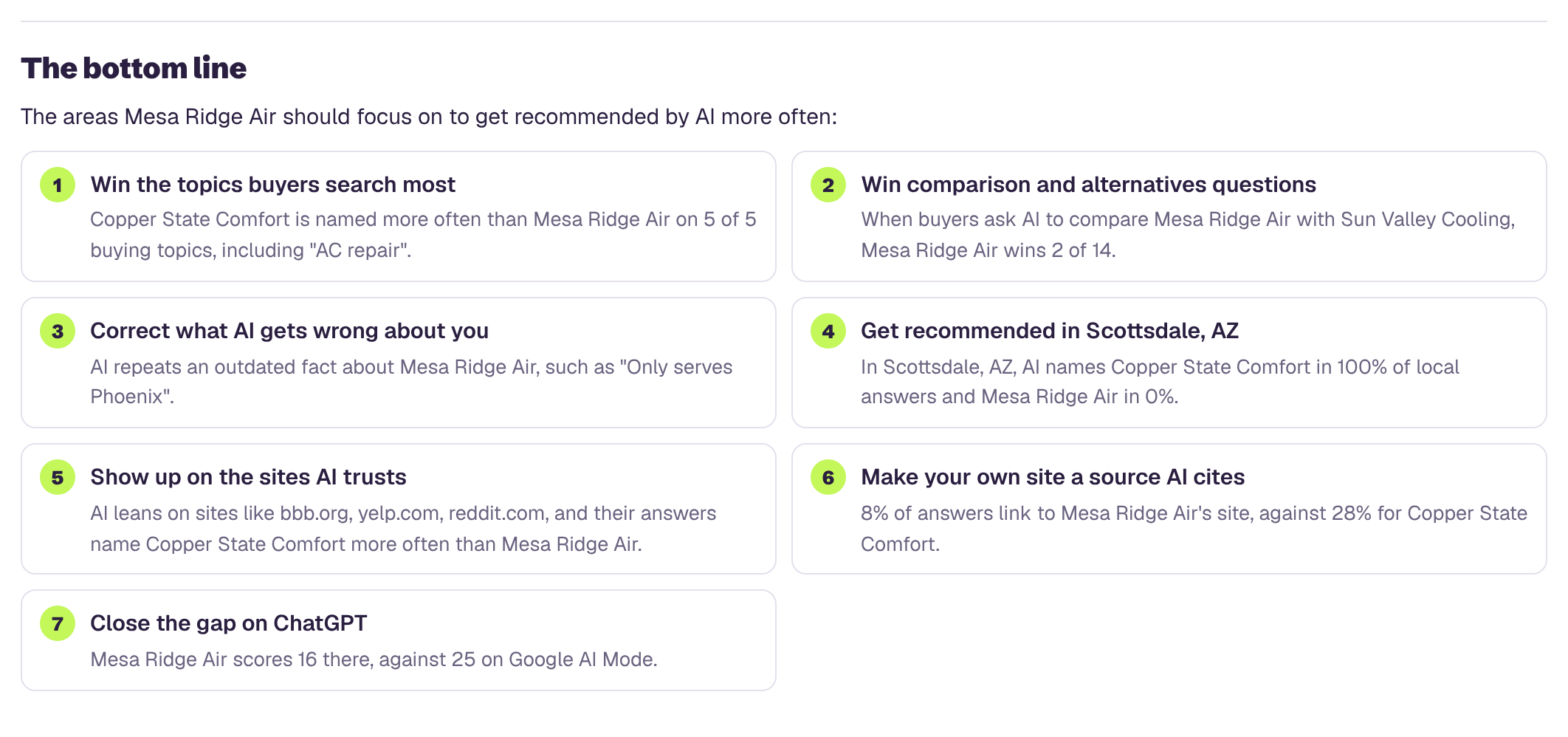
For a cleaning company, common wrong facts include "doesn't serve [suburb]," "doesn't do move-out cleans," "only does commercial" or a pricing complaint from years ago that no longer applies.
What to publish: A clear description of how you schedule and staff. Do you assign a regular cleaner or team? How do you handle sick days and holidays? What's your re-clean guarantee? Then encourage happy recurring customers to mention those things in reviews.
"Best house cleaning service in [neighborhood]?"
What AI usually says: It names a few services, usually local ones with strong reviews and clear pricing, sometimes alongside national franchises or booking platforms.
What to publish: A page for every area you serve. Cleaning companies often serve a tight radius to keep drive time down, so be specific about the neighborhoods and suburbs you cover, and get reviews that mention them.
Recurring customers are the business
The first clean is the hardest sale, and it's often the least profitable. The value is in the customers who stay for years. AI plays a part here too. Current customers ask things like "is it normal to tip a house cleaner?", "how much notice should I give to cancel?" and "should I switch cleaning services?"
The companies that keep customers make the relationship easy: simple rescheduling, clear communication, consistent cleaners, and a quick fix when something is missed. They also make it easy to leave a review after a great clean, when customers are happiest.
Commercial and specialty cleaning
Many cleaning companies also serve offices, medical practices, short-term rentals, new construction and post-renovation jobs. These buyers ask AI different questions: "Airbnb turnover cleaning in Austin," "post-construction cleaning company in Denver," "office cleaning for a 5,000-square-foot dental practice." If you do this work, give each type its own page, with what's included, scheduling and pricing.
What the sample report shows
Here's what a Visible Queries report looks like for Mesa Ridge Air, the sample Phoenix-area HVAC company from our guide. The questions are different for cleaning companies, but the patterns are the same.
It also shows visibility city by city, with the competitor AI names most in each:
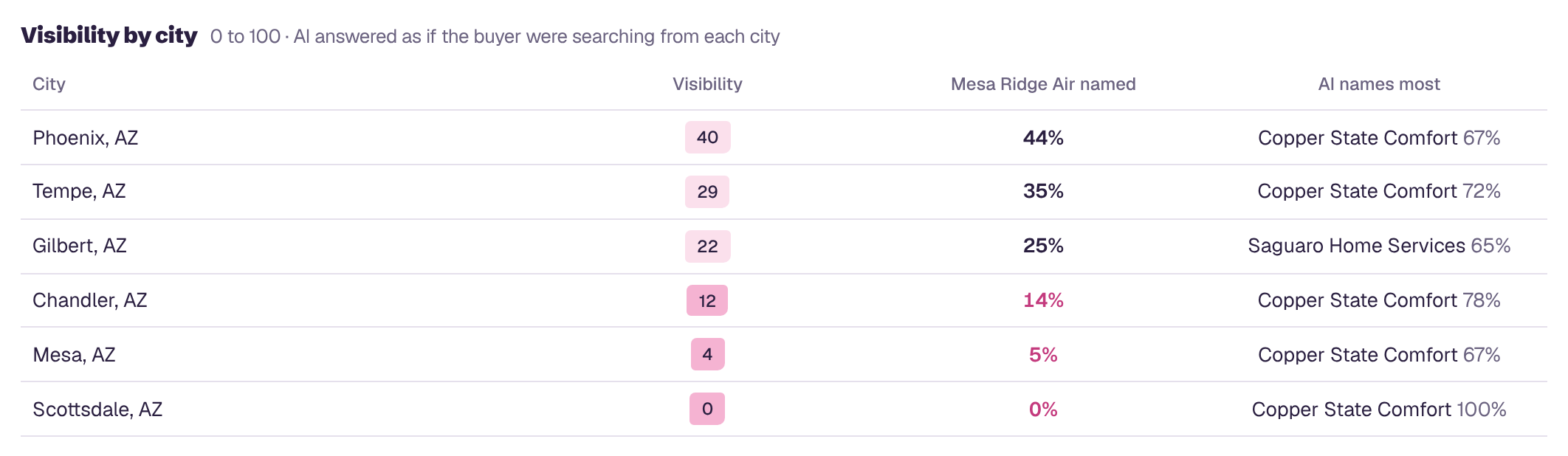
The gap is clearest side by side:
If you only fix three things
- Publish clear pricing and checklists. By home size, frequency and type of clean.
- Spell out trust. Insurance, bonding, background checks, key handling, regular cleaners and your guarantee.
- Be specific about where you work. A page for every area, with local reviews.
People are asking AI who they can trust in their home. The cleaning company AI names will be the one it understands best.
Part of our guide: Why AI visibility matters for home services companies
See what AI tells customers about your cleaning company
Enter your website and get a free AI visibility report. It takes a few minutes, and you'll see:
- Your AI visibility score, overall and for ChatGPT, Gemini, Claude, Perplexity and Google's AI Overviews and AI Mode
- Which cleaning services AI recommends instead of you, and how often
- Your visibility in every city you serve, and the competitor AI names most in each one
- What AI gets wrong about you, and what to fix first
- Your biggest gaps: the buyer questions where AI leaves you out, and who it recommends instead
- A downloadable PDF you can share with your team