"What is this bug?" How homeowners choose a pest control company through AI
Homeowners now ask AI to identify the pest, tell them whether it's dangerous and recommend who to call. Here's what AI tells them, and how pest control companies get named and turn that first call into a plan.
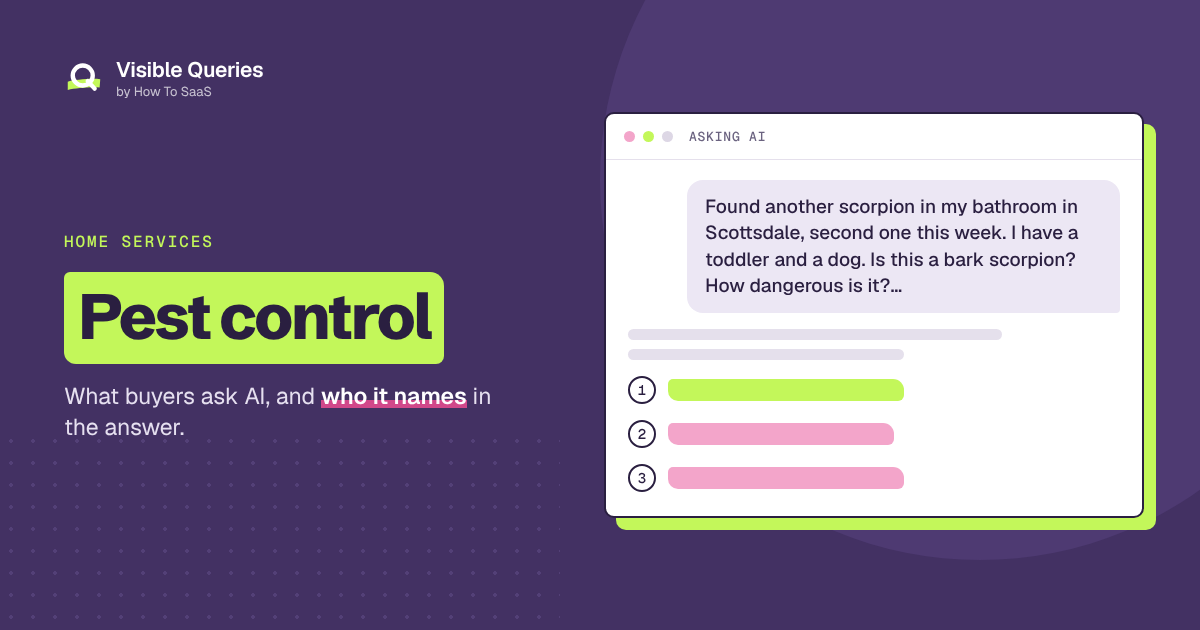
It's 11 p.m. in Scottsdale, and a homeowner has just found a scorpion on the bathroom floor, the second this week. There's a toddler in the house and a dog that sniffs everything. They take a photo and ask ChatGPT:
"Found another scorpion in my bathroom in Scottsdale, second one this week. I have a toddler and a dog. Is this a bark scorpion? How dangerous is it? How do I keep them out, and which pest control companies in Scottsdale are best for scorpions and safe for kids and pets?"
AI identifies the likely species, explains the risk to small children, says what to do if someone is stung, describes how professionals usually handle scorpions, and names three local companies. The homeowner books one in the morning and signs up for a quarterly plan.
Pest control is different from most home services in two ways. The first call usually starts with a question AI is very good at, which is identifying what the homeowner just found. And the real value isn't the first visit, it's the recurring plan that follows. AI now shapes both.
Our home services guide covers the homeowner's journey in general. This one goes through the questions that decide pest control customers, what AI usually says, and what companies can publish so AI names them.
Here are the questions at a glance:
| The question | What gets you named |
|---|---|
| "What is this?" | Local identification guides with real photos |
| "Is it dangerous?" | Calm, honest risk explanations |
| "Can I get rid of it myself?" | A genuinely helpful "DIY or call us?" page |
| "Is pest control safe for kids and pets?" | What you use, where you apply it and how long to stay away |
| "Is a plan worth it?" | Your plans, visit frequency, prices and guarantee in plain language |
| "Termite bond or not?" | A clear guide to inspections, treatments and warranties |
| "Best pest control company in [city]?" | A page for every area you serve |
"What is this?" (with a photo)
More and more pest questions arrive with a picture: a bug on the counter, droppings in the pantry, a swarm by the window, bites on an arm.
What AI usually says: It identifies the likely pest, often with a confidence caveat, explains how to tell it apart from look-alikes, and describes what it means. Termite swarmers vs flying ants, carpenter ants vs sugar ants, bed bug bites vs mosquito bites, mouse vs rat droppings.
Why it matters: Identification decides urgency and who gets called. "Flying ants, mostly harmless" ends the conversation. "Termite swarmers, call a professional" starts a high-value one.
What to publish: Local identification guides with real photos from your area, like "common ants in Houston and how to tell them apart" or "is it a termite or a flying ant? A guide for Tampa homeowners." Local, photo-rich content is exactly what AI leans on.
"Is it dangerous?"
What AI usually says: It explains the real risks, like venomous stings, disease from rodents, structural damage from termites and allergic reactions, and the special concerns for children, pets and older adults.
What to publish: Honest risk explanations for the pests you treat, calm rather than alarmist. Over-the-top scare copy reads as marketing, and AI tends to discount it.
"Can I get rid of it myself?"
What AI usually says: For ants, occasional spiders and minor mouse problems, it often suggests DIY steps first. For termites, bed bugs, serious rodent infestations, wasp nests in walls and scorpions in high numbers, it recommends a professional.
What to publish: A "DIY or call us?" page that's genuinely helpful. It earns trust, and trust earns the call when DIY stops working.
"Is pest control safe for my kids and pets?"
This may be the most common worry in the category.
What AI usually says: It explains that safety depends on the products and methods used, describes typical precautions like keeping pets away until treatments dry, and suggests asking companies what they use.
What to publish: Clear, specific information about what you use, where you apply it, how long families and pets should stay away, and any low-toxicity or eco-friendly options. A vague "pet-safe!" badge is much weaker than a plain explanation.
"Is a pest control plan worth it? Quarterly or monthly?"
This is where the business is made.
What AI usually says: It explains how recurring plans work, when they make sense (climate, pest pressure, home type), typical costs and what to check in the contract: what's covered, re-service guarantees and cancellation terms.
What to publish: Your plans in plain language: what each covers, how often you visit, the price or price range, the guarantee and how to cancel. Clear cancellation terms matter. Complaints about contracts that are hard to cancel are some of the most repeated reviews in the industry, and AI repeats them.
"Termite bond or not?"
What AI usually says: It explains termite inspections, treatment options like liquid barriers and bait systems, and what bonds or warranties typically cover, with advice to read the terms carefully.
What to publish: A clear guide to your termite services, including inspection, treatment options, what your warranty covers, annual renewal and how real estate termite letters work in your area.
"Best pest control company in [city]?"
What AI usually says: It names a few companies, often defaulting to big national brands when it doesn't know enough about local ones.
Why it matters: Pests are local, and so are the answers. A company can be the go-to name in one city and unknown in the next:
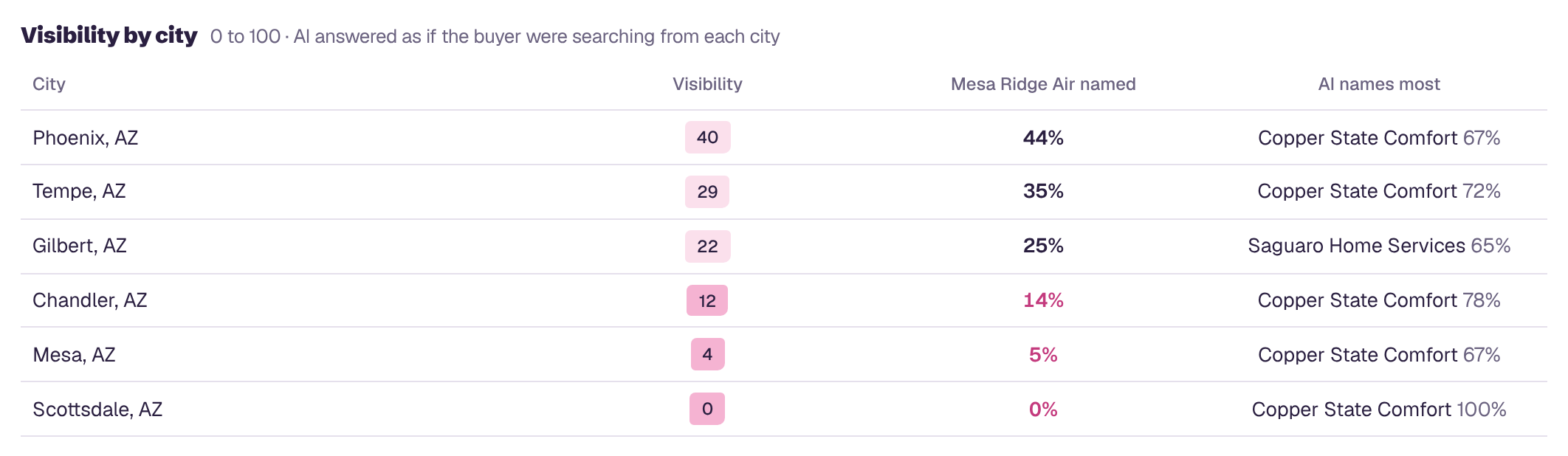
For a pest control company, a gap like that means every scorpion question in a city full of desert landscaping goes to a competitor. Local pages, local reviews and local pest content close it.
The pest calendar
Pest questions follow the seasons, and the companies that publish ahead of each one tend to get named:
| Season | What homeowners ask AI | What to have published |
|---|---|---|
| Early spring | "Flying ants or termites?" "Ants in the kitchen." | Termite swarm guide, ant identification |
| Late spring | "Wasp nest under the deck." "Ticks in the yard." | Stinging insect and tick guides |
| Summer | "Mosquito control for a backyard party." "Scorpions at night." | Mosquito and scorpion programs |
| Fall | "Mice in the walls." "Stink bugs everywhere." | Rodent exclusion and overwintering pest guides |
| Winter | "Rats in the attic." "Cockroaches in the apartment." | Rodent and indoor pest guides |
| Any time | "Bed bugs after a hotel stay." | Bed bug identification and treatment guide |
Adjust for your region. Southern states see many pests year-round, and northern cities have a sharp fall rodent season. A page that's live before the season starts is far more likely to be cited when the questions arrive.
Commercial pest control
Restaurants, property managers, warehouses, schools and healthcare facilities ask AI different questions: "Pest control for restaurants in Atlanta that provides inspection documentation," "pest control contract for a 200-unit apartment complex," "who handles pest audits for food warehouses?" If commercial work matters to you, give it a page, with the industries you serve, the documentation and audit support you provide, and response times.
What the sample report shows
Here's what a Visible Queries report looks like for Mesa Ridge Air, the sample Phoenix-area HVAC company from our guide. The questions are different for pest control companies, but the patterns are the same.
The report then picks out your biggest gaps: the buyer questions where AI leaves you out, and who it recommends instead:
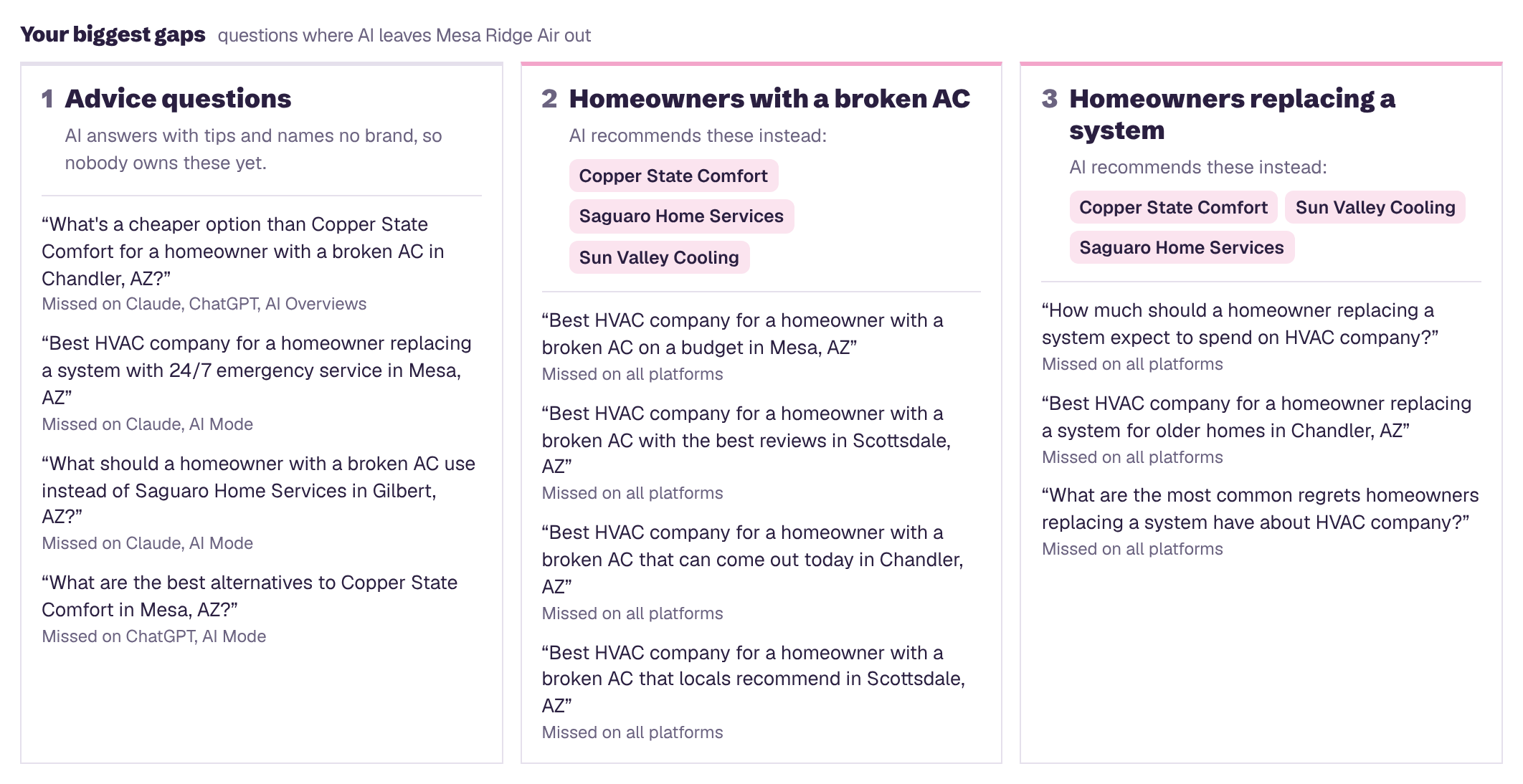
The gap is clearest side by side:
If you only fix three things
- Publish local, photo-rich identification guides. For the pests your customers actually find.
- Be clear about safety and plans. What you use, how it affects kids and pets, what plans include and how to cancel.
- Build a page for every city you serve. With local pests, local seasons and local reviews.
Every night, someone in your service area is staring at a bug and asking AI what it is. The pest control company AI names will be the one it understands best.
Part of our guide: Why AI visibility matters for home services companies
See what AI tells homeowners about your pest control company
Enter your website and get a free AI visibility report. It takes a few minutes, and you'll see:
- Your AI visibility score, overall and for ChatGPT, Gemini, Claude, Perplexity and Google's AI Overviews and AI Mode
- Which pest control companies AI recommends instead of you, and how often
- Your visibility in every city you serve, and the competitor AI names most in each one
- What AI gets wrong about you, and what to fix first
- Your biggest gaps: the buyer questions where AI leaves you out, and who it recommends instead
- A downloadable PDF you can share with your team