How homeowners choose a home services company now, and why AI visibility decides who gets the call
Homeowners now ask AI who to call for AC, plumbing, roofing and pest control. Here's how their journey works, what they ask at each step, and how to build a company AI recommends.
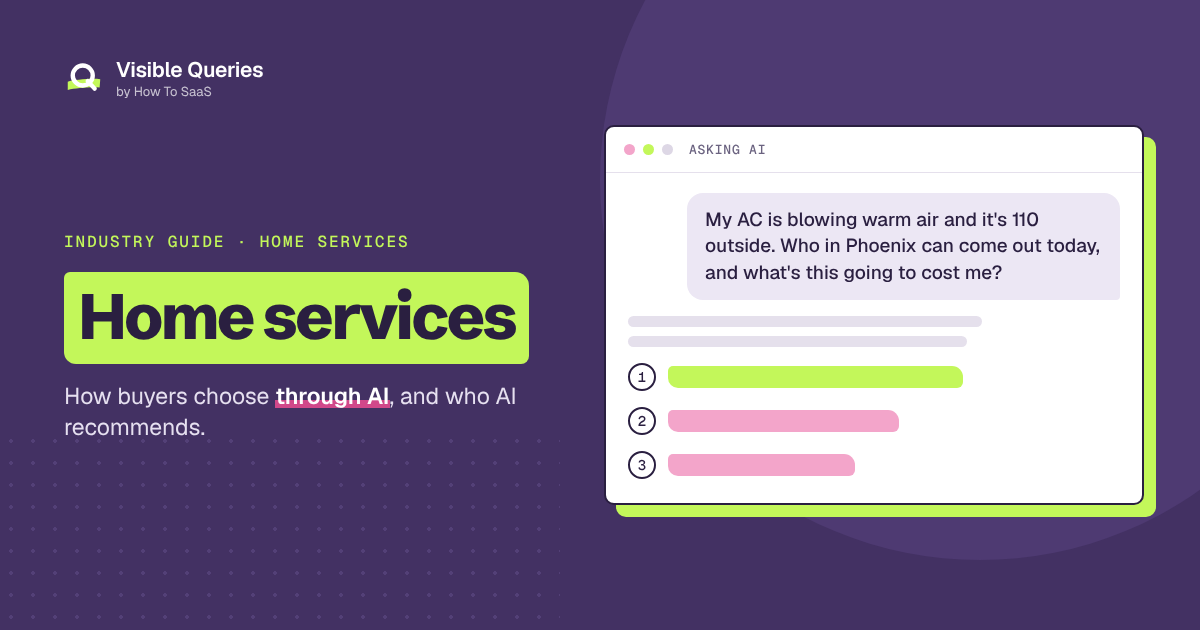
It's 4:40 on a Saturday afternoon in July in Phoenix. The thermostat says 84 and climbing. The AC is running, but the air coming out of the vents is warm.
Ten years ago, the homeowner standing under that vent would have grabbed a phone, typed "AC repair near me" into Google, skipped past the ads, scanned the map, and called the first company with decent stars that picked up.
Today there's a good chance they do something different. They open ChatGPT, or Gemini, or they read the AI Overview sitting on top of their Google results, and they type the question the way they'd ask a neighbor:
"My AC is blowing warm air and it's 110 outside. Who in Phoenix can come out today, and what's this going to cost me?"
What comes back isn't a list of ten links. It's an answer. It explains that warm air often points to a refrigerant leak, a failed capacitor or a frozen coil. It gives a rough price range for each. Then it names three or four local companies that offer same-day service, with a sentence on why each one is a good pick.
The homeowner calls the first one.
That moment, repeated across millions of broken water heaters, leaking roofs, ant invasions and half-finished bathroom remodels, is the biggest change in how homeowners find contractors since the Yellow Pages gave way to search. And unlike search, there's no second page. A home services company is either part of the answer or it isn't in the conversation.
This article walks through how the homeowner's journey works now, step by step, with examples from across the trades: HVAC, plumbing, electrical, roofing, pest control, landscaping, cleaning, remodeling, solar, restoration and moving. It covers what homeowners ask at each step, what makes AI recommend one company over another, and, most importantly, what the companies that get recommended tend to do differently. Most of it isn't a marketing trick. It's just what a well-run home services company looks like from the outside.
Along the way you'll see screenshots from a Visible Queries report for Mesa Ridge Air, a sample HVAC company in the Phoenix area. The company and its competitors are made up, but the report is real. It's exactly what any home services company sees when it runs its own report.
Why the old playbook isn't enough anymore
For fifteen years, the home services marketing playbook was fairly settled. You claimed your Google Business Profile, collected reviews, ran local service ads, bought leads from a marketplace or two, and built a website with a page for each service. If you ranked in the map pack for "plumber near me," the phone rang.
All of that still matters. But it was built for a world where the homeowner did the work of comparing. Search engines handed them options, and they sorted through them.
AI flips that. The assistant does the comparing. It reads your website, your reviews, your listings, local news stories, forum threads and competitors' pages, then hands the homeowner a short, confident recommendation. The homeowner gets a summary, not a set of options.
Three things follow from that:
- The shortlist got shorter. Search gave a homeowner ten or more companies to consider. An AI answer usually names three to five. Being sixth is the same as not being there.
- The order matters more. Many homeowners call the first name that sounds right, especially when something is broken. Being named first is worth far more than being named fourth.
- Your reputation travels without you. When a homeowner asks "Is this company any good?", AI answers in a few sentences that sum up hundreds of reviews and mentions. You don't get to make your case. The summary does it for you.
None of this means search is dead. Plenty of homeowners still scroll. But more of them start with an AI answer every year, and those homeowners arrive at your door having already decided a lot about you.
The homeowner's journey, step by step
Every home services job, from a $150 drain clearing to a $60,000 kitchen remodel, follows roughly the same journey. What changes is how fast the homeowner moves through it, and which step decides the job.
- Something happens. A breakdown, a discovery, or a decision to finally fix that thing.
- They try to understand it. What's wrong, how serious it is, and what it might cost.
- They build a shortlist. Who can do it, nearby, soon.
- They check who to trust. Licensed? Honest? Any red flags?
- They choose. Price, timing, financing, warranty, gut feel.
- They live with the result. Maintenance, repeat work, referrals, and reviews.
AI now shows up at every one of these steps. Here's what it looks like at each one.
Step 1: Something happens
Home services jobs start in one of two ways, and the difference shapes everything that follows.
Emergencies. The water heater floods the garage. The furnace quits on the coldest night of the year. A tree limb comes through the roof. A breaker keeps tripping and the outlets smell like something's burning. These homeowners aren't researching. They want help, fast, from someone they won't regret letting in the door. The time between "something's wrong" and "I've booked someone" can be under an hour.
Planned projects. The roof is 22 years old and the neighbors just replaced theirs. The kitchen hasn't been touched since 1994. Electricity bills keep climbing and solar looks tempting. The family is moving across the country in August. These homeowners might research for weeks or months, and they ask a lot more questions along the way.
Most trades see both. A plumber gets the 2 a.m. burst pipe and the planned repipe of an older home. A roofer gets the storm-damage emergency and the scheduled replacement. An electrician gets the dead circuit and the EV charger install. The questions homeowners ask AI are very different in each case, and so is what wins.
What AI hears at this step sounds like this:
- "Water is leaking from the ceiling under my upstairs bathroom. What should I do right now?"
- "My furnace is making a loud banging noise when it starts. Is that dangerous?"
- "There are termite wings on my windowsill. How worried should I be?"
- "Is it worth replacing a 20-year-old roof before I sell my house?"
- "We're thinking about solar in Sacramento. Where do we even start?"
Notice that none of these name a company. Homeowners at this step aren't shopping yet. But the answers they get set the frame for everything that follows. If AI explains that ceiling leaks under a bathroom are usually a failed wax ring or supply line and that a licensed plumber should check for hidden water damage, the homeowner now knows they need a plumber, possibly a restoration company, and that "hidden water damage" is the phrase to watch.
The companies that show up later in the journey are very often the ones whose content helped shape these early answers.
Step 2: They try to understand what's wrong and what it costs
This is where homeowners do their homework, and it's the step most home services companies ignore.
Before anyone calls a contractor, they want to know three things: what's probably wrong, how serious it is, and roughly what it will cost. They're trying not to get ripped off. They've heard stories about the $12,000 AC replacement that turned out to be a $200 capacitor, or the roofer who found "extensive damage" that wasn't there.
So they ask:
- "Why is my AC running but not cooling?" (HVAC)
- "How much does it cost to replace a water heater in Denver?" (plumbing)
- "Repair or replace: my 14-year-old AC needs a new compressor. What should I do?" (HVAC)
- "Why does my breaker keep tripping when I run the microwave?" (electrical)
- "How much does a full roof replacement cost for a 2,000-square-foot house in Dallas?" (roofing)
- "How do I know if I have termites or carpenter ants?" (pest control)
- "What does a bathroom remodel actually cost in Toronto in 2026?" (remodeling)
- "Is it worth getting solar in Ohio if we only plan to stay 7 years?" (solar)
- "How much does mold remediation cost after a basement flood?" (restoration)
These are the questions where AI does its most detailed work. It explains causes, gives price ranges, describes what affects the price, and often recommends what kind of professional to call.
It also cites sources. When an answer pulls its price range from a contractor's blog post titled "What a water heater replacement really costs in Denver (and what drives the price up)," that contractor is now in the conversation before the homeowner has even started looking for one. When the homeowner later asks "Who should I call for a water heater replacement in Denver?", the company that taught them the answer has a head start.
This is also where a lot of companies quietly lose. Their website says "Call for a free quote." There's no price range, no explanation of what drives the cost, nothing to cite. So AI builds its answer from national cost guides, lead marketplaces and competitors who were willing to publish numbers. The homeowner learns from someone else.
Here's what this looks like in a real report. Each row is a topic homeowners ask about, with how often it's searched each month and the share of AI answers on that topic that name the company and each of its top competitors.
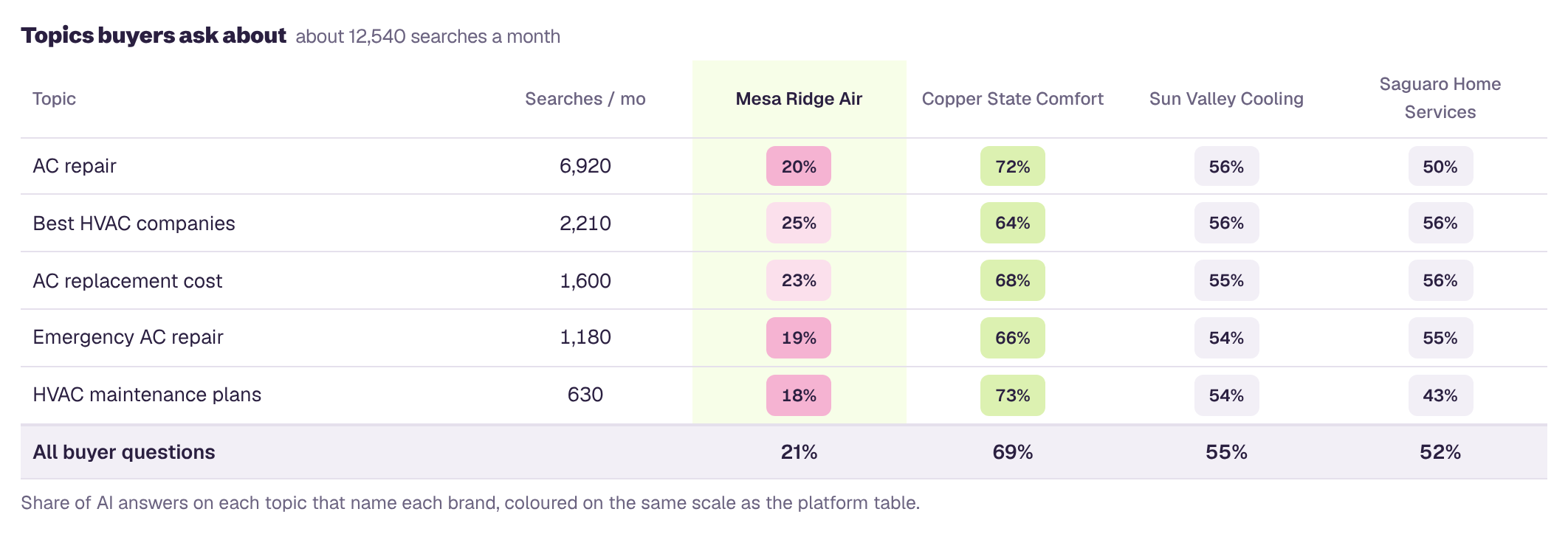
Look at "AC repair," the most searched topic. Copper State Comfort is named in 72% of those answers and Mesa Ridge Air in 20%. That's where homeowners decide whether a handyman will do or they need a pro, and Mesa Ridge Air is missing from four out of five of those conversations.
What good companies do at this step: they teach. They publish straight answers to the questions homeowners ask before they call, including honest price ranges, what drives the price up or down, when a repair makes sense and when it doesn't, and what a homeowner can safely check themselves. This isn't giving away the business. A homeowner who learned from you trusts you, and AI treats you as a source worth citing.
Step 3: They build a shortlist
Now the homeowner is shopping. They know roughly what they need, and they want names.
- "Who are the best HVAC companies in Phoenix?"
- "Which plumbers in Austin offer 24/7 emergency service?"
- "Best roofing companies in Tampa for storm damage insurance claims"
- "Who does pest control for scorpions in Scottsdale?"
- "Which house cleaning services in Calgary bring their own supplies and do move-out cleans?"
- "Who are the most reliable movers for a long-distance move from Chicago to Denver?"
- "Which electricians in Raleigh install Level 2 EV chargers?"
This is where AI's answer turns into a shortlist, and it's the step most business owners think of first when they hear "AI visibility." It matters enormously. But it has a twist that catches a lot of home services companies off guard: AI answers are local, and they change from city to city.
A homeowner in Tempe asking "best HVAC company" gets a different answer than a homeowner in Scottsdale, even though the two cities are 15 minutes apart. AI is working from what it can find about each city: which companies have service pages for it, which ones local reviews mention, which ones show up in local news and community roundups.
That means a company can be well known in its home city and almost invisible in the suburbs where it does half its work. Here's what that looks like for our sample HVAC company:
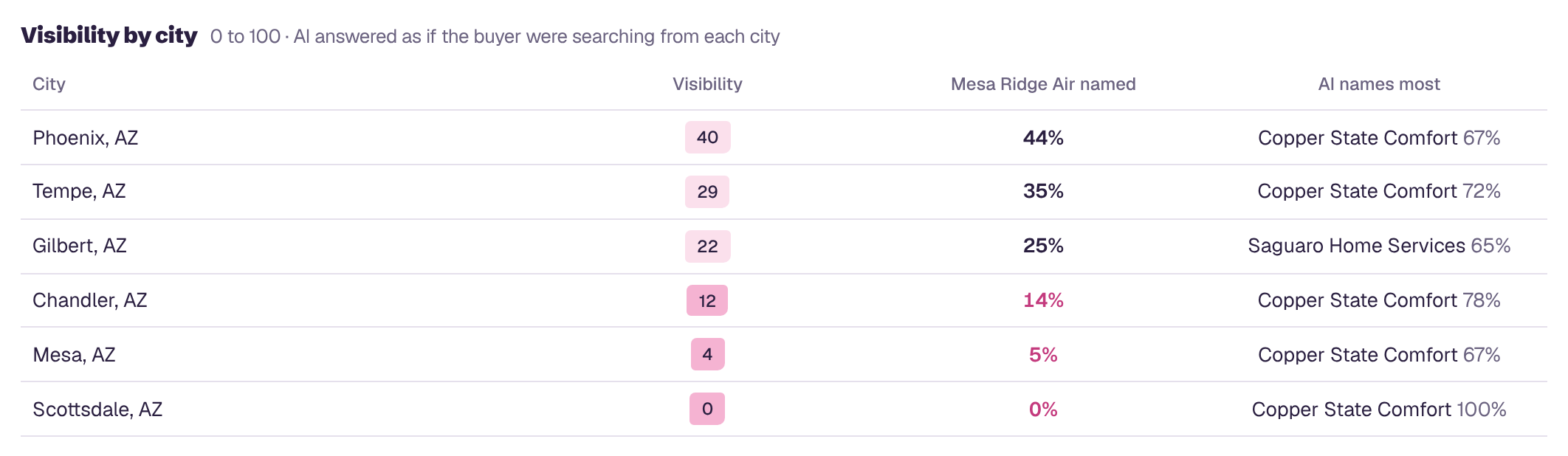
Mesa Ridge Air does reasonably well in Phoenix and Tempe, where it's named in about a third or more of local answers. In Mesa it's named in 5%. In Scottsdale, a wealthy suburb full of large homes with big AC systems, it never comes up at all. In every city except Gilbert, AI names the same competitor most often.
The owner of a company like this might have no idea. Their Google Business Profile is in Phoenix, their reviews mention Phoenix, and their website has one generic "Areas we serve" page listing twelve city names. To AI, they're a Phoenix company, so a Scottsdale homeowner never hears their name.
The pattern is the same across trades. A pest control company in Houston can dominate the inner loop and be absent in Katy and Sugar Land. A roofer based in Fort Worth might never be named for Arlington, even though they've done hundreds of roofs there. A cleaning company in Vancouver might show up for "house cleaning" but not for "move-out cleaning," which is the job with the best margins.
What good companies do at this step: they make it obvious where they work and what they do there. That means a real page for each city they serve, with local detail and not just the city name swapped in, plus service pages specific enough to match how homeowners ask ("emergency water heater replacement," not just "plumbing services"). They also earn mentions in each community: local news, neighborhood groups, sponsorships, local business associations and supplier dealer locators.
Step 4: They check who to trust
Homeowners are letting strangers into their homes, often while they're at work or with kids around. They're handing over thousands of dollars for work they can't easily judge. So once they have a shortlist, they vet.
This used to mean reading reviews one by one. Now many homeowners just ask:
- "Is Mesa Ridge Air legit and trustworthy?"
- "Is [company] licensed and insured in Arizona?"
- "What are the most common complaints about [company]?"
- "Does [company] push unnecessary replacements?"
- "Are there hidden fees with [company]?"
- "Does [company] show up on time and keep customers informed?"
- "Do [company]'s roofs hold up after a few years?"
AI answers by summarizing everything it can find: reviews on Google, Yelp, the BBB and Nextdoor, forum threads, complaint sites, your own website, and anything the local news has written. It turns hundreds of opinions into a few sentences, and it tends to pick up themes.
If twenty of your 400 reviews mention a technician who pushed a full system replacement, AI may well say "Some customers report pressure to replace rather than repair." That one sentence can outweigh 380 happy customers, because it's exactly what a nervous homeowner is looking for.
The flip side is also true. Companies whose reviews consistently mention specific things like "explained everything before starting," "price matched the estimate," "cleaned up after themselves" or "showed up in the two-hour window" tend to get those exact traits repeated back to homeowners as reasons to choose them.
Trust questions also expose a quieter problem: AI getting basic facts wrong.
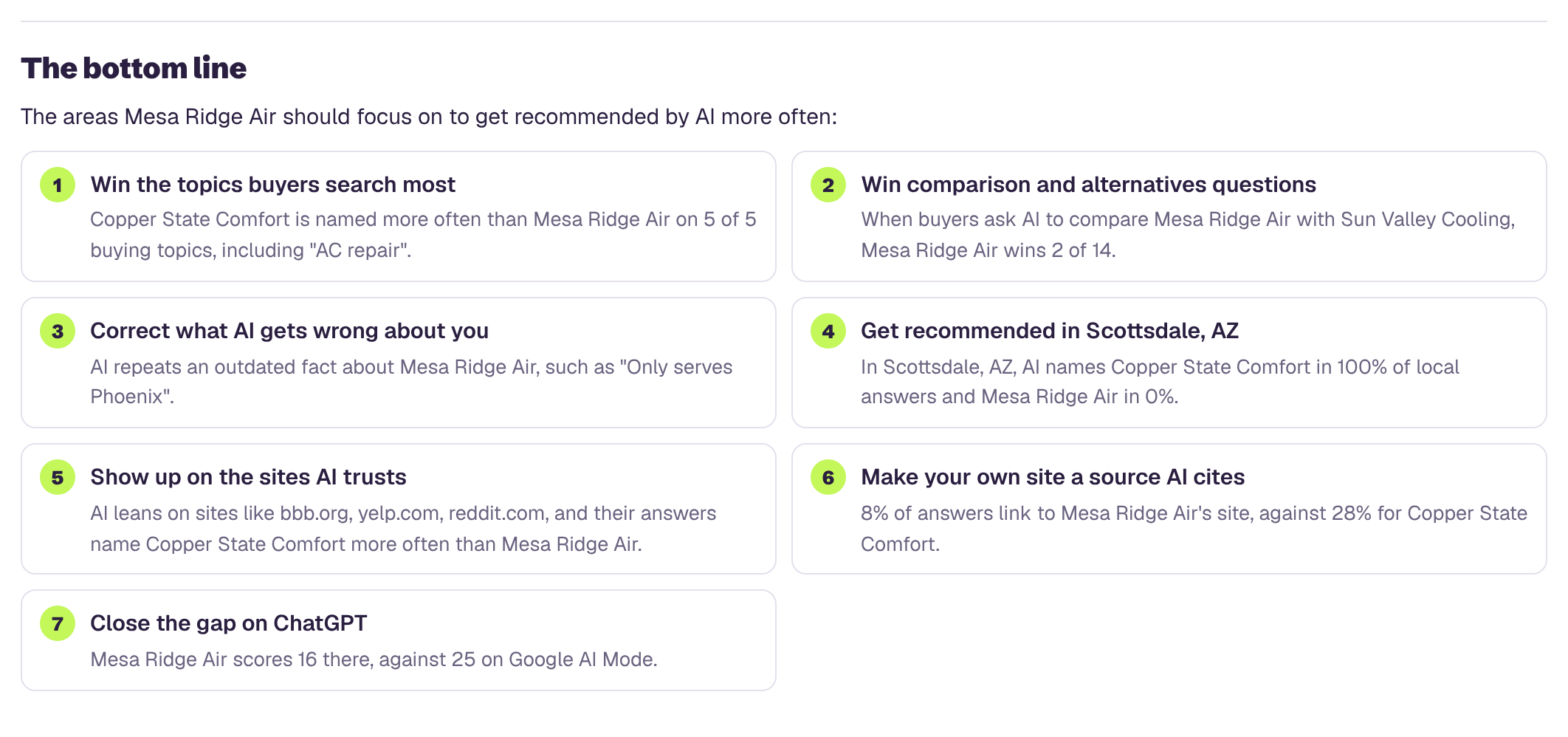
The top gap in our sample report is a factual one. AI tells homeowners that Mesa Ridge Air only serves Phoenix. The company actually serves six cities. Every homeowner in Tempe, Mesa, Chandler, Gilbert or Scottsdale who asks about them hears that they're out of range.
Wrong facts are common in home services, and they're expensive. AI might repeat an old phone number, a service the company stopped offering, a service area from five years ago, a business name from before an acquisition, or the claim that there's no emergency service when there is. It usually happens because the right information isn't stated clearly and consistently in the places AI reads.
The report shows an accuracy score for exactly this reason. It checks how often AI gets the company's core facts right.
What good companies do at this step: they run the business in a way that earns specific, positive reviews, and they ask for reviews in a way that brings out the details, like "Would you mention what we fixed and whether the price matched the estimate?" They answer negative reviews calmly and specifically, because AI reads the replies too. They make the trust basics easy to verify: license numbers, insurance, warranties and how complaints get handled, stated plainly on the site. And they keep their facts identical everywhere: website, Google Business Profile, Yelp, BBB, Angi, Nextdoor and manufacturer listings.
Step 5: They choose
By now the homeowner has two or three names. The final decision comes down to practical things: price, timing, financing, warranty, and whether the company seems like it will make this easy.
- "Mesa Ridge Air vs Copper State Comfort: which is better for an AC replacement?"
- "Which HVAC companies in Phoenix offer 0% financing on new systems?"
- "Do any roofers in Charlotte offer a lifetime workmanship warranty?"
- "Which plumbers in Edmonton offer flat-rate pricing instead of hourly?"
- "Is a national lawn care chain or a local company better for Bermuda grass in Atlanta?"
- "What's a cheaper option than [big franchise] for drain cleaning?"
- "Which solar installers in San Diego include battery storage and handle the permits?"
Head-to-head questions are where AI's answers get most specific, and where companies can lose a job they had almost won. If AI says the competitor offers financing, a 10-year labor warranty and same-week installs, and says nothing about you on those points because your website doesn't mention them, the homeowner reasonably assumes you don't have them.
The competitor table shows who's winning these moments overall: how often AI names each company when homeowners ask questions that don't name a brand. In the sample report, Copper State Comfort is named in 69% of those answers and Mesa Ridge Air in 21%. A homeowner who asks AI a handful of questions over a week will hear one name far more often than the other, and familiarity is a powerful tiebreaker.
What good companies do at this step: they make the decision easy. Pricing approach, financing options, warranties, guarantees, scheduling windows and what happens if something goes wrong are all stated clearly, in plain language, on the pages AI reads. They don't hide the things that make them better. They also make sure comparisons are fair. A page explaining "How we're different from national franchises," written honestly and without trash talk, gives AI something concrete to work with when a homeowner asks for a comparison.
Step 6: They live with the result
The journey doesn't end when the truck pulls away. This is the step that builds a great home services company, and it feeds every earlier step for the next homeowner.
After the job, homeowners ask things like:
- "Is an HVAC maintenance plan worth it?"
- "How often should I get my water heater flushed?"
- "My new roof is leaking six months later. What are my rights?"
- "How often do I need quarterly pest control in Florida?"
- "Is it normal for a new AC to short-cycle in the first week?"
These questions decide whether a one-time customer becomes a maintenance-plan member, a repeat customer and a source of referrals. They also decide what that homeowner writes in their review, which becomes the raw material AI uses to describe you to the next homeowner at step 4.
This is the loop that matters most. Companies that deliver well, follow up, explain their work and stand behind it collect specific, positive reviews. Those reviews shape what AI says about them. What AI says shapes who gets the next call. Over time, the gap between the companies AI recommends and the ones it doesn't tends to widen, because recommendations bring jobs, jobs bring reviews, and reviews bring more recommendations.
What good companies do at this step: they treat after-the-job content and service as part of the product. Maintenance guides, seasonal checklists, warranty explanations and "what's normal after your install" pages answer the questions homeowners ask AI after the job, and they keep the company's name attached to those answers. Maintenance plans and follow-up calls create the steady, detailed reviews that AI learns from.
How the journey plays out trade by trade
The six steps are the same for every trade, but the step that decides the job is different. Here's where the weight falls for each of the major home services trades, and what the companies that win tend to do.
HVAC
HVAC lives at both ends of the urgency scale. Summer breakdowns in Phoenix, Dallas or Las Vegas and winter furnace failures in Minneapolis or Winnipeg are true emergencies, where step 3 decides everything and being named first for "can come out today" is worth a lot. System replacements are the opposite: $8,000 to $20,000 decisions where homeowners spend real time at step 2 ("repair or replace?") and step 5 (financing, efficiency ratings, rebates, warranties).
The trust question that matters most in HVAC is about upselling. Homeowners are primed to suspect a replacement pitch, and AI picks up any pattern of it in reviews. Companies that publish honest repair-versus-replace guidance, with real numbers, tend to earn both the citation and the trust.
Full guide: AI visibility for HVAC companies
Plumbing
Plumbing is the most emergency-driven trade. Burst pipes, sewer backups, no hot water and overflowing toilets don't wait. Homeowners ask "who can come right now" and "what should I do until they get here." The second question is a huge opening: the plumber whose site explains how to shut off the main water valve becomes the source AI cites in a stressful moment.
Price fear is intense in plumbing, especially around after-hours rates. Homeowners ask AI things like "how much does an emergency plumber charge on a Sunday in Toronto?" Plumbers who explain their pricing model, whether that's flat-rate, trip fees or after-hours surcharges, give AI something concrete. Plumbers who don't leave homeowners to guess, and AI fills the gap with someone else.
Full guide: AI visibility for plumbers
Electricians
Electrical work splits into safety calls ("outlet sparking," "lights flickering," "burning smell from the panel") and upgrade projects like panel upgrades, EV chargers, generators, lighting and rewiring older homes. The upgrade side is growing fast and is heavily researched. A homeowner buying an EV will ask AI about charger types, panel capacity, permits and rebates before they ask for an electrician.
Electricians who explain those projects clearly, including permits, inspection, timelines and utility rebates by city or province, tend to be the ones AI names when the homeowner gets to step 3. Licensing questions come up constantly, so a visible license number matters more here than in most trades.
Full guide: AI visibility for electricians
Roofing
Roofing has two very different journeys. Storm damage is urgent, local and often tied to insurance. Homeowners ask "how do I file a roof insurance claim in Texas" and "which roofers work directly with insurance companies." Replacement is a big planned purchase with lots of step 2 and step 4 research, including materials, lifespan, warranties and red flags.
Roofing also has a trust problem the industry knows well: storm chasers. Homeowners ask AI "how do I avoid roofing scams after a hailstorm," and the answer usually tells them to look for a local address, a long track record and verifiable reviews. Roofers who make those things obvious, with years in business, a physical location, local projects and manufacturer certifications, fit what AI is telling homeowners to look for.
Full guide: AI visibility for roofers
Pest control
Pest control questions are highly local and seasonal: scorpions in Arizona, termites in Florida, mosquitoes in Houston, bed bugs in big cities, mice in Canadian winters. A homeowner's first question is usually identification ("what are these tiny black ants in my kitchen") and safety ("is pest control safe for my dog and kids").
Companies that answer local, specific pest questions and explain treatments, safety and recurring plans in plain language tend to win steps 2 and 6. Recurring service is the business model, so the after-the-job questions ("do I really need quarterly service?") matter as much as the first call.
Full guide: AI visibility for pest control companies
Landscaping and lawn care
Lawn care is recurring and seasonal, with lots of price comparison. Homeowners ask "how much does weekly lawn mowing cost in Charlotte," "best grass for shade in Atlanta," and "is a lawn treatment program worth it." Landscaping projects like patios, irrigation, xeriscaping and outdoor lighting look more like remodeling, with long research cycles and lots of photos.
The winners tend to be companies with clear local expertise: which grasses do well here, what the watering restrictions are, when to aerate. That's exactly the kind of local knowledge AI looks for and cites.
Full guide: AI visibility for landscaping and lawn care companies
House cleaning
Cleaning is a trust purchase more than almost any other home service. Someone is in the house, often unsupervised, on a recurring basis. Homeowners ask AI "are cleaners from [company] background checked," "what's included in a deep clean," and "what if something gets broken."
The specific services matter too. Move-out cleaning, post-construction cleaning and Airbnb turnovers all get searched separately, and companies that describe each one clearly get matched to more questions.
Full guide: AI visibility for house cleaning services
Remodeling
Kitchen, bath, basement, flooring, painting and window projects have the longest journeys and the biggest tickets. Homeowners might ask AI dozens of questions over months, from "how much does a kitchen remodel cost in Minneapolis" and "how long does a bathroom remodel take" to "what should be in a remodeling contract" and "how do I know if a contractor is overcharging."
That long journey is a big opportunity. A remodeler can be part of the homeowner's thinking for months before the first call, if their content keeps showing up in the answers. Project galleries, realistic budgets by project type, timelines and "what to expect" guides all give AI material to work with.
Full guide: AI visibility for remodelers
Solar
Solar might be the most researched home purchase after the house itself. Homeowners ask about payback periods, net metering rules in their state or province, incentives, battery storage, roof suitability and, very often, scams and high-pressure sales. AI answers many of those questions with real skepticism about aggressive door-to-door sellers.
Installers that publish honest, local, numbers-based guidance ("what solar really saves in Sacramento after the latest net-metering changes") and make their licensing, warranties and installation process transparent fit what AI tells homeowners to look for.
Full guide: AI visibility for solar installers
Water and fire restoration
Restoration is pure emergency, often in the middle of the night, and almost always involves insurance. Homeowners ask "what do I do after a basement flood," "does homeowners insurance cover water damage from a burst pipe," and "who handles mold after a leak in Seattle."
Restoration companies often reach homeowners through plumbers, insurers and property managers, so third-party mentions matter even more than usual. The companies AI recommends tend to have clear 24/7 messaging, local presence in each city they serve, and helpful content about the insurance process.
Full guide: AI visibility for restoration companies
Moving and junk removal
Moving is a high-anxiety, one-time purchase with a reputation problem. Homeowners ask AI "how do I avoid moving scams," "are binding estimates better," and "what's a fair price to move a 3-bedroom from Chicago to Denver." Long-distance moves bring licensing questions, like DOT and MC numbers in the US, and AI often tells homeowners to check them.
Junk removal is simpler and faster, closer to an emergency booking, with questions about price by truckload, what they take, and whether they donate or recycle. In both cases, transparent pricing and visible credentials are what AI points homeowners toward.
Full guide: AI visibility for moving and junk removal companies
Building a home services company AI recommends
Put the six steps and the trades together and a clear picture comes out. The companies AI recommends aren't the ones that found a trick. They're the ones whose operations, reputation and information all line up, so that everything AI reads about them points in the same direction.
Here's what that looks like in practice.
1. Be the company that explains things. Homeowners at step 2 want to understand the problem and the price before they call. Publish honest answers: what's likely wrong, what it usually costs in your market, what drives the price, when repair makes sense and when it doesn't. Every technician already explains this at the kitchen table a dozen times a week. Write it down once and let AI repeat it.
2. Be specific about where you work. If you serve eight cities, AI should know all eight, with a real page for each one that shows local projects, local reviews, local conditions and local details like permits or rebates. A single "areas we serve" list isn't enough.
3. Be specific about what you do. "Plumbing services" doesn't match "tankless water heater installation" or "sewer line camera inspection." Homeowners ask for specific jobs, so describe specific jobs.
4. Earn reviews that say something. Star ratings get you on the list. Review content decides how AI describes you. Train your team to ask for reviews that mention the problem, the fix, the price compared with the estimate, and how the technician communicated. Then respond to every review, good and bad, because AI reads the replies.
5. Run the business so the reviews come out right. No amount of content fixes a pattern of upselling, missed windows or surprise fees. AI will find it and repeat it. The most reliable way to be recommended is to be a company people recommend: clear estimates, on-time arrivals, clean job sites, and standing behind the work.
6. Keep your facts identical everywhere. Name, phone, address, service areas, hours, emergency availability, licenses and warranties should match on your website, Google Business Profile, Yelp, BBB, Angi, Nextdoor, manufacturer dealer locators and any directory you're listed in. Inconsistency is where wrong answers come from.
7. Be known outside your own website. Local news coverage, community sponsorships, trade association memberships, supplier and manufacturer recognition, and mentions in neighborhood groups all tell AI you're a real, trusted local business. They're also the sources AI is most likely to trust.
8. Make the decision easy. Spell out financing, warranties, guarantees, scheduling and pricing approach. If you're better than the national franchise on something that matters, say so plainly and specifically.
9. If you've grown through acquisitions, tell one clear story. Home services is consolidating fast, and many companies now run several local brands under one roof. AI often gets confused here. It describes the old owner, mixes up service areas, or treats two of your brands as competitors. Make the relationships, service areas and brand names clear and consistent, and retire old names cleanly.
10. Measure it, city by city. You can't fix what you can't see. Most home services owners have never looked at what AI says about them across their whole service area, against the specific competitors they lose jobs to.
That last point is where the report comes in. Here's the top of the sample report for Mesa Ridge Air:
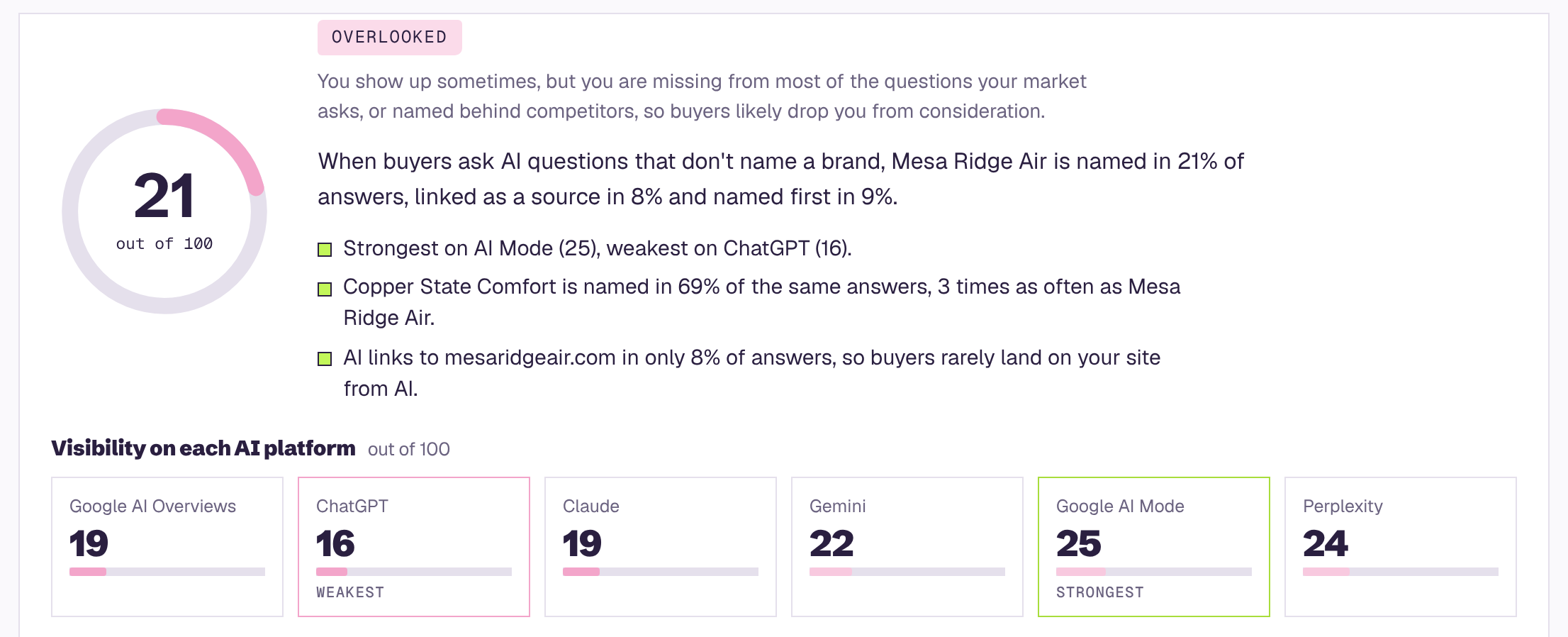
The numbers say it plainly: Mesa Ridge Air scores 21, in the Overlooked band. It comes up in 21% of buyer questions, and its biggest competitor comes up in 69%. Just below it, the report breaks visibility into the numbers that matter for a home services company:

For an emergency-driven trade, first mention is the number to watch, because homeowners with a broken AC or a burst pipe often call the first name they hear. Citation rate shows whether AI is sending homeowners to your website or to a directory. Accuracy shows whether AI is telling homeowners the truth about you.
Run the report again after you make changes, and you can see these numbers move, city by city, against the competitors that matter.
The homeowners haven't stopped looking for you
Homeowners still need their AC fixed, their roofs replaced and their basements dried out. What's changed is who does the first round of comparing. More and more, it's an AI assistant, and it hands the homeowner a short list of names before they ever see your website, your reviews or your truck.
The good news for well-run home services companies is that AI mostly rewards things they already care about: doing good work, being honest about price, showing up when they say they will, and standing behind the job. The work is making sure all of that is visible, specific and consistent in the places AI reads, and checking that it's actually working.
Keep learning
- What is AI visibility?
- How to get your business recommended by AI, with guides for ChatGPT, Google AI Overviews, Perplexity, Gemini and Claude
- AI visibility benchmark 2026
- The AI visibility glossary
See what AI tells homeowners about your company
Enter your website and get a free AI visibility report. It takes a few minutes, and you'll see:
- Your AI visibility score, overall and for ChatGPT, Gemini, Claude, Perplexity and Google's AI Overviews and AI Mode
- Who AI recommends instead of you, and how often
- Your visibility in every city you serve, and the competitor AI names most in each one
- What AI gets wrong about you, and what to fix first
- Your biggest gaps: the buyer questions where AI leaves you out, and who it recommends instead
- A downloadable PDF you can share with your team