What homeowners ask AI before they call a plumber, and how plumbers get named in the answer
When water is where it shouldn't be, homeowners ask AI what's wrong, whether it's an emergency and who to call. Here's what AI tells them, and what plumbers can publish so AI names them.
Plumbing calls rarely start calmly. There's water on the basement floor, a toilet that won't stop running at 2 a.m., a sewer smell nobody can place, or a stain spreading across the ceiling under the upstairs bathroom.
In those moments, homeowners want three answers fast: what's happening, how bad it is, and who can fix it. More and more of them get all three from an AI assistant before they call anyone.
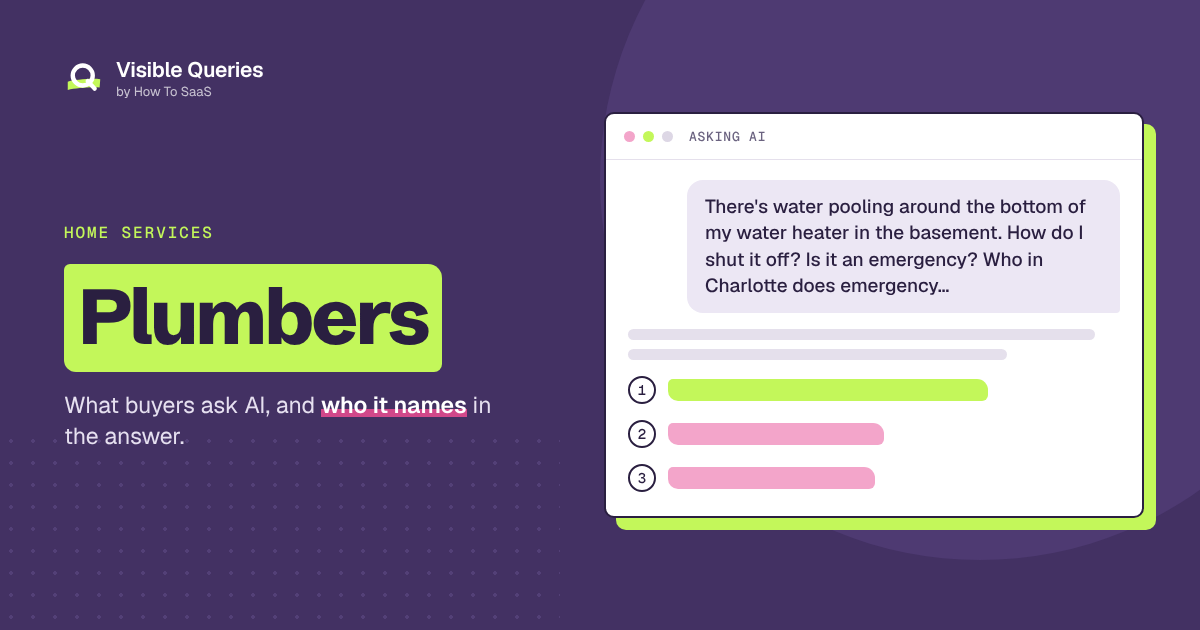
"There's water pooling around the bottom of my water heater in the basement. How do I shut it off? Is it an emergency? Who in Charlotte does emergency plumbing on a Sunday?"
AI tells them where the shutoff usually is, explains that a leak from the bottom of the tank usually means the tank has failed, gives a rough replacement price, and names a few local plumbers with weekend service. The first one named often gets a $2,000 job before lunch.
Our home services guide covers the homeowner's journey in general. This one goes through the questions that decide plumbing jobs, what AI usually says when homeowners ask them, and what a plumbing company can publish so that it's the one AI names.
Here are the questions at a glance:
| The question | What gets you named |
|---|---|
| "What do I do right now?" | A calm "what to do while you wait" page for burst pipes, leaks and backups |
| "Is this an emergency, or can it wait?" | An honest emergency-or-not guide and your real after-hours pricing |
| "Can I fix this myself?" | A "DIY or call us?" page that says where to stop |
| "How much does it cost to [job]?" | Local price ranges and how you price |
| "Tankless or tank? Repipe or repair?" | Plain comparisons with your own recommendation |
| "Is [plumber] legit? Do they overcharge?" | License, insurance, service area and pricing approach on one page |
| "Who's the best plumber in [city]?" | A real page for every city you serve |
"What do I do right now?"
What AI usually says: For leaks, it walks the homeowner through finding the main shutoff, turning off the water heater's gas or power, moving valuables, and taking photos for insurance. For clogs, it warns against mixing drain chemicals. For gas smells, it says to leave the house and call the gas company.
Why it matters: The first five minutes shape everything after. A homeowner who has been helped through the panic by an answer that sounds like your company is primed to call your company.
What to publish: A short, calm "what to do while you wait" page for your most common emergencies: burst pipes, water heater leaks, sewer backups, overflowing toilets, frozen pipes. Make it skimmable and specific to your area, like where shutoffs usually are in local homes and what to do in a freeze.
"Is this an emergency, or can it wait until Monday?"
What AI usually says: It sorts problems into urgent and not urgent. Active leaks, sewer backups, no water and gas smells are emergencies. A slow drain or a dripping faucet can usually wait. It often mentions that after-hours service costs more.
Why it matters: This is where homeowners decide whether to pay emergency rates. Plumbers who are honest about what can wait earn trust that pays off on the calls that can't.
What to publish: An honest "emergency or not?" guide, plus your real after-hours policy and pricing. If you don't charge extra on weekends, say so loudly. It's a strong reason to be named.
"Can I fix this myself?"
What AI usually says: For running toilets, simple clogs, faucet cartridges and minor leaks under sinks, it often says yes and explains how. For water heaters, gas lines, sewer lines, slab leaks and anything behind a wall, it recommends a licensed plumber.
Why it matters: Plumbing has more genuine DIY fixes than most trades, so this question comes up constantly. Plumbers who answer it honestly come across as experts, not salespeople, and AI picks up that tone.
What to publish: A "DIY or call us?" page for common problems, with the honest line where a homeowner should stop. It earns you the call when they reach that line.
"How much does it cost to [replace a water heater / repipe a house / fix a slab leak]?"
What AI usually says: A broad national range, with what moves the price: tank vs tankless, gas vs electric, access, permits, the age and material of the pipes, and whether walls or slabs need opening.
Why it matters: Homeowners anchor on the number AI gives them. If your price is above it and nobody has explained why, you start the conversation defending yourself. Plumbing also has a reputation problem with surprise pricing, and AI reflects that worry back to homeowners.
What to publish: Local price ranges for your most common jobs, with what's included. Explain how you price, whether that's flat-rate, upfront or hourly, plus any trip or diagnostic fee. Clear pricing is one of the strongest trust signals a plumber can have.
"Tankless or tank? Trenchless or traditional? Repipe or repair?"
What AI usually says: It lays out the trade-offs for each choice, including upfront cost, lifespan, efficiency, disruption and the conditions where each one makes sense.
Why it matters: These are the big-ticket decisions, and the homeowner usually gets more than one quote. The plumber whose explanation matches what AI says looks honest.
What to publish: Plain-language comparisons for the choices you quote most often, with your own recommendation and when you'd make it. Include local factors like hard water, which shortens tank and tankless life in places like Phoenix and Las Vegas.
"Is [plumber] legit? Do they overcharge?"
What AI usually says: A short summary of reviews, plus licensing and years in business if it can find them. Pricing complaints get repeated, even old ones.
Why it matters: This is the last check before a homeowner lets someone into the house. One wrong or outdated fact can lose the job without you ever knowing.
Here's what that looks like in a real report:
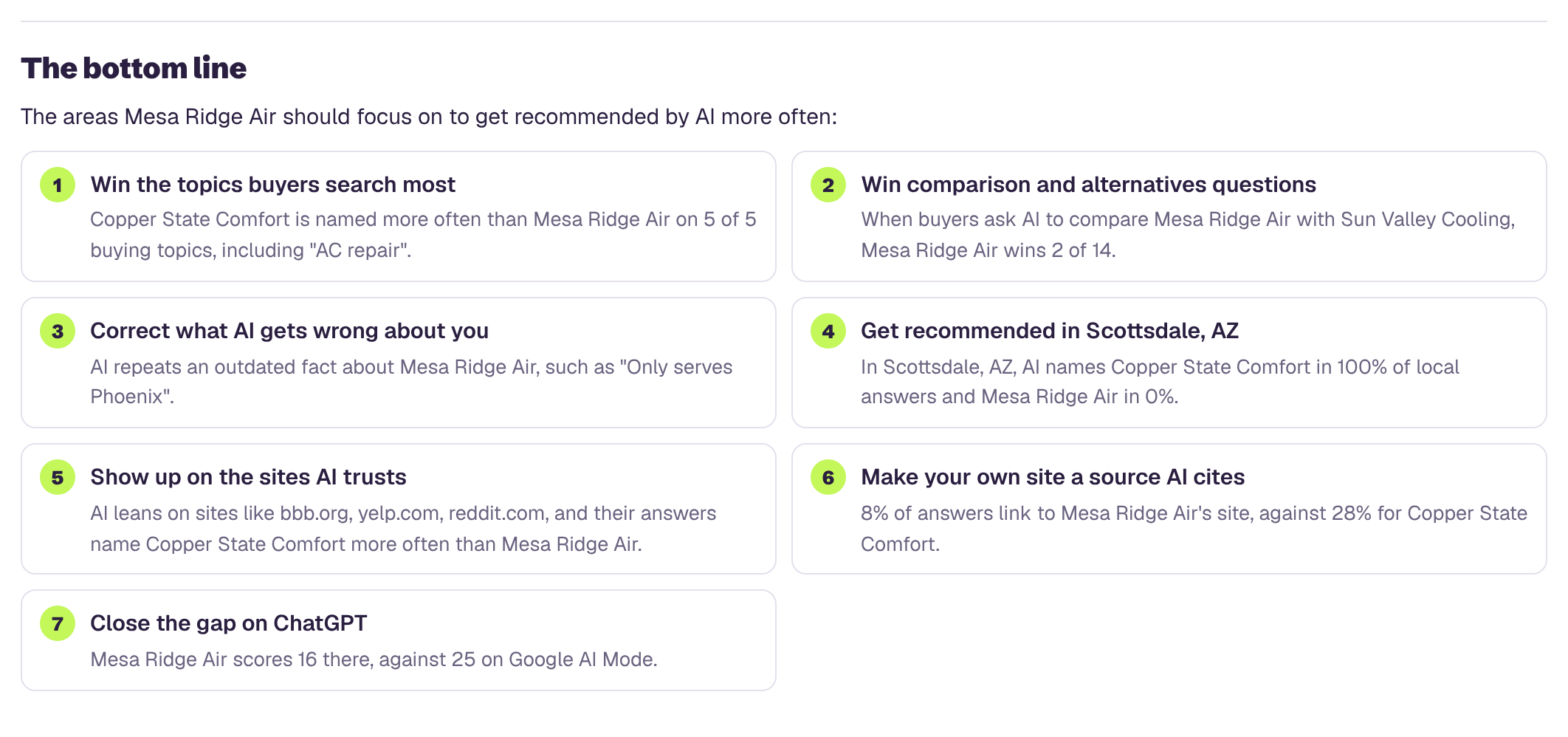
For a plumber, a wrong service area is especially costly. Emergencies are hyper-local. If AI thinks you don't cover a suburb, every flooded basement there goes to someone else.
What to publish: One clear page with your license number, insurance, years in business, service area by city and pricing approach. Respond to reviews, especially ones about price. AI reads responses too.
"Who's the best plumber in [city]?"
What AI usually says: It names three or four companies, usually with a line on each, like "24/7 service," "family-owned," "known for upfront pricing" or "drain and sewer specialists." It adds tips like checking licensing and asking about trip fees.
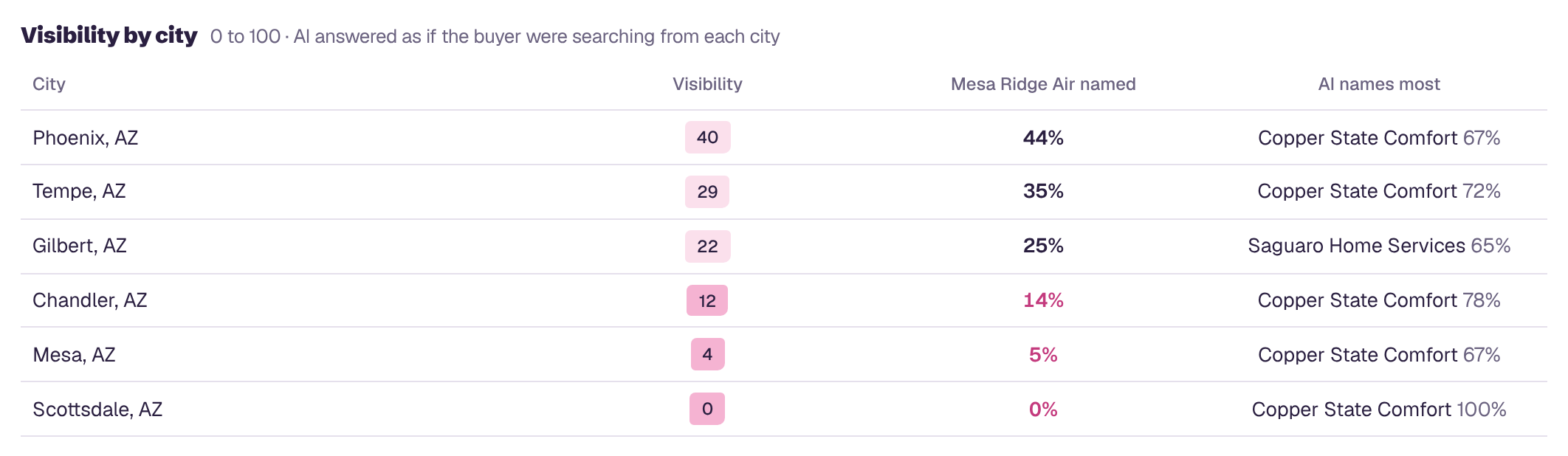
Why it matters: This is the shortlist, and for plumbing it's intensely local. Someone with water on the floor wants a plumber ten minutes away, not forty. AI knows that, so it answers this question differently in every suburb, depending on what it can find about each company there.
That's why a plumbing company can be the go-to name in one city and invisible two exits down the highway:
What to publish: A real page for every city or area you serve, not a list of city names in the footer. Include jobs you've done there, reviews from local customers, and the plumbing issues common in that area's housing.
Where you are changes the question
Plumbing problems are regional, and homeowners ask AI about the ones they actually have:
- Hard water in Phoenix, Las Vegas, San Antonio and much of the Prairies: scale, short water heater life, softeners and filtration.
- Frozen and burst pipes in Minneapolis, Chicago, Calgary and Winnipeg: prevention, thawing, and what to do when a pipe bursts in a cold snap.
- Slab leaks in Texas, Florida and Southern California: detection, rerouting vs repair, and insurance.
- Old pipes in older cities and inner suburbs: galvanized steel, cast iron drains, lead service lines and polybutylene in 1980s and 1990s homes.
- Tree roots in sewer lines in mature neighborhoods: camera inspections, hydro-jetting and trenchless repair.
- Septic systems and wells in rural and exurban areas, which many city-focused plumbers don't handle.
A plumber who writes about the problems in their own area, in the words local homeowners use, gives AI a reason to treat them as the local expert. "How to prevent frozen pipes in a Calgary cold snap" will be cited for Calgary questions long before a generic national article is.
When the home is being bought or sold
A lot of plumbing work starts with a home inspection report:
- "Inspector found polybutylene pipes. Should I walk away or ask for a credit?"
- "Sewer scope showed a belly in the line. How much to fix?"
- "Water heater is 14 years old. Should the seller replace it?"
- "Is a lead service line a big deal?"
These questions come with deadlines, because closing dates don't move. Buyers and their agents want a fast, credible estimate. Plumbers who explain common inspection findings, offer sewer scopes and give quick quotes for real estate transactions get named by AI and remembered by local agents, which is its own referral engine.
The name problem
Plumbing has a special visibility problem: names. There are a lot of "[City] Plumbing," "[Name] & Sons Plumbing," "Rooter" and "Drain" companies, plus franchise locations of national brands. AI sometimes mixes them up, merging two companies' reviews, putting one company's phone number on another's summary, or crediting a franchise location's reviews to the national brand.
If your name is common, make it unambiguous everywhere:
- Use exactly the same name, address and phone number on your website, Google Business Profile and every directory.
- Say clearly on your website what makes you distinct, like "family-owned since 1987, not affiliated with [similar name]," if confusion is likely.
- If you're a franchise location, give your location its own rich page, with local technicians, local reviews and local jobs, so AI knows you exist separately from the brand.
Residential, commercial and new construction
Restaurant owners ask AI about grease traps and backflow testing. Property managers ask about emergency contracts for multifamily buildings. Builders ask about rough-in subcontractors. If your website is all residential service, AI won't send you any of that work. Give each line of business its own page, with what you do, the buildings you work in and your response times.
What the sample report shows
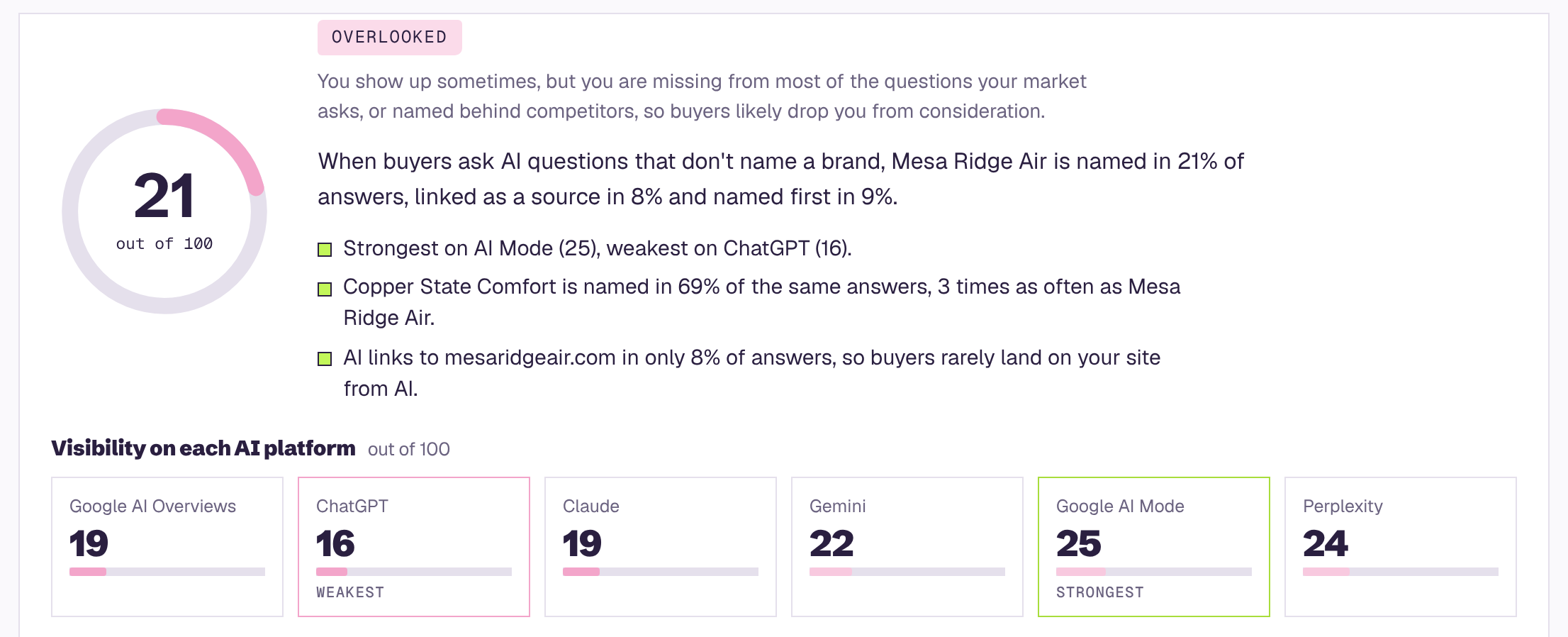
Here's what a Visible Queries report looks like for Mesa Ridge Air, the sample Phoenix-area HVAC company from our guide. The questions are different for plumbers, but the patterns are the same.
The report starts with one score out of 100, a score for each AI platform, and the competitor AI names most:
The gap is clearest side by side:
If you only fix three things
- Make your emergency hours and pricing impossible to get wrong. The same hours, the same after-hours policy and the same service area on every listing.
- Publish honest triage content. "What to do right now," "emergency or not?" and "DIY or call us?" for your most common calls.
- Explain how you price. Trip fees, flat-rate or hourly, and local ranges for common jobs.
Somewhere in your service area tonight, someone is standing in a puddle, asking AI what to do. The plumber AI names will be the one it understands best.
Part of our guide: Why AI visibility matters for home services companies
See what AI tells homeowners about your plumbing company
Enter your website and get a free AI visibility report. It takes a few minutes, and you'll see:
- Your AI visibility score, overall and for ChatGPT, Gemini, Claude, Perplexity and Google's AI Overviews and AI Mode
- Which plumbers AI recommends instead of you, and how often
- Your visibility in every city you serve, and the competitor AI names most in each one
- What AI gets wrong about you, and what to fix first
- Your biggest gaps: the buyer questions where AI leaves you out, and who it recommends instead
- A downloadable PDF you can share with your team