Is solar worth it here? How homeowners choose a solar installer through AI
Homeowners now ask AI whether solar pays off where they live, whether to lease or buy, and which installers to trust. Here's what AI tells them, and how solar companies get named in the answer.
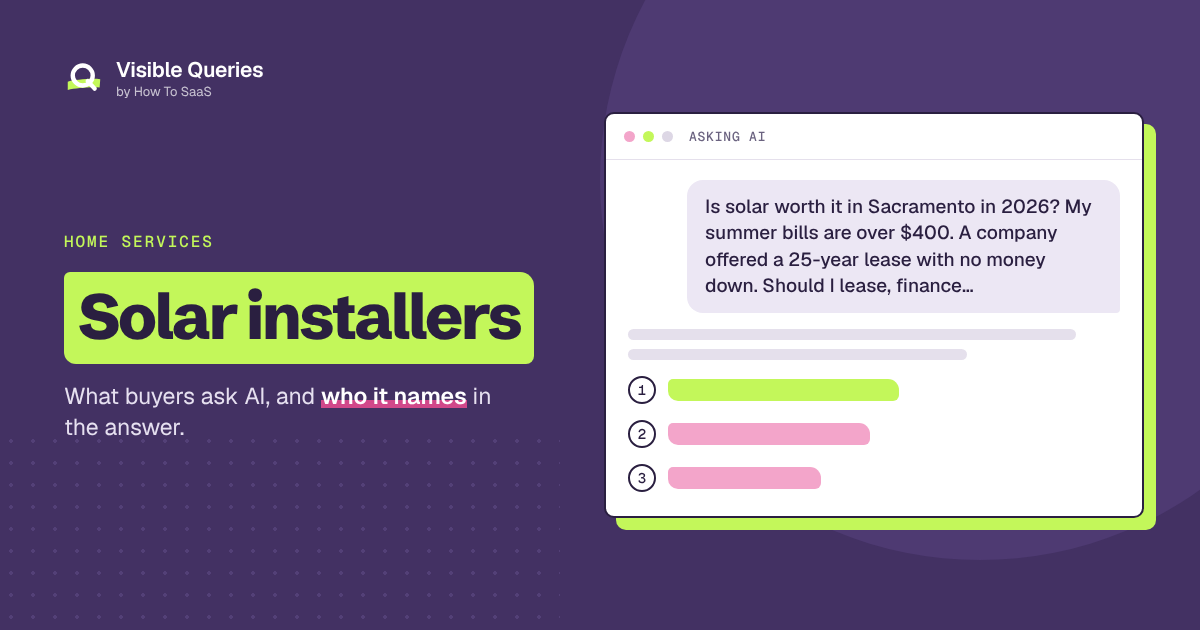
A homeowner in Sacramento just got a summer electric bill over $400. A salesperson knocked on the door last week promising "free solar" and a 25-year lease. A neighbor bought panels three years ago and loves them. Another neighbor says the lease made their house harder to sell. Before talking to anyone else, they ask ChatGPT:
"Is solar worth it in Sacramento in 2026? My summer bills are over $400. A company offered a 25-year lease with no money down. Should I lease, finance or buy? What about batteries? And which local solar installers are trustworthy?"
AI explains how payback works, what affects it locally (electricity rates, net metering rules, roof orientation, shading, incentives), the trade-offs between leasing, loans and cash purchases, why batteries are increasingly popular, and how to vet installers. Then it names three local companies. One of them gets a $28,000 system with a battery.
Solar is one of the most researched purchases in home services. It's expensive, financially complicated, heavily marketed, and dependent on policies that change. Homeowners know they're likely to be sold to, so they research hard, and AI is now a central part of that research.
Our home services guide covers the homeowner's journey in general. This one goes through the questions that decide solar sales, what AI usually says, and what installers can publish so AI names them.
Here are the questions at a glance:
| The question | What gets you named |
|---|---|
| "Is solar worth it where I live?" | A current guide to local rates, billing rules and payback |
| "Lease, loan or buy?" | An honest comparison of your financing options |
| "Do I need a battery?" | A local guide to batteries and outages |
| "Is my roof okay for solar?" | How you assess roofs and handle roof warranties |
| "How do I avoid a bad solar company?" | Who installs, your certifications and your equipment |
| "Best solar installers in [city]?" | A page for every city, with local installs |
| "What happens after it's installed?" | Your service, monitoring and warranty process |
"Is solar worth it where I live?"
What AI usually says: It explains that it depends on electricity rates, sun exposure, roof condition and orientation, local net metering or billing rules, available incentives and how long the homeowner plans to stay. It gives a rough payback range and suggests getting a few quotes.
Why it matters: This is the first question, and the answer decides whether the homeowner keeps going. AI's answer depends heavily on local detail. The installer that explains solar economics for that city or utility is the one it relies on.
What to publish: A plain, current guide to solar economics in your area: your utilities' rates and billing rules, typical system sizes and payback ranges, and incentives, with a "last updated" date. Policy changes quickly in solar, and current content beats old content every time.
"Lease, loan or buy?"
What AI usually says: It compares ownership costs, long-term savings, tax credit eligibility, maintenance responsibility, and the effect on selling the home. It often cautions homeowners to read lease and PPA terms carefully.
Why it matters: This is where trust is won or lost. Homeowners who feel pushed toward one option tend to walk away.
What to publish: An honest comparison of the financing options you offer, with when each makes sense and what the fine print usually says. Installers who explain the downsides of their own options come across as trustworthy, to homeowners and to AI.
"Do I need a battery?"
What AI usually says: It explains what batteries do (backup during outages and, in some places, saving money under time-of-use rates or changed net metering rules), what they cost and when they're worth it.
What to publish: A local guide to batteries: how billing rules in your area affect their value, how outages typically affect your region, the battery brands you install, and typical costs.
"Is my roof okay for solar?"
What AI usually says: It discusses roof age, material, orientation and shading, and suggests replacing an old roof before installing panels.
What to publish: How you assess roofs, whether you offer roofing or partner with roofers, how you handle penetrations and warranties, and what happens if the roof needs replacing later.
"How do I avoid a bad solar company?"
What AI usually says: It lists warning signs: high-pressure door-to-door sales, "free solar" claims, unrealistic savings promises, unclear contracts, and companies that subcontract everything with no local presence. It suggests checking licensing, reviews, years in business, warranties and who actually does the installation.
Why it matters: Solar's reputation problems mean AI is cautious. It recommends installers that look established, transparent and local.
What to publish: Who installs your systems (your own crews or subcontractors), your licensing and certifications, the equipment and warranties you offer, how you estimate production and savings, and what happens after installation, including monitoring, service and warranty claims.
"Best solar installers in [city]?"
What AI usually says: It names a few installers, often with a line on each, plus a reminder to get multiple quotes.
Why it matters: This is the shortlist. Here's how that looks in a real report, topic by topic:
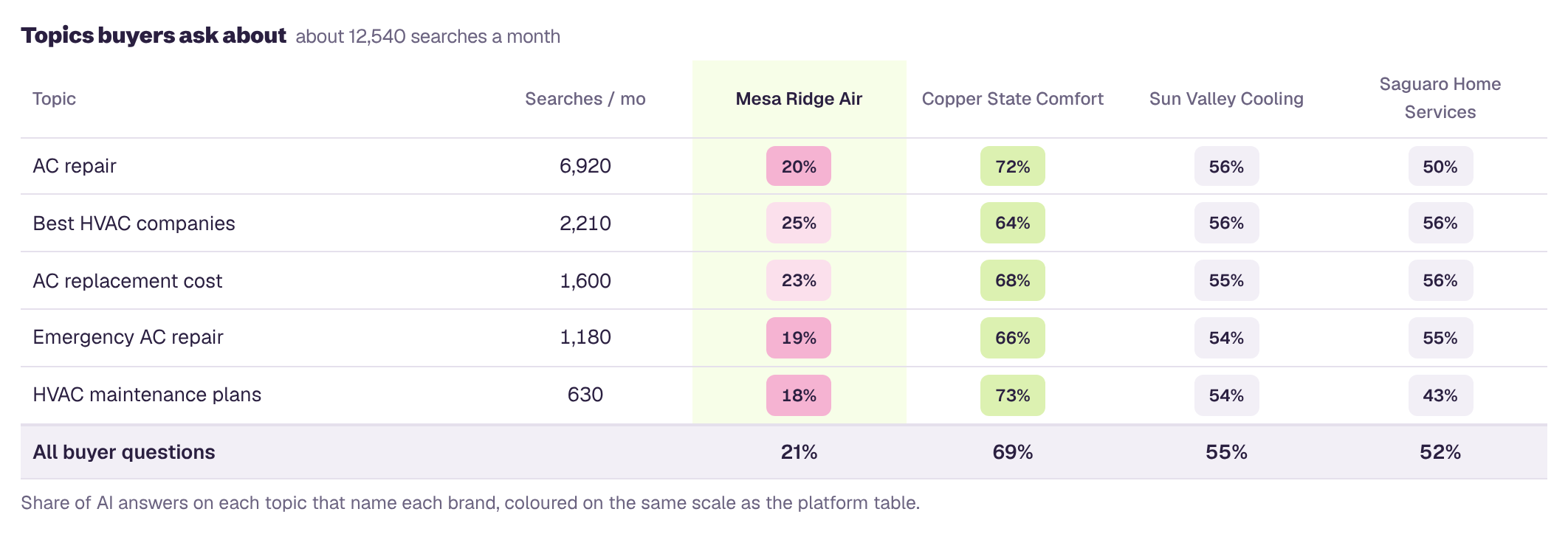
For a solar installer, the topics to watch are the early ones, like "is solar worth it?" and "what's better than [competitor]?" Homeowners who are still deciding whether to go solar at all are the most valuable people in the funnel, and AI shapes their thinking long before they ask for quotes.
"What happens after it's installed?"
What AI usually says: For homeowners who already have solar, it answers questions about low production, monitoring apps, panel cleaning, inverter failures, warranty claims and what to do if their installer went out of business.
Why it matters: Service after installation is a huge source of reviews, good and bad, and the "my installer disappeared" story is common enough that AI repeats it.
What to publish: Your service and warranty process, monitoring, response times, and whether you service systems installed by other companies. That last one can be a real growth line, and AI recommends installers who clearly offer it.
Policy changes are a visibility opportunity
Incentives, tax credits, net metering rules and utility rate structures change often, and every change sends homeowners to AI with new questions: "Is solar still worth it after the rule change?", "Did the tax credit change?", "Should I add a battery now?"
The installers that publish fast, clear, local explanations when the rules change become the sources AI cites. Date every update. In solar, being current is part of being trustworthy.
Commercial and community solar
Business owners, farms, churches and property managers ask AI about commercial solar, depreciation, demand charges, carports and community solar subscriptions. If you do commercial work, give it its own page, with project examples, financing options and the types of buildings you work on.
What the sample report shows
Here's what a Visible Queries report looks like for Mesa Ridge Air, the sample Phoenix-area HVAC company from our guide. The questions are different for solar installers, but the patterns are the same.
Under the score, the report breaks visibility into the numbers that matter most:

The gap is clearest side by side:
If you only fix three things
- Publish current, local solar economics. Rates, billing rules, incentives and payback, with a date.
- Be honest about financing and batteries. When each option makes sense, and the fine print.
- Show who you are after the sale. Crews, warranties, monitoring and service.
Homeowners are asking AI whether solar is worth it before they let any salesperson in. The installer AI names will be the one that answers most honestly.
Part of our guide: Why AI visibility matters for home services companies
See what AI tells homeowners about your solar company
Enter your website and get a free AI visibility report. It takes a few minutes, and you'll see:
- Your AI visibility score, overall and for ChatGPT, Gemini, Claude, Perplexity and Google's AI Overviews and AI Mode
- Which solar installers AI recommends instead of you, and how often
- Your visibility in every city you serve, and the competitor AI names most in each one
- What AI gets wrong about you, and what to fix first
- Your biggest gaps: the buyer questions where AI leaves you out, and who it recommends instead
- A downloadable PDF you can share with your team