Kitchens, baths and the contractor nobody wants to regret: how homeowners choose a remodeler through AI
Homeowners now ask AI what a remodel should cost, how long it takes and how to avoid a bad contractor. Here's what AI tells them, and how kitchen, bath, flooring, painting and window companies get named.
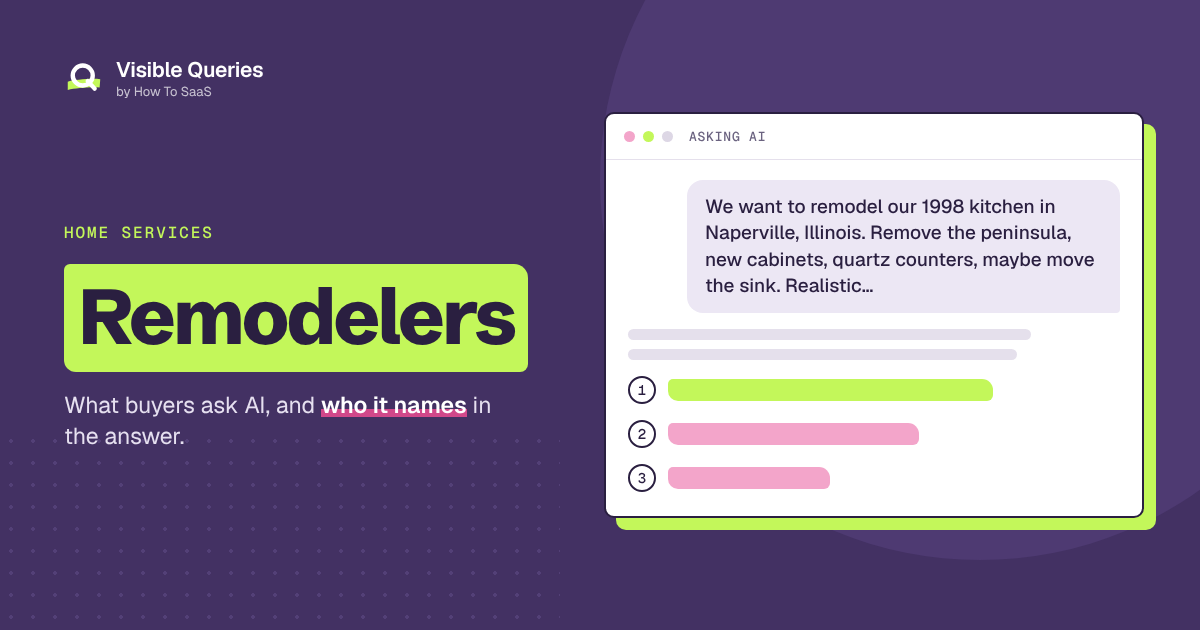
A homeowner in Naperville has been staring at the same 1998 kitchen for six years: oak cabinets, almond appliances, a peninsula that blocks everything. They've saved up, and they've heard the horror stories: the contractor who disappeared halfway through, the six-week job that took six months, the budget that doubled. Before calling anyone, they ask ChatGPT:
"We want to remodel our 1998 kitchen in Naperville, Illinois. Remove the peninsula, new cabinets, quartz counters, maybe move the sink. Realistic budget? How long will it take? How do we avoid a bad contractor, and who are well-reviewed kitchen remodelers near Naperville?"
AI explains mid-range and upscale budget ranges, what drives the cost (layout changes, cabinets, plumbing moves), realistic timelines including design and lead times, how payment schedules usually work, the red flags to watch for, and the questions to ask. Then it names three local remodelers. One gets a $75,000 project.
Remodeling covers a lot of trades: kitchen and bath, basements, additions, flooring, painting, windows and doors, siding, decks. What they share is a buyer who is spending a lot, worried about getting burned, and researching for weeks. AI is now a big part of that research.
Our home services guide covers the homeowner's journey in general. This one goes through the questions that decide remodeling jobs, what AI usually says, and what remodelers can publish so AI names them.
Here are the questions at a glance:
| The question | What gets you named |
|---|---|
| "What will it really cost?" | Local budget ranges with real recent projects |
| "How long does a remodel take?" | Your process and timeline, phase by phase |
| "How do I avoid a bad contractor?" | Your contract, payment schedule, permits and licensing, explained |
| "Design-build or general contractor?" | How you work and who's on the team |
| "Is [remodeler] good?" | Project stories, specific reviews and calm responses to criticism |
| "Is it worth it?" | Honest guidance on what pays back at resale in your market |
"What will it really cost?"
What AI usually says: Wide national ranges for common projects, from a bathroom refresh to a full kitchen gut, plus what moves the price: layout changes, moving plumbing or walls, cabinet grade, countertop material, appliances, permits and the age of the house. It usually suggests budgeting a contingency.
Why it matters: This is the anchor. If a homeowner arrives with AI's number in mind and your quote is 40% higher, you're defending yourself from the first meeting.
What to publish: Real local budget ranges for the projects you do, with examples. "Three recent Naperville kitchens: $48,000, $75,000 and $120,000, and what made the difference." Honest ranges build more trust than "contact us for a quote."
"How long does a remodel take?"
What AI usually says: It separates design, permits, ordering and construction, and notes that cabinet and window lead times often decide the schedule. It gives typical ranges and warns about delays.
What to publish: Your actual process and timeline, phase by phase, including how you handle lead times and delays, and how homeowners live through it, like temporary kitchens and dust control.
"How do I avoid a bad contractor?"
This is the defining question of the category.
What AI usually says: It lists red flags: large upfront deposits, no written contract, no permits, pressure to decide quickly, no license or insurance, cash only, vague scopes. It recommends checking licensing, insurance, references, reviews and past work, and getting a detailed written estimate.
Why it matters: Homeowners use this checklist to filter contractors, and AI is effectively telling them what to look for in you.
What to publish: Answer the checklist directly. A page that explains your contract, your payment schedule, permits, licensing, insurance, warranties, how change orders work and how you communicate during the job. You're doing the homeowner's due diligence for them, and AI notices.
"Design-build firm or general contractor? Do I need a designer?"
What AI usually says: It explains the differences between design-build firms, general contractors with separate designers, and specialty installers, and when each makes sense.
What to publish: A clear description of how you work and who's on the team: in-house designers, project managers and trades, or the trusted partners you bring in.
"Is [remodeler] good? Any complaints?"
What AI usually says: A short summary of reviews and reputation. Delays, communication and budget overruns are the most commonly repeated themes.
What to publish: Project galleries with real stories, reviews that mention specifics, and calm, helpful responses to criticism. If AI has a wrong fact about you, like the wrong service area, "only does bathrooms" or "doesn't pull permits," fix it at the source.
"Is it worth it?"
What AI usually says: It discusses return on investment for common projects at resale, while noting that most people remodel for how they live, not for resale.
What to publish: Honest guidance for your market about what pays back at resale and what's mostly for enjoyment. Local real estate context, like "what Naperville buyers expect in a kitchen," is the kind of specific content AI likes.
Specialty trades: flooring, painting, windows, siding and decks
Many remodeling businesses specialize, and each specialty has its own questions:
- Flooring: "LVP vs hardwood for a house with dogs." "Can you put new flooring over old?" "Cost per square foot installed."
- Painting: "How much to paint a 2,500-square-foot house exterior?" "How often should a house be painted in Florida?" "Do painters move furniture?"
- Windows and doors: "Are replacement windows worth it?" "Vinyl vs fiberglass windows." "Window replacement rebates."
- Siding: "Fiber cement vs vinyl siding." "Siding replacement cost." "Siding for hail."
- Decks: "Composite vs wood deck." "Deck permit requirements." "Cost of a 400-square-foot deck."
Each needs the same things: clear local pricing, material comparisons, process explanations and real project examples. A painting company with "how much does it cost to paint a house exterior in Charlotte?" on its site will be cited long before one with a generic services page.
What the report shows
A remodeler's report usually tells a clear story in its headline: how often AI names you compared with your biggest competitor.
For remodelers, the gap often comes from thin websites. A beautiful project gallery with no words, no locations and no budgets gives AI almost nothing to work with. Adding the story behind each project, including the city, the problem, the scope, the budget range and the timeline, turns photos into material AI can use.
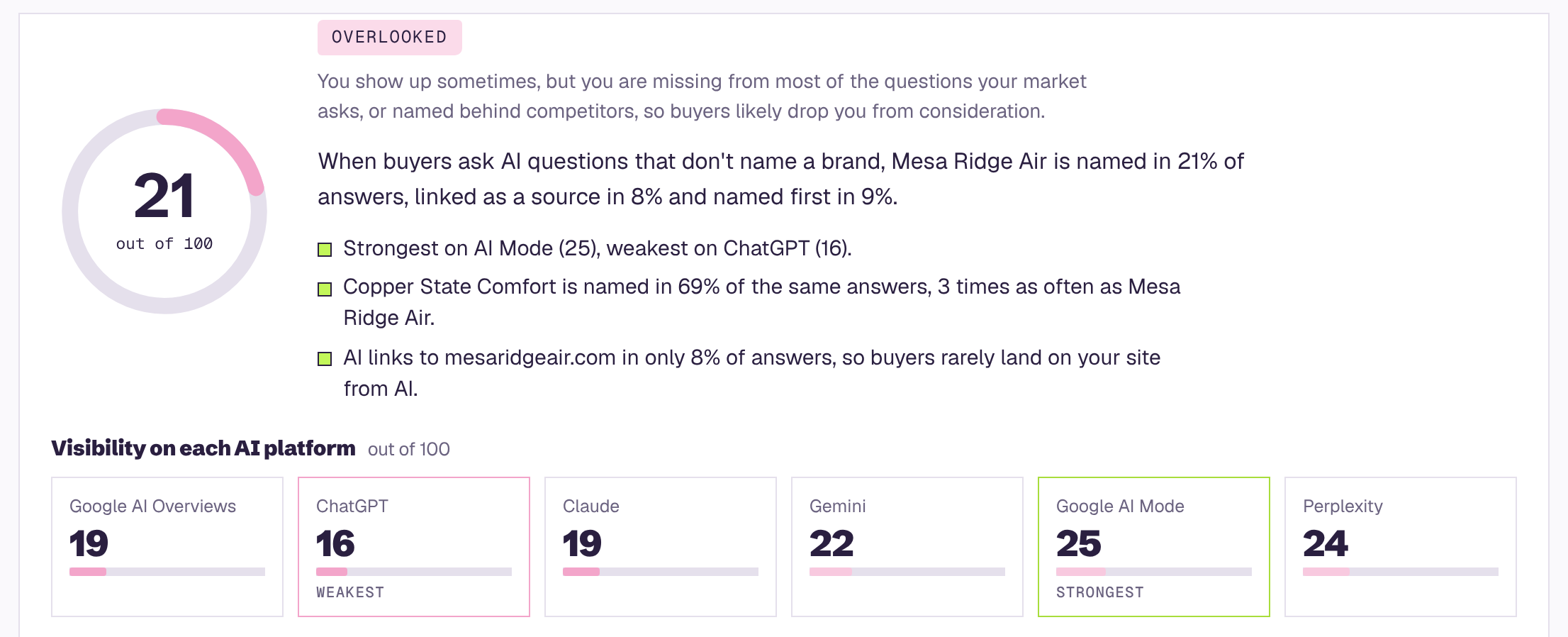
Here's more from the same kind of report, for Mesa Ridge Air, a fictional Phoenix-area HVAC company.
Under the score, the report breaks visibility into the numbers that matter most:

The gap is clearest side by side:
If you only fix three things
- Publish real local budgets and timelines. With examples from projects you've completed.
- Answer the "avoid a bad contractor" checklist on your own site. Contracts, payments, permits, licensing, insurance, warranties and communication.
- Turn your gallery into stories. City, scope, budget range, timeline and what the homeowner wanted.
Homeowners are asking AI how not to regret their remodel. The remodeler AI names will be the one that answers that question best.
Part of our guide: Why AI visibility matters for home services companies
See what AI tells homeowners about your remodeling company
Enter your website and get a free AI visibility report. It takes a few minutes, and you'll see:
- Your AI visibility score, overall and for ChatGPT, Gemini, Claude, Perplexity and Google's AI Overviews and AI Mode
- Which remodelers AI recommends instead of you, and how often
- Your visibility in every city you serve, and the competitor AI names most in each one
- What AI gets wrong about you, and what to fix first
- Your biggest gaps: the buyer questions where AI leaves you out, and who it recommends instead
- A downloadable PDF you can share with your team