After the storm: what homeowners ask AI before they trust a roofer
Homeowners now ask AI whether their roof is damaged, whether insurance will pay, and how to avoid storm chasers. Here's what AI tells them, and how established roofers get named in the answer.
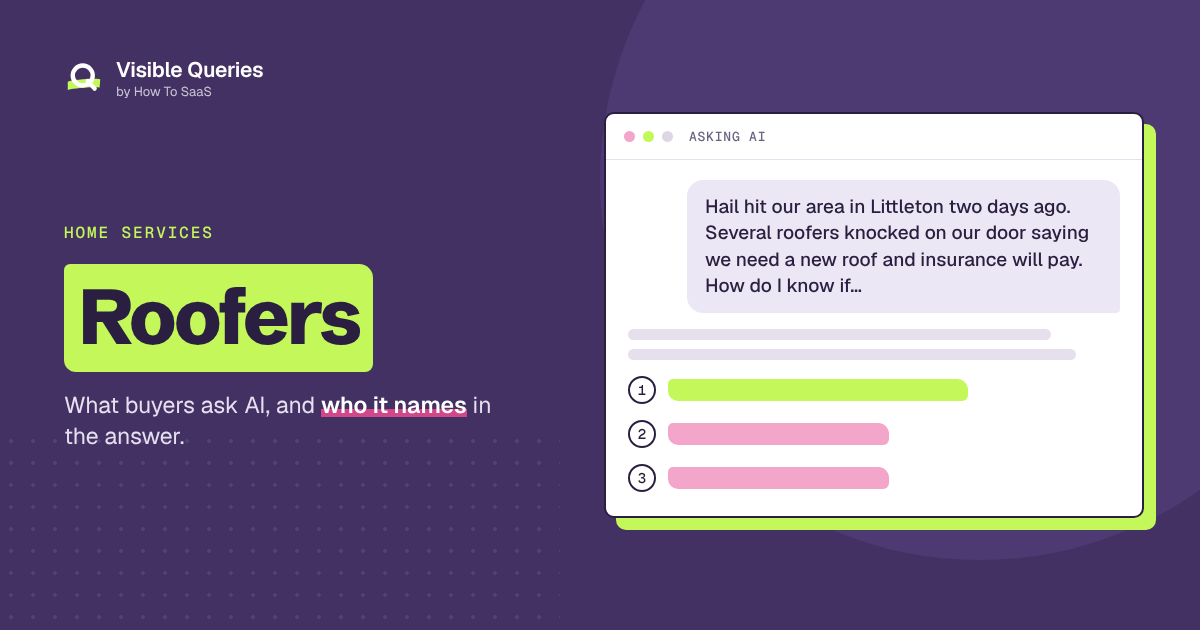
Two days after a hailstorm, a homeowner in Littleton, Colorado, has had four roofers knock on the door. Each says the roof is damaged and insurance will cover a full replacement. One wants a signature today. The homeowner sees a few dented gutters and some granules in the downspout, and nothing else. That night, they ask ChatGPT:
"Hail hit our area in Littleton two days ago. Several roofers knocked on our door saying we need a new roof and insurance will pay. How do I know if there's real damage? Should I call insurance first or a roofer? How do I avoid storm chasers, and which local roofers are trustworthy?"
AI explains how hail damage is assessed, how claims usually work, the warning signs of storm-chasing contractors, and why to choose a local, established roofer with a real address and insurance. Then it names three Denver-area roofers with long local track records. One of them gets an $18,000 replacement a month later.
Roofing has a trust problem, and homeowners know it. Every big storm brings out-of-town crews and high-pressure sales. That's exactly why AI's answer to "who can I trust?" carries so much weight in this trade, and why established local roofers have a real advantage if AI can see it.
Our home services guide covers the homeowner's journey in general. This one is specific to roofing: the storm problem, the questions that decide roofing jobs, and what roofers can publish so AI names them.
Here are the questions at a glance:
| The question | What gets you named |
|---|---|
| "Does my roof have hail damage?" | A storm damage guide with photos from local jobs |
| "Will insurance pay for a new roof?" | An honest explanation of how claims work where you operate |
| "Repair or replace?" | Repair-or-replace guidance that includes when you'd repair |
| "How much does a new roof cost here?" | Local price ranges by material, and what your quote includes |
| "Is [roofer] a local company?" | Your address, years in business, crews and licensing |
| "Best roofers in [suburb]?" | A page for every city, with local jobs and reviews |
The storm chaser problem, and why it helps good roofers
After a big hail or wind event, homeowners are flooded with door-knockers, flyers and calls. Many are legitimate. Some aren't: crews that arrive from out of state, sign contracts on the spot, cut corners and leave before the warranty matters.
AI has read a lot about this. When homeowners ask about roofers after a storm, AI often:
- Warns about high-pressure tactics, like on-the-spot contracts and offers to "cover your deductible."
- Advises choosing a roofer with a local address, years in business, licensing where required, insurance and manufacturer certifications.
- Suggests getting multiple inspections and calling the insurance company before signing anything.
That's good news for established local roofers, if AI can see that they're established and local. A roofer with a real office, ten years of reviews spread across many neighborhoods, manufacturer certifications and a clear storm guide looks exactly like what AI tells homeowners to look for.
A roofer that looks thin online, with a new website, a handful of reviews from one storm season, a generic name and no address, can be lumped in with the companies AI is warning about, even if they've been roofing for 20 years.
"Does my roof have hail damage?"
What AI usually says: It explains what hail damage looks like: bruised or cracked shingles, granule loss, dented vents and gutters, damaged flashing. It warns against climbing on the roof and suggests a professional inspection, ideally from more than one company.
What to publish: A storm damage guide with real photos from local jobs, what to look for from the ground, what to photograph for insurance, and how your inspection works. Say whether inspections are free and whether you'll meet the insurance adjuster.
"Will insurance pay for a new roof?"
What AI usually says: It explains that coverage depends on the policy, the cause and age of the damage, the deductible and whether the policy pays replacement cost or actual cash value. It describes the usual claim steps and warns against contractors who promise insurance will pay.
What to publish: An honest explanation of how claims typically work where you operate, what you do and don't do in the process, and a clear statement that you never promise insurance will pay. Overpromising is exactly what AI warns about.
"Repair or replace?"
What AI usually says: It weighs the roof's age, the extent of damage, the material, the local climate and how long the homeowner plans to stay. It notes that patched roofs can look mismatched and that some damage is cosmetic.
What to publish: Your honest repair-or-replace guidance, including when you'd recommend a repair. Roofers who say "you don't need a new roof" sometimes earn more trust, and more referrals, than any ad.
"How much does a new roof cost here, and what material is best?"
What AI usually says: A wide national range, then the factors that move it: size, pitch, layers to tear off, material, ventilation and local labor. On materials, it compares asphalt, impact-resistant shingles, metal, tile and others for cost, lifespan and climate.
What to publish: Local price ranges by material and roof type, what's included in your quotes (tear-off, underlayment, ice and water shield, ventilation, flashing, cleanup, permits, warranty), and climate-specific advice. In hail country, explain impact-resistant shingles and any insurance discounts. In hurricane country, explain wind ratings and inspections. In snow country, explain ice dams and ventilation.
"Is [roofer] a local company? Any complaints?"
What AI usually says: What it can find about the company's address, years in business, licensing, certifications and reviews. If reviews mention unfinished jobs or ignored warranty claims, it repeats them.
What to publish: A clear "about us" page with your address, years in business, crews, licensing, insurance and certifications. Respond to complaints with what you did to fix them. AI reads those responses too.
"Best roofers in [suburb]?"
What AI usually says: It names a few companies, usually with a line on each, and repeats its storm-chaser advice.
Why it matters: This is the shortlist, and it changes from suburb to suburb. Here's how the report breaks it down by city:
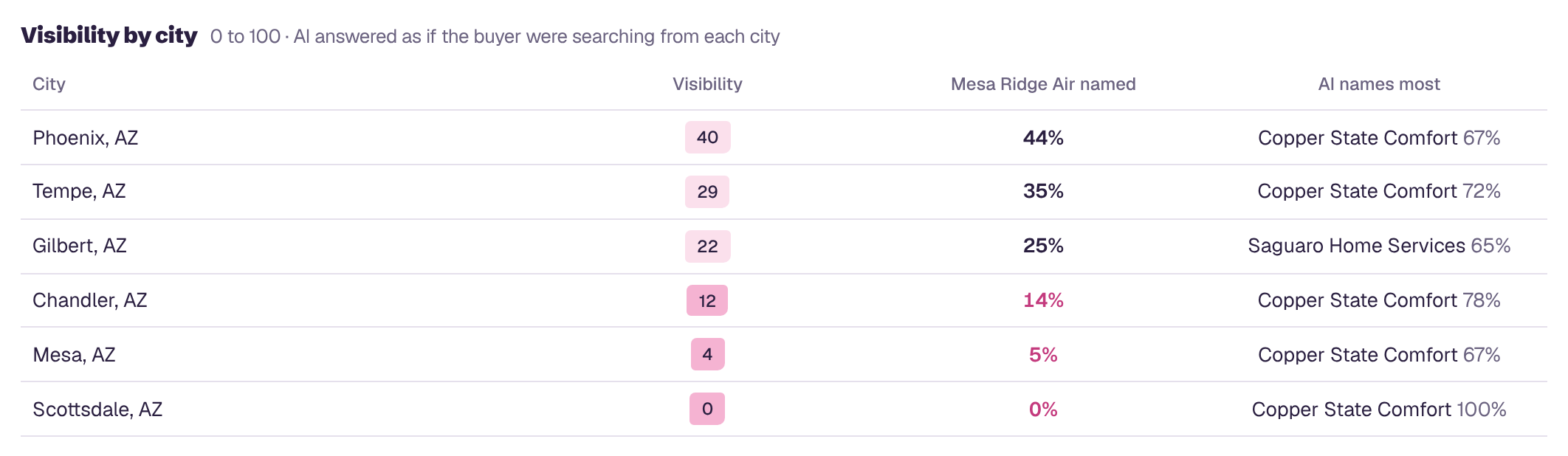
For roofers, the topics to watch are "best-of lists" and "alternatives to competitors" in the suburbs where storms just hit. Those are the questions homeowners ask in the week after a storm. If a competitor is listed first there, they get the inspections.
The "cited" column matters too. When AI names you but doesn't cite your website, it's describing you from somewhere else, often an old directory listing. When it cites your site, it's using your words, your certifications and your proof.
What to publish: A page for every city you serve, with jobs completed there, local storm history and reviews from local homeowners.
Commercial and multifamily roofing
Commercial roofing is a different conversation. Property managers, facility directors and business owners ask about TPO, EPDM, modified bitumen, coatings, inspections, maintenance contracts and leak response times. If your commercial work isn't clearly described, AI won't recommend you for it. Give it a page with the roof systems you install, the buildings you work on, manufacturer certifications for commercial systems and project examples.
What the sample report shows
Here's what a Visible Queries report looks like for Mesa Ridge Air, the sample Phoenix-area HVAC company from our guide. The questions are different for roofers, but the patterns are the same.
And it shows the actual questions, platform by platform, with who was named:
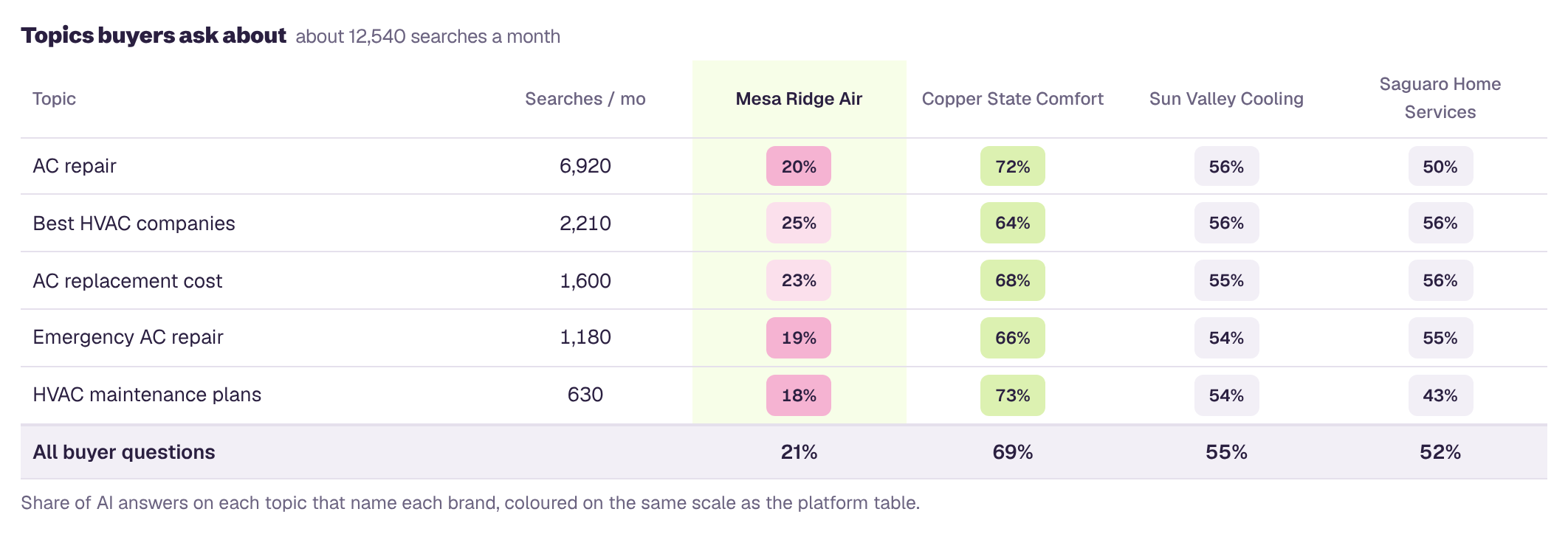
The gap is clearest side by side:
If you only fix three things
- Look as established as you are. Address, years in business, certifications, insurance, crews and reviews spread across many years and neighborhoods.
- Publish an honest storm and insurance guide. What damage looks like, how claims usually work, how to avoid scams, and a clear promise not to overpromise.
- Build a page for every city you serve. With local jobs, local storms and local reviews.
The next storm will send thousands of homeowners to AI asking who they can trust. The roofers AI names will be the ones that clearly look local, established and honest.
Part of our guide: Why AI visibility matters for home services companies
See what AI tells homeowners about your roofing company
Enter your website and get a free AI visibility report. It takes a few minutes, and you'll see:
- Your AI visibility score, overall and for ChatGPT, Gemini, Claude, Perplexity and Google's AI Overviews and AI Mode
- Which roofers AI recommends instead of you, and how often
- Your visibility in every city you serve, and the competitor AI names most in each one
- What AI gets wrong about you, and what to fix first
- Your biggest gaps: the buyer questions where AI leaves you out, and who it recommends instead
- A downloadable PDF you can share with your team