Lawns, patios and weekly service: how homeowners choose a landscaper through AI
Homeowners now ask AI why their lawn is dying, what a backyard redesign costs and which landscaping company to hire. Here's what AI tells them, and how landscaping and lawn care companies get named.
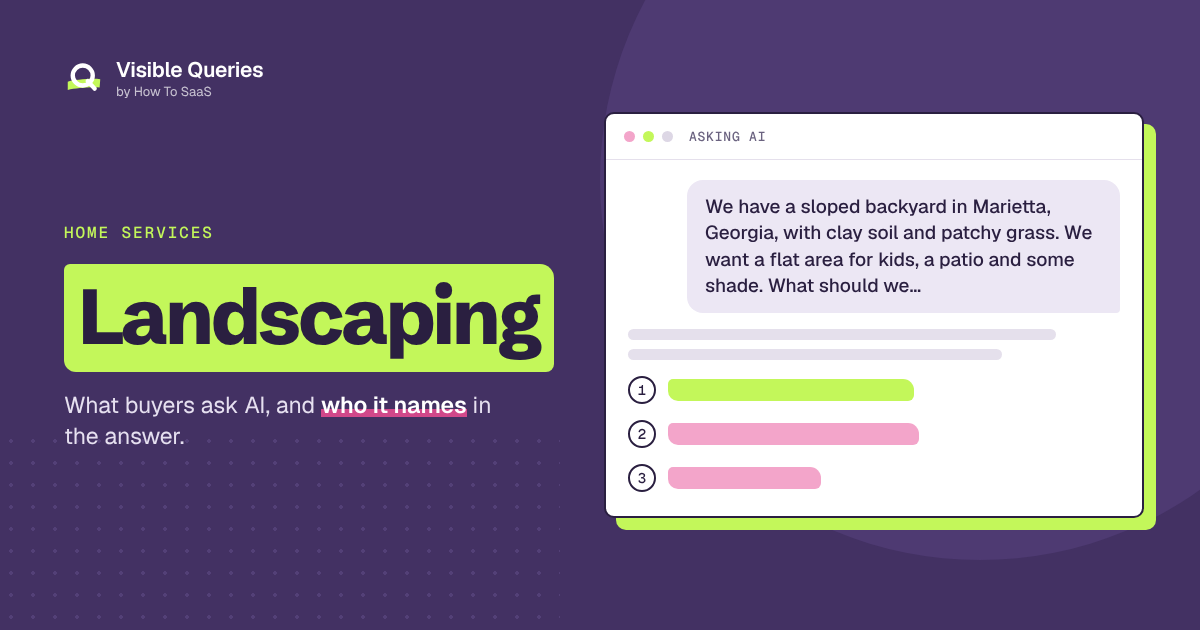
A couple in suburban Atlanta just bought their first house. The backyard is a slope of red clay, patchy grass and one sad crape myrtle. They want somewhere the kids can play and the adults can sit in the evening, and they have no idea where to start. So they ask ChatGPT:
"We have a sloped backyard in Marietta, Georgia, with clay soil and patchy grass. We want a flat area for kids, a patio and some shade. What should we do first, what would it cost, and who are good landscapers around Marietta for design and install?"
AI explains grading and drainage, why clay soil matters, which grasses do well in Georgia's sun and heat, rough costs for a paver patio, retaining walls and sod, and the difference between a design-build firm and a maintenance crew. Then it names three local companies. The first one ends up with a $38,000 project, and the homeowners sign up for its weekly maintenance too.
Landscaping is really two businesses. One is recurring service: mowing, fertilization, weed control, aeration, irrigation checks and seasonal cleanups. The other is projects: design, hardscaping, planting, drainage, lighting and outdoor living. Homeowners ask AI very different questions about each, and a company that does both needs to be visible for both.
Our home services guide covers the homeowner's journey in general. This one goes through the questions that decide landscaping and lawn care jobs, and what companies can publish so AI names them.
Here are the questions at a glance:
| The question | What gets you named |
|---|---|
| "Why is my lawn turning brown?" | Local lawn problem guides by season |
| "Is a lawn care program worth it?" | What your program includes, visit by visit, and what it costs |
| "How much does weekly mowing cost?" | Starting prices by lot size and what's included |
| "What should we do with our backyard?" | Project galleries with budgets and the stories behind them |
| "How much does a patio or retaining wall cost?" | Local price ranges for your common projects |
| "Design-build firm or a landscaper?" | How you work, and who designs and builds |
| "Which plants will survive here?" | Plant guides for your climate and local water rules |
The lawn care questions
"Why is my lawn turning brown?"
What AI usually says: It runs through the likely causes, such as drought stress, grubs, fungus, dog spots, dull mower blades, the wrong grass for the shade, or dormancy. It suggests a few checks, like the tug test for grubs and a soil test.
What to publish: Local lawn problem guides, specific to your grass types and climate. "Brown patches in St. Augustine grass in Houston" is far more useful, and more likely to be cited, than a generic national article.
"Is a lawn care program worth it?"
What AI usually says: It explains what typical programs include, like fertilization, pre-emergent and post-emergent weed control, grub control and aeration, how often treatments happen and what they cost compared with DIY.
What to publish: Your program in plain language: each visit and what happens, the price by lawn size, what's guaranteed and how to pause or cancel. Pet and child safety information belongs here too, because it's one of the most common questions.
"How much does weekly mowing cost?"
What AI usually says: A rough range by lot size, plus what affects it: edging, trimming, blowing, bagging, frequency and contract length.
What to publish: Price ranges for your mowing service by lot size, what's included, and how scheduling works in peak season.
The project questions
"What should we do with our backyard?"
What AI usually says: It asks about goals and budget, then suggests a plan that often begins with drainage and grading, then hardscape, then planting, then lighting. It explains why order matters.
What to publish: Real project stories with photos, budgets and timelines. "A sloped Marietta backyard turned into a play lawn and patio for $38,000" teaches AI exactly what you do, where and for how much.
"How much does a paver patio / retaining wall / outdoor kitchen cost?"
What AI usually says: National ranges per square foot or per project, with what moves the price: materials, access, excavation, base preparation, permits and drainage.
What to publish: Local price ranges for your common projects, and the factors that move them. Homeowners anchor on AI's number, and your explanation should be the one shaping it.
"Design-build firm or a landscaper?"
What AI usually says: It explains that design-build firms handle design and installation together, often at higher prices, while some landscapers mainly maintain and plant. It suggests choosing based on project size.
What to publish: A clear description of what you are: design-build, installation, maintenance or all three. If you have licensed landscape architects or certified designers, say so.
"Which plants will survive here?"
What AI usually says: It suggests natives and climate-appropriate plants, mentions hardiness zones, water needs and deer resistance, and notes local restrictions on water use.
What to publish: Plant guides for your region. Native plants, drought-tolerant designs, deer-resistant planting and water-wise landscaping are all growing search topics, especially where water restrictions are common.
Water, rules and climate
Landscaping questions depend heavily on where people live, and homeowners ask AI about local rules as well as plants:
- Water restrictions and drought in the Southwest, California and parts of Texas: xeriscaping, turf removal rebates, drip irrigation and smart controllers.
- HOA rules in many suburbs: approved plants, fence heights, front-yard requirements and approval processes.
- Freeze, snow and salt in the north: winter prep, snow removal, salt damage and spring cleanups.
- Storms and erosion in the Southeast and Gulf: drainage, French drains, retaining walls and tree risk.
- Wildfire in parts of the West: defensible space and fire-resistant planting.
A landscaper who writes about the rules and conditions in their area, like "turf removal rebates in Las Vegas" or "getting an HOA to approve your backyard plan in Frisco," gives AI exactly the local detail it looks for.
Snow removal and other seasonal lines
In colder regions, many landscaping companies run snow removal in winter. Homeowners and property managers ask AI about that too: "Residential snow removal contracts in Minneapolis," "per-push vs seasonal snow plowing," "commercial snow removal for a strip mall." If you offer it, give it its own page, with service areas, contract types, trigger depths and response times. Seasonal lines are easy to forget online, and AI forgets them too.
What the report shows
The report breaks visibility down into a few numbers that matter for a landscaping company:

For landscapers, citation rate is especially telling. If AI names your company but rarely links to your site, it's probably describing you from directory listings or old reviews, which often say "lawn care" when you also do $50,000 projects, or the other way round. Projects, photos and pricing on your own site give AI better material.
Here's more from the same kind of report, for Mesa Ridge Air, a fictional Phoenix-area HVAC company.
For a business that serves more than one city, the report checks each one separately:
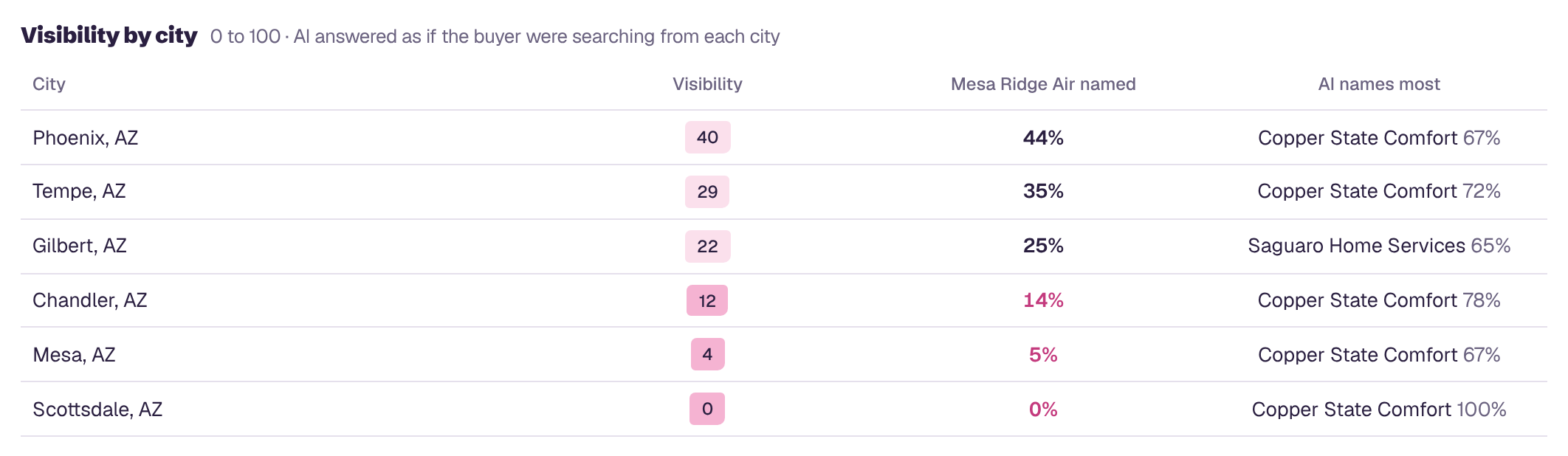
The gap is clearest side by side:
If you only fix three things
- Say clearly whether you do service, projects or both. Separate pages for each, with what's included.
- Publish real local projects. Photos, budgets, timelines and the problems you solved.
- Write for your climate and rules. Grasses, plants, water restrictions, HOAs and seasons where you work.
Homeowners are asking AI what to do with their yards before they ask anyone else. The landscaper AI names will be the one it understands best.
Part of our guide: Why AI visibility matters for home services companies
See what AI tells homeowners about your landscaping company
Enter your website and get a free AI visibility report. It takes a few minutes, and you'll see:
- Your AI visibility score, overall and for ChatGPT, Gemini, Claude, Perplexity and Google's AI Overviews and AI Mode
- Which landscapers AI recommends instead of you, and how often
- Your visibility in every city you serve, and the competitor AI names most in each one
- What AI gets wrong about you, and what to fix first
- Your biggest gaps: the buyer questions where AI leaves you out, and who it recommends instead
- A downloadable PDF you can share with your team