The 7 questions that decide who gets the HVAC job, and what AI tells homeowners about each one
Homeowners now ask AI whether their AC can be saved, what a new system should cost and who can come out today. Here are the questions that decide HVAC jobs, what AI usually answers, and what to publish so AI names your company.
Most HVAC jobs are won or lost in one of a handful of moments. A homeowner is standing under a vent blowing warm air. A technician has just said the word "replace." Three quotes are on the kitchen table and they're $6,000 apart. A neighbor mentioned heat pumps at a barbecue.
In each of those moments, more homeowners now ask AI before they call anyone. And AI doesn't just answer the question. It names companies.
Our home services guide covers the homeowner's journey in general. This one is specific to heating and cooling. It goes through the seven questions that decide HVAC jobs, what AI usually tells homeowners when they ask them, and what an HVAC company can publish so that AI names it in the answer.
Here are the seven at a glance:
| The question | When homeowners ask it | What gets you named |
|---|---|---|
| "Why is my AC blowing warm air?" | Something just broke, often on a hot weekend | Troubleshooting pages and clear same-day availability |
| "Is it worth repairing a 15-year-old AC?" | Right after a big repair quote | Your real repair-or-replace thresholds |
| "How much should a new system cost in [city]?" | Bracing for a replacement | Local price ranges and what moves the price |
| "Is a heat pump worth it where I live?" | Any time they replace anything | A heat pump guide for your climate, with current rebates |
| "Which HVAC company is best for [city]?" | Whenever they need a quote or a fast repair | A page, listings and reviews for every city you serve |
| "Is [company] legit?" | Before they let anyone into the house | One clear page of licensing, service area and track record |
| "Is a maintenance plan worth it?" | After a repair or before a season | Exactly what your plan includes and costs |
1. "Why is my AC blowing warm air?"
When they ask it: Something just broke. It's often hot, often a weekend and often urgent.
What AI usually says: It lists the common causes, like a tripped breaker, a dirty filter, a frozen evaporator coil, a failed capacitor or low refrigerant. It tells the homeowner what they can check safely, like the thermostat, filter and breaker, and what needs a technician. Then it often names two or three local companies that offer same-day service.
What it means for you: This is the most valuable moment in residential HVAC, because whoever is named first often gets the call without competition. AI builds the diagnosis from whatever explains it best, and it names the companies it associates with fast, local service.
What to publish:
- A plain-language troubleshooting page for your most common calls: warm air, no heat, short cycling, water leaking, strange noises, frozen lines.
- A clear "what you can check before you call us" section. It builds trust, and it's exactly what AI likes to quote.
- Your real availability, stated the same way everywhere: same-day cutoff time, weekend hours, after-hours fees.
2. "Is it worth repairing a 15-year-old AC?"
When they ask it: A technician has just quoted a big repair, like a compressor, a coil or a refrigerant recharge on an old R-22 system, and mentioned replacement.
What AI usually says: It explains the usual rules of thumb: the age of the system, the cost of the repair compared with replacement, the refrigerant type, efficiency gains, and how long the homeowner plans to stay. It often suggests getting a second opinion.
What it means for you: This is the hinge between a $600 ticket and a $14,000 one, and many homeowners don't trust the company that's asking. If AI's explanation matches yours, your recommendation looks honest. If AI recommends getting a second opinion, the company it names for that opinion has a real chance of winning the replacement.
What to publish:
- Your actual repair-or-replace guidance, with the age and cost thresholds you use and the cases where you'd tell someone to repair.
- An honest explanation of older refrigerants and what they mean for repair costs.
- A "second opinion" offer, if you have one. Homeowners ask for it by name.
3. "How much should a new AC and furnace cost in [city]?"
When they ask it: They've decided to replace, or they're bracing for it.
What AI usually says: It gives a broad national range, then explains what moves the price: system size, efficiency rating, brand, ductwork, attic or closet installation, permits and local labor. It warns that quotes vary widely.
What it means for you: Homeowners anchor on whatever range AI gives them. If AI's number is far below your typical price and nobody has explained why, you start the sales conversation on the back foot.
What to publish:
- Local price ranges for your common system types, with what's included and what's extra.
- A breakdown of the things that move the price: tonnage, efficiency, ductwork changes, electrical upgrades and permits.
- An example or two of real installs, with a description of the home and a price band.
4. "Is a heat pump worth it where I live?"
When they ask it: Increasingly, any time they're replacing anything. Heat pumps come up constantly, especially where utilities and governments offer incentives.
What AI usually says: It explains how heat pumps work, how cold-climate models have improved, what they cost to run compared with gas, and which rebates or tax credits might apply. It usually recommends a load calculation.
What it means for you: This is one of the fastest-growing questions in HVAC, and AI's answer depends heavily on local detail it can find. A homeowner in Minneapolis, Toronto or Denver gets a very different answer from one in Atlanta, and the company that explains heat pumps for that climate gets named.
What to publish:
- A heat pump guide for your climate: how cold it gets, how cold-climate units perform, when a dual-fuel setup makes sense.
- Current local rebates and incentives, with a date on the page so it's clearly up to date.
- Whether you do load calculations, and why they matter.
5. "Which HVAC company is best for [city]?"
When they ask it: At every stage, but especially when they need a quote or a fast repair.
What AI usually says: It names a few companies, often with a line on each: "known for fast service," "family-owned since 1985," "strong reviews for installs." It usually adds a few tips on choosing a contractor.
What it means for you: This is the shortlist. And it's local in a way that surprises a lot of owners. AI answers "best HVAC company" differently for each city, based on what it can find about each company in that city.
Here's what that looks like for Mesa Ridge Air, the sample Phoenix-area HVAC company from our home services guide:
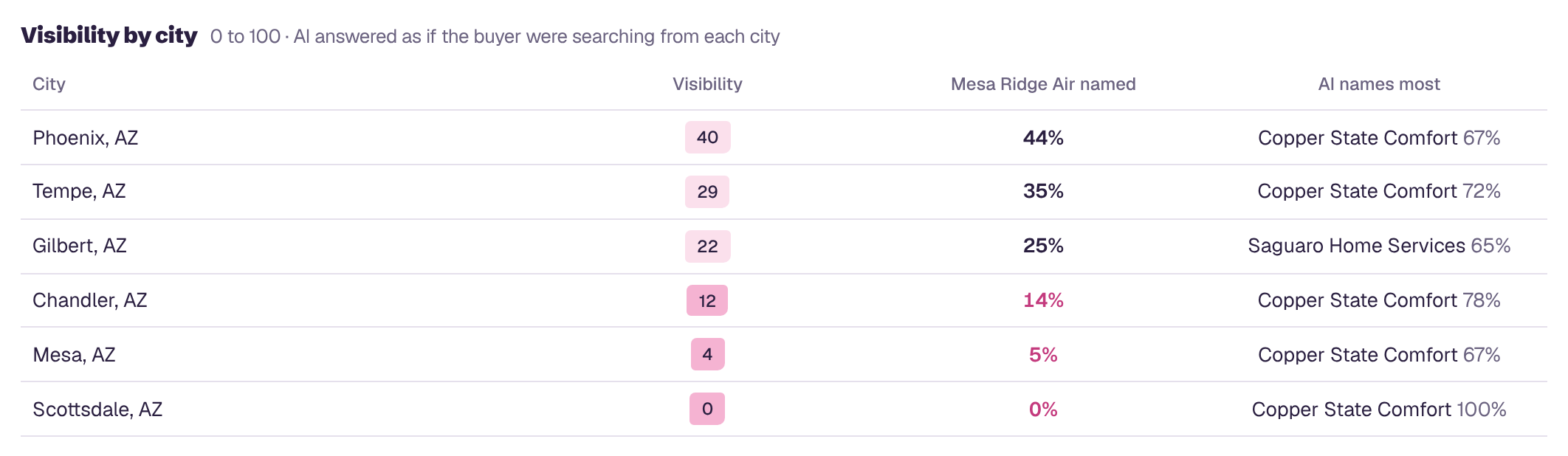
The company serves all six cities. But its reviews, Google Business Profile and website all point to Phoenix, so AI treats it as a Phoenix company. A homeowner in Scottsdale, a suburb full of large homes and big systems, never hears its name.
What to publish:
- A real page for each city you serve, with jobs you've done there, reviews from homeowners there, and anything specific about homes or climate there.
- Consistent service-area information on every listing.
- Reviews that mention the city. Ask for them.
6. "Is [company] legit? Any complaints?"
When they ask it: After they have a name or a quote, and before they let someone into the house or sign a contract.
What AI usually says: A short summary of reviews and reputation, plus anything it can find about licensing, years in business and complaints. If something's wrong in what it has read, it repeats it.
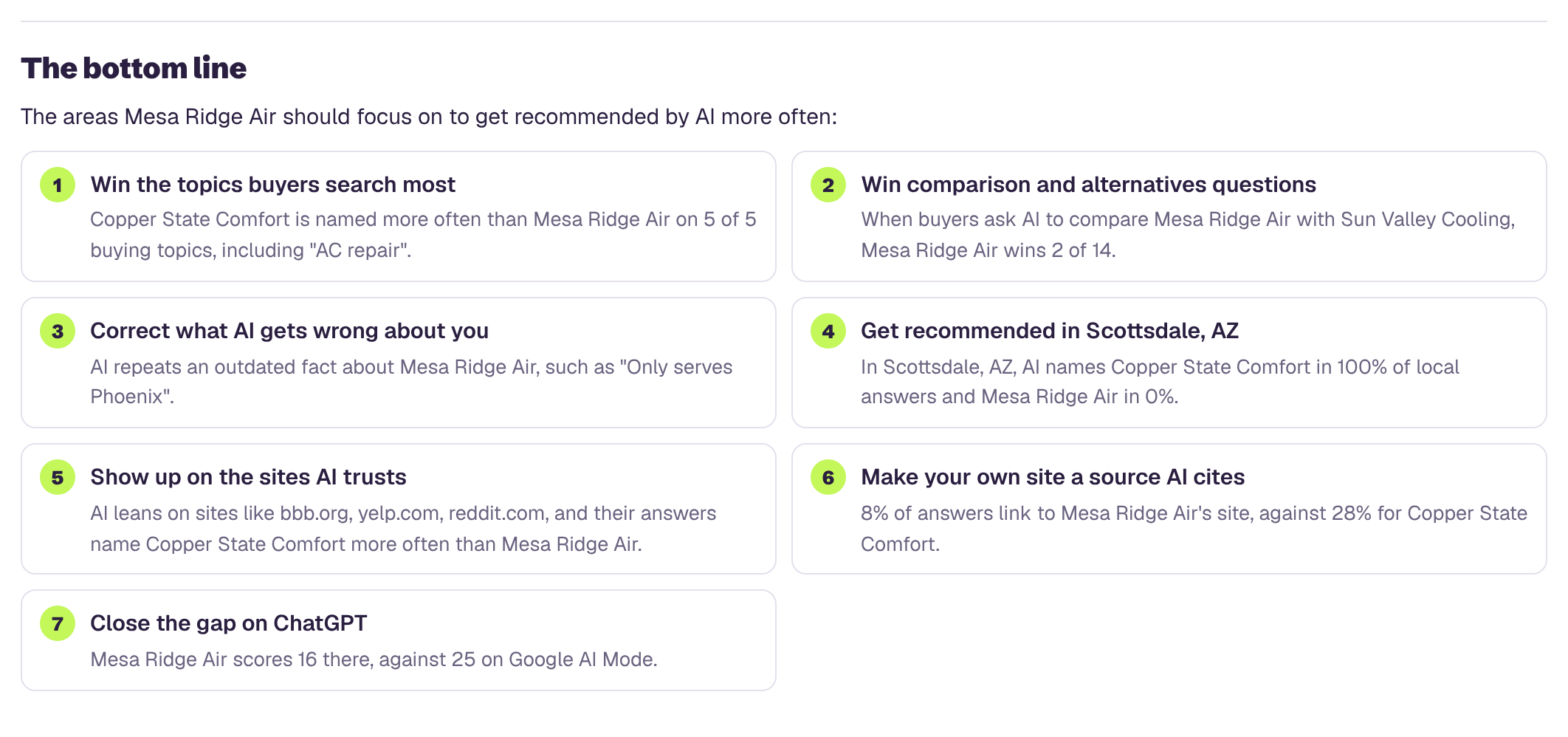
What it means for you: Your reputation now arrives as two sentences. If those sentences include a wrong fact, you lose the job and never find out. In the sample report, AI told homeowners that Mesa Ridge Air only serves Phoenix. The company actually serves six cities. That one wrong fact cost it every homeowner outside Phoenix who asked.
What to publish:
- One clear "about us" page with licensing, insurance, certifications such as NATE, years in business, dealer status and service area.
- Responses to reviews, especially critical ones. AI reads them.
- A check on what AI is saying about you, especially your service area and emergency availability. Those are the errors that cost the most calls.
7. "Is an HVAC maintenance plan worth it?"
When they ask it: After a repair, before a season, or when a technician offers a plan.
What AI usually says: It explains what tune-ups usually include, why they can extend equipment life and catch problems early, and what plans typically cost. It often says plans are worth it for older systems or homes in extreme climates.
What it means for you: Maintenance plans are the recurring revenue that smooths out HVAC's seasons, and they're how a one-time repair customer becomes a 15-year customer. If AI explains your plan as clearly as it explains the concept, you convert more of them.
What to publish:
- Exactly what your plan includes, how many visits, what it costs, member discounts and priority service.
- What a tune-up actually checks, in plain language.
- How your plan handles emergencies, because "members get priority service in a heat wave" is a strong reason to sign up.
The calendar decides which questions matter
HVAC questions follow the weather, and AI answers follow the questions. The companies that show up most tend to publish ahead of the season.
| Season | What homeowners ask AI | What to have published |
|---|---|---|
| Late spring | "Will my AC make it through summer?" "AC tune-up cost." | A pre-summer checklist and your tune-up offer |
| First heat wave | "AC not cooling." "Who can come out today?" | Troubleshooting pages and clear same-day availability |
| Late summer | "Repair or replace my AC?" "New AC cost." | Repair-or-replace guidance and local price ranges |
| Fall | "Furnace tune-up." "Heat pump or furnace?" | A furnace safety checklist and heat pump guide |
| First hard freeze | "Furnace not working." "Emergency heating repair." | No-heat troubleshooting and emergency availability |
| Winter | "High heating bills." "Is my furnace efficient?" | Efficiency and replacement guidance, with rebates |
A page that's useful in March gets picked up and cited by June. A page published during the heat wave is usually too late.
What the report tells an HVAC company
A Visible Queries report shows an HVAC company how it shows up for questions like these on ChatGPT, Gemini, Claude, Perplexity, Google's AI Overviews and Google AI Mode. It starts with one number:
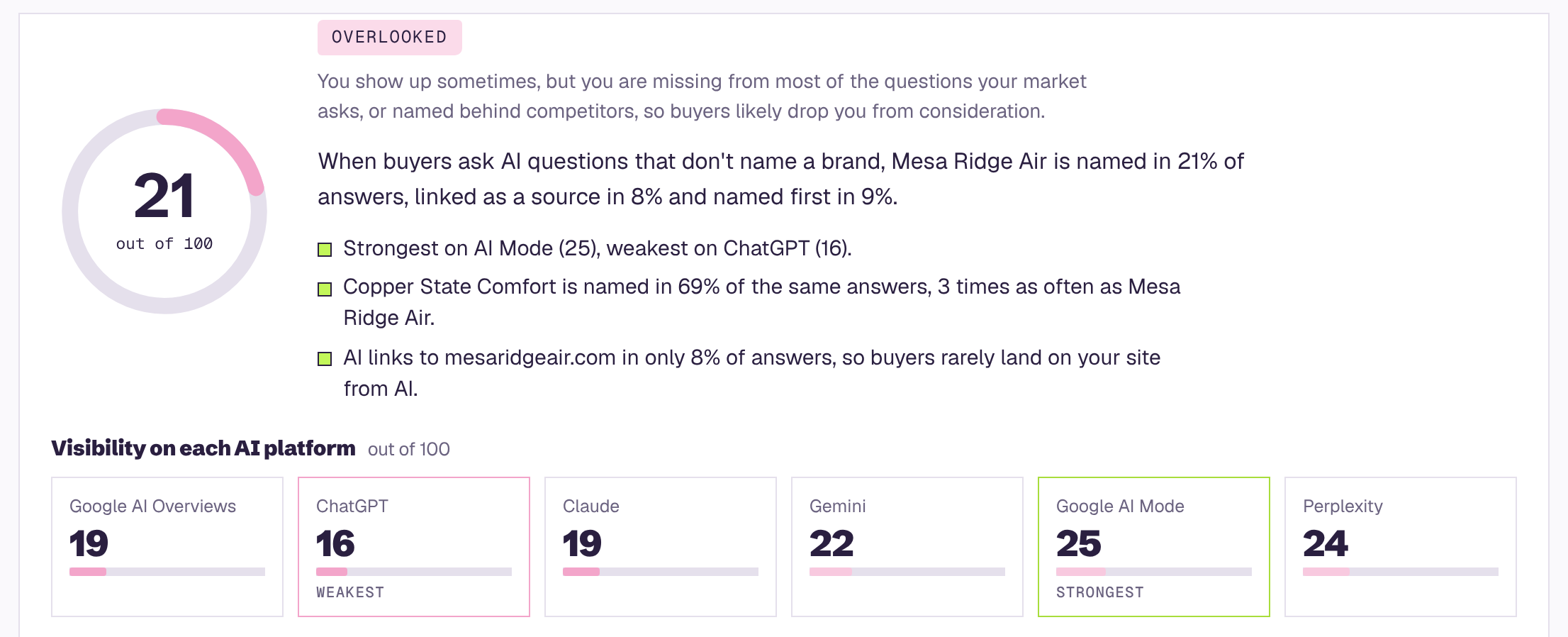
The gap behind that score is easiest to see side by side. When homeowners ask questions that don't name a company, this is how often each one comes up:
For an HVAC company, three parts of the report tend to matter most:
- Visibility by city. Which suburbs know you and which ones don't, like Scottsdale in the sample above.
- Topics customers ask about. How often each topic is searched, and how often AI names you and each competitor on it. In the sample, Copper State Comfort was named in 72% of answers about AC repair and Mesa Ridge Air in 20%.
- Your biggest gaps. The groups of customer questions where AI leaves you out, who it recommends instead, and real example questions. In the sample, the competitor ahead most often was Copper State Comfort, the company AI named most in every city except Gilbert.
If you only fix three things
- Make your service area and availability impossible to get wrong. A page per city, the same hours everywhere, and same-day and emergency policies stated plainly.
- Publish honest answers to the repair-or-replace and cost questions. With your real thresholds and local price ranges.
- Get reviews that mention the city and the problem. "Came out at 9 p.m. in Gilbert and had the AC running in an hour" teaches AI more than "great service!"
Somewhere in your service area today, a homeowner is asking one of these seven questions. The HVAC company AI names will be the one it understands best.
Part of our guide: Why AI visibility matters for home services companies
See what AI tells homeowners about your HVAC company
Enter your website and get a free AI visibility report. It takes a few minutes, and you'll see:
- Your AI visibility score, overall and for ChatGPT, Gemini, Claude, Perplexity and Google's AI Overviews and AI Mode
- Which HVAC companies AI recommends instead of you, and how often
- Your visibility in every city you serve, and the competitor AI names most in each one
- What AI gets wrong about you, and what to fix first
- Your biggest gaps: the buyer questions where AI leaves you out, and who it recommends instead
- A downloadable PDF you can share with your team